
Catalogue Search | MBRL


Are you sure you want to remove the book from the shelf?

{{itemTitle}}
67,179
result(s) for
"Shakespeare"
Sort by:

Othello's secret : the Cyprus problem
\"Othello's Secret uncovers the relationship between the play and the conflicts that have torn apart its Cypriot setting, providing a new and powerfully political reading. Exploring the domestic and military anxieties connected by Shakespeare, Christofides highlights the ways in which these issues resonate with current ideological and geographical divisions in Cyprus, divisions rooted in the 16th century struggles to control the island. Challenging the conventional view of Othello as a Venetian play, this book offers a fierce and personal example of how early modern literature can purposefully contribute to even the most complex geopolitical debates\"-- Provided by publisher.
Book

Speaking of the Moor
Selected byChoicemagazine as an Outstanding Academic Title \"Speak of me as I am,\" Othello, the Moor of Venice, bids in the play that bears his name. Yet many have found it impossible to speak of his ethnicity with any certainty. What did it mean to be a Moor in the early modern period? In the late sixteenth and early seventeenth centuries, when England was expanding its reach across the globe, the Moor became a central character on the English stage. InThe Battle of Alcazar,Titus Andronicus,Lust's Dominion, andOthello, the figure of the Moor took definition from multiple geographies, histories, religions, and skin colors. Rather than casting these variables as obstacles to our-and England's-understanding of the Moor's racial and cultural identity, Emily C. Bartels argues that they are what make the Moor so interesting and important in the face of growing globalization, both in the early modern period and in our own. InSpeaking of the Moor, Bartels sets the early modern Moor plays beside contemporaneous texts that embed Moorish figures within England's historical record-Richard Hakluyt'sPrincipal Navigations, Queen Elizabeth's letters proposing the deportation of England's \"blackamoors,\" and John Pory's translation ofThe History and Description of Africa. Her book uncovers the surprising complexity of England's negotiation and accommodation of difference at the end of the Elizabethan era.
eBook


Shakespeare's cinema of love
This engaging and stimulating book argues that Shakespeare's plays
significantly influenced movie genres in the twentieth century,
particularly in films concerning love in the classic Hollywood
period. Shakespeare's 'green world' has a close functional
equivalent in 'tinseltown' and on 'the silver screen', as well as
in hybrid genres in Bollywood cinema. Meanwhile, Romeo and
Juliet continues to be an enduring source for romantic tragedy
on screen. The nature of generic indebtedness has not gained
recognition because it is elusive and not always easy to recognise.
The book traces generic links between Shakespeare's comedies of
love and screen genres such as romantic comedy, 'screwball' comedy
and musicals, as well as clarifying the use of common conventions
defining the genres, such as mistaken identity, 'errors', disguise
and 'shrew-taming'. Speculative, challenging and entertaining, the
book will appeal to those interested in Shakespeare, movies and the
representation of love in narratives.
eBook

Antipodal Shakespeare : remembering and forgetting in Britain, Australia and New Zealand, 1916-2016
\"In this collaborative monograph, five scholars from Britain, Australia and New Zealand reflect on the modes of commemoration of Shakespeare in and after the Tercentenary year, 1916, in two hemispheres. They argue that it was at this moment of remembering that 'global Shakespeare' first emerged in recognizable, if embryonic form. Despite a recent surge of interest in the Shakespeare Tercentenary, a great deal has been forgotten about this key moment in the history of the place of Shakespeare in national and global culture - much more than has been remembered. In addressing this the book offers new materials and discoveries about, and new interpretations of, the Tercentenary celebrations in Britain and in Australia and New Zealand, and reflects also on the long legacy of those celebrations\"-- Provided by publisher.
BOOK

Shakespeare's Festive Comedy
In this classic work, acclaimed Shakespeare critic C. L. Barber argues that Elizabethan seasonal festivals such as May Day and Twelfth Night are the key to understanding Shakespeare's comedies. Brilliantly interweaving anthropology, social history, and literary criticism, Barber traces the inward journey--psychological, bodily, spiritual--of the comedies: from confusion, raucous laughter, aching desire, and aggression, to harmony. Revealing the interplay between social custom and dramatic form, the book shows how the Elizabethan antithesis between everyday and holiday comes to life in the comedies' combination of seriousness and levity.
\"I have been led into an exploration of the way the social form of Elizabethan holidays contributed to the dramatic form of festive comedy. To relate this drama to holiday has proved to be the most effective way to describe its character. And this historical interplay between social and artistic form has an interest of its own: we can see here, with more clarity of outline and detail than is usually possible, how art develops underlying configurations in the social life of a culture.\"--C. L. Barber, in the Introduction
This new edition includes a foreword by Stephen Greenblatt, who discusses Barber's influence on later scholars and the recent critical disagreements that Barber has inspired, showing thatShakespeare's Festive Comedyis as vital today as when it was originally published.
eBook

Shakespeare : actors and audiences
400 years on from Shakespeare's death, Shakespeare: Actors and Audiences shines a spotlight on the role of the audience at Shakespeare's plays. Exploring the relationship that has kept Shakespeare's name and work alive through four centuries, scholars, audiences, actors and directors reflect on the role of the audience and provide fresh insights into the relationship that lies at the heart of Shakespeare in performance. Publisher.
Book
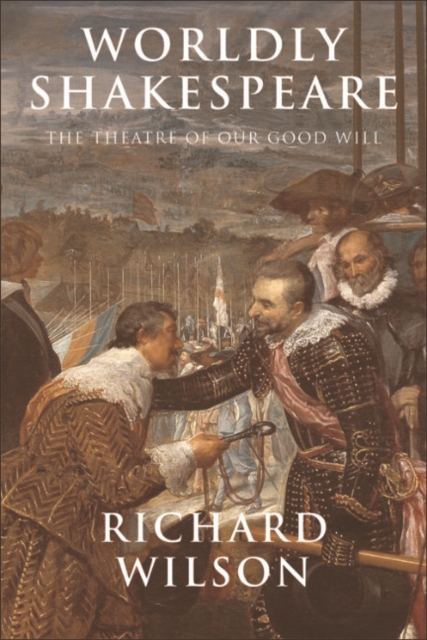
Worldly Shakespeare : the theatre of our good will
A comprehensive rereading of Shakespeare's plays in light of current debates about free speech and toleration.
eBook


Shakespeare in the Theatre: Mark Rylance at the Globe
Each volume in the Shakespeare in the Theatre series focuses on a director or theatre company who has made a significant contribution to Shakespeare production, identifying the artistic and political/social contexts of their work. The series introduces readers to the work of significant theatre directors and companies whose Shakespeare productions have been transformative in our understanding of his plays in performance. Each volume examines a single figure or company, considering their key productions, rehearsal approaches and their work with other artists. Since its opening in the late 1990s, the reconstructed Shakespeare’s Globe Theatre has made an indelible impression on the contemporary British theatre scene. This book explores the theatre’s first decade of productions under the pioneering leadership of Sir Mark Rylance. Drawing upon an extensive range of material from the theatre’s archive, interviews with Globe practitioners, and Rylance’s own personal archive, this book argues that the Rylance era was a ground-breaking and important period of recent theatre history. It concludes with an in-depth interview with Rylance himself. The book gives a unique insight into Rylance’s practice and impact, and will be of interest to anyone studying Shakespeare in performance. Series Editors: Bridget Escolme, Queen Mary University of London, UK, Peter Holland, University of Notre Dame, USA and Farah Karim-Cooper, Shakespeare’s Globe, London, UK.
eBook