
Catalogue Search | MBRL


Are you sure you want to remove the book from the shelf?

{{itemTitle}}
99
result(s) for
"Shakespeare, William, 1564-1616 -- Characters -- Women"
Sort by:


What You Will
In What You Will Kathryn Schwarz traces a curious pattern in sixteenth- and seventeenth-century representations of femininity: women pose a threat when they conform too willingly to social conventions. Exemplary texts describe chaste women who kill their rapists, constant wives who make marriage a debilitating obligation, and devoted mothers who destroy the fitness of children. These cautionary tales draw attention to the more ordinary, necessary choices that take prescribed roles as a mandate for purposeful acts. For early modern narratives, writes Schwarz, intentional compliance poses a complex problem: it sustains crucial tenets of order and continuity but unsettles the hierarchical premises from which those tenets derive. Feminine will appears as a volatile force within heterosociality, lending contingent security to a system that depends less on enforced obedience than on contract and consent.The book begins with an examination of early modern disciplines that treat will as an aspect of the individual psyche, of rhetoric, and of sexual and gendered identities. Drawing on these readings, Schwarz turns to Shakespearean works in which feminine characters articulate and manage the values that define them, revealing the vital force of conventional acts. Her analysis engages with recent research that has challenged the premise of feminine subordination, both by identifying alternative positions and by illuminating resistance within repressive structures. Schwarz builds on this awareness of disparate modes and sites of action in formulating the book's central questions: With what agency, and to what effect, do feminine subjects inhabit the conventions of femininity? In what sense are authenticity and masquerade inseparable aspects of social performance? How might coercive systems produce effective actors? What possibilities emerge from the paradox of prescribed choice? Her conclusions have implications not only for early modern scholarship but also for histories of gender and sexuality, queer studies, and theories of the relationship between subjectivity and ideological constraint.
eBook

Performing Shakespeare's women : playing dead
\"Shakespeare's women rarely reach the end of the play alive. Whether by murder or by suicide, onstage or off, female actors in Shakespeare's works often find themselves 'playing dead.' But what does it mean to 'play dead', particularly for women actors, whose bodies become scrutinized and anatomized by audiences and fellow actors who 'grossly gape on'? In what ways does playing Shakespeare's women when they are dead emblematize the difficulties of playing them while they are still alive? Ultimately, what is at stake for the female actor who embodies Shakespeare's women today, dead or alive? Situated at the intersection of the creative and the critical, Performing Shakespeare's Women: Playing Dead engages performance history, current scholarship and the practical problems facing the female actor of Shakespeare's plays when it comes to 'playing dead' on the contemporary stage and in a post-feminist world. This book explores the consequences of corpsing Shakespeare's women, considering important ethical questions that matter to practitioners, students and critics of Shakespeare today\"-- Provided by publisher.
BOOK
Women in Shakespeare : a dictionary
This is a comprehensive reference guide examining the language employed by Shakespeare to represent women in the full range of his poetry and plays.Including over 350 entries, Alison Findlay shows the role of women within Shakespearean drama, their representations on the Shakespearean stage, and their place in Shakespeare's personal and.
eBook

Shakespeare and feminist theory
Are Shakespeare's plays dramatizations of patriarchy or representations of assertive and eloquent women? Or are they sometimes both? And is it relevant, and if so how, that his women were first played by boys? This book shows how many kinds of feminist theory help analyze the dynamics of Shakespeare's plays. Both feminist theory and the plays deal with issues such as likeness and difference between the sexes, the complexity of relationships between women, the liberating possibilities of desire, what marriage means and how much women can remake it, how women can use and expand their culture's ideas of motherhood and of women's work, and how women can have power through language. This lively exploration of these and related issues is an ideal introduction to the field of feminist readings of Shakespeare.
BOOK
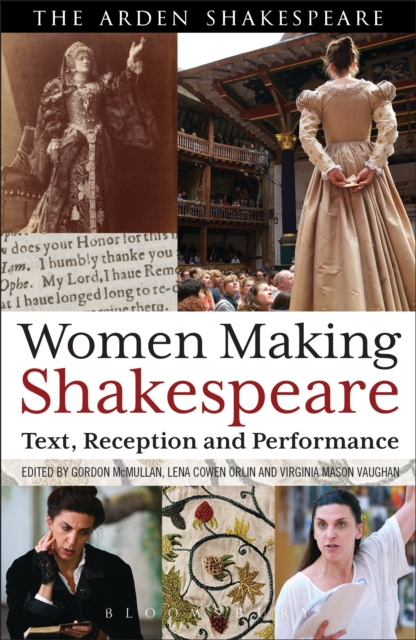
Women making Shakespeare : text, reception, performance
Women Making Shakespeare presents a series of 20-25 short essays that draw on a variety of resources, including interviews with directors, actors, and other performance practitioners, to explore the place (or constitutive absence) of women in the Shakespearean text and in the history of Shakespearean reception - the many ways women, working.
eBook

I was Cleopatra
\"In Shakespeare's time, women were not allowed to appear on stage, and so female parts were played by boy actors. In I Was Cleopatra, readers meet John Rice -- perhaps the most beautiful and acclaimed boy actor of them all. It is believed by many that John Rice originated the roles of Lady Macbeth, Cleopatra and Cordelia, and this fictional memoir explores his life both on and off the stage. With graceful prose and an encyclopedic knowledge of the period, Dennis Abrams invites readers to experience gender fluidity and sexuality through the fictional recollections of a fascinating historical figure as he reflects on his life in this 'farewell' to his theatrical past. The story follows John from the age of thirteen, when he leaves his family in Reading to join the King's Men theater troupe in London as an apprentice boy actor. Over the course of the next few years, John eagerly hones the acting skills necessary to portray female roles. He memorizes lines, reads all the plays he can get his hands on, and works on imitating female gestures and mannerisms. He becomes a friend, and eventually a lover, of Alexander, a boy actor who is getting too old to play female roles. And he works closely with Shakespeare himself, who coaches him through the roles of Lady Macbeth and Cleopatra, among others. But around the time he turns sixteen, John starts to worry about inevitably becoming too old to convincingly portray women onstage, which leads to some unsettling choices.\"--Amazon.com.
BOOK

As She Likes It
As She Likes It is the first attempt to tackle head on the enduring question of how to perform those unruly women at the centre of Shakespeare's comedies. Unique amongst both Shakespearian and feminist studies, As She Likes It asks how gender politics affects the production to the comedies, and how gender is represented, both in the text and on the stage. Penny Gay takes a fascinating look at the way Twelfth Night, The Taming of the Shrew, Much Ado About Nothing, As You Like It and Measure for Measure have been staged over the last half a century, when perceptions of gender roles have undergone massive changes. She also interrogates, rigorously but thoughtfully, the relationship between a male theatrical establishment and a burgeoning feminist approach to performance. As illuminating for practitioners as it will be enjoyable and useful for students, As She Likes It will be critical reading for anyone interested in women's experience of theatre.
eBook

Enter the body
\"Enter the Body gives voice to a cast of the young women who die in Shakespeare's most iconic plays. Focusing on the stories of Juliet, Ophelia, and Cordelia, ...McCullough brilliantly weaves retellings of Romeo & Juliet, Hamlet, and King Lear into a larger story of young women reclaiming their stories in the aftermath of trauma.\"--Front cover flap.
BOOK
Shakespeare and feminist theory
Are Shakespeare's plays dramatizations of patriarchy or representations of assertive and eloquent women?Or are they sometimes both?And is it relevant, and if so how, that his women were first played by boys?This book shows how many kinds of feminist theory help analyze the dynamics of Shakespeare's plays.
eBook