
Catalogue Search | MBRL


Are you sure you want to remove the book from the shelf?

{{itemTitle}}
78
result(s) for
"Shakespeare, William, 1564-1616. Macbeth"
Sort by:

Macbeth : a dagger of the mind
From the ambitious and mad titular character to his devilish wife Lady Macbeth to the moral and noble Banquo to the mysterious Three Witches, Macbeth is one of William Shakespeare's more brilliantly populated plays and remains among the most widely read, performed in innovative productions set in a vast array of times and locations, from Nazi Germany to Revolutionary Cuba. Macbeth is a distinguished warrior hero, who over the course of the play, transforms into a brutal, murderous villain and pays an extraordinary price for committing an evil act. A man consumed with ambition and self-doubt, Macbeth is one of Shakespeare's most vital meditations on the dangerous corners of the human imagination. Award-winning writer and beloved professor Harold Bloom investigates Macbeth's interiority and unthinkable actions with razor-sharp insight, agility, and compassion. He also explores his own personal relationship to the character: Just as we encounter one Anna Karenina or Jay Gatsby when we are seventeen and another when we are forty, Bloom writes about his shifting understanding--over the course of his own lifetime--of this endlessly compelling figure, so that the book also becomes an extraordinarily moving argument for literature as a path to and a measure of our humanity. Bloom is mesmerizing in the classroom, wrestling with the often tragic choices Shakespeare's characters make. He delivers that kind of exhilarating intimacy and clarity in Macbeth, the final book in an essential series.
Book

The Shakespearean International Yearbook
This eighth volume of The Shakespearean International Yearbook presents a special section on 'European Shakespeares', proceeding from the claim that Shakespeare's literary craft was not just native English or British, but was filtered and fashioned through a Renaissance awareness that needs to be recognized as European, and that has had effects and afterlives across the Continent. Guest editors Ton Hoenselaars and Clara Calvo have constructed this section to highlight both how the spread of 'Shakespeare' throughout Europe has brought together the energies of a wide variety of European cultures across several centuries, and how the inclusion of Shakespeare in European culture has been not only a European but also a world affair. The Shakespearean International Yearbook continues to provide an annual survey of important issues and developments in contemporary Shakespeare studies. Contributors to this issue come from the US and the UK, Spain, Switzerland and South Africa, Canada, The Netherlands, India, Portugal, Greece, France, and Hungary. In addition to the section on European Shakespeares, this volume includes essays on the genre of romance, issues of character, and other topics.
Stuart Sillars is a Professor of English Literature at Bergen. Tom Bishop is based at the University of Auckland, New Zealand. Alexa Huang is a Professor of Enligh at George Washington University.
Contents: Part I Special Section: 'European Shakespeares', Edited by Ton Hoenselaars and Clara Calvo: Introduction: European Shakespeare - quo vadis?, Ton Hoenselaars and Clara Calvo; The chore and the passion: Shakespeare and graduation in mid-20th century Portugal, Rui Carvalho Homem; Henry V and the Anglo-Greek alliance in World War II, Tina Krontiris; Asian Shakespeares in Europe: from the unfamiliar to the defamiliarised, Alexander C.Y. Huang; Rearticulating a culture of links: Peter Brook's European Shakespeare, Fran Rayner; Shakespeare uprooted: the BBC and ShakespeareRe-Told (2005), Clara Calvo and Ton Hoenselaars; The anti-Americanism of EU Shakespeare, Douglas Bruster; Shakespeare and France in the European mirror, Jean-Christophe Mayer. Part II Shapes of Character: Man's chief good: the Shakespearean character as evaluator, Mustapha Fahmi; 'I have no other but a woman's reason': folly, femininity and sexuality in Renaissance discourses and Shakespeare's plays, Paromita Chakravarti. Part III Shapes of Romance: Shipwreck and ecology: towards a structural theory of Shakespeare and romance, Steve Mentz; Great miracle or lying wonder: Janus-faced romance in Pericles, Tiffany J. Werth; 'Better days': cultural memory in As You Like It, Indira Ghose. Part IV Review Essays: (Re)presenting Shakespeare's co-authors: lessons from the Oxford Shakespeare, Tom Rooney; Inventing the human: brontosaurus Bloom and 'the Shakespeare in us', Laurence Wright; Bibliography; Index.
eBook

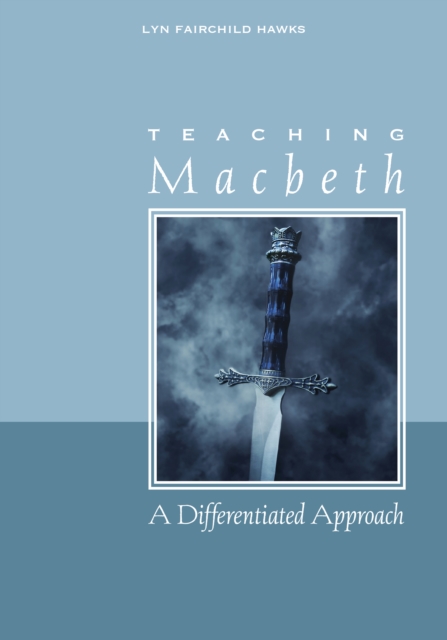
Teaching Macbeth
Macbeth, a story of ambition, terror, and conscience, speaks to our students and our era. Through differentiated instruction, Lyn Fairchild Hawks offers myriad ways to engage students with different readiness levels and interests in this timeless tale of fear and courage, order and chaos, guilt and remorselessness. The book offers a wide range of exciting lesson ideas to challenge your learners, including key scenes to teach, big ideas and essential questions,film analysis activities, close reading assignments, performance activities, andpreassessments and summative assessments. Macbeth can come alive for all students through independent reading options linked by theme, activities and projects mirroring professional roles, and relevance \"hooks\" to meet students' interests. Also included are a unit calendar, DIY tips for lesson design, and a companion website with more than forty ready-to-use handouts.
eBook

Shakespeare's big men : tragedy and the problem of resentment
Shakespeare's Big Men examines five Shakespearean tragedies--Julius Caesar, Hamlet, Othello, Macbeth, and Coriolanus--through the lens of generative anthropology and the insights of its founder, Eric Gans. Generative anthropology's theory of the origins of human society explains the social function of tragedy: to defer our resentment against the \"big men\" who dominate society by letting us first identify with the tragic protagonist and his resentment, then allowing us to repudiate the protagonist's resentful rage and achieve theatrical catharsis. Drawing on this hypothesis, Richard van Oort offers inspired readings of Shakespeare's plays and their representations of desire, resentment, guilt, and evil. His analysis revives the universal spirit in Shakespearean criticism, illustrating how the plays can serve as a way to understand the ethical dilemma of resentment and discover within ourselves the nature of the human experience.\"-- Provided by publisher.
Book

Of Philosophers and Kings
This innovative work argues that Shakespeare was as great a philosopher as he was a poet, and that his greatness as a poet derived even more from his power as a thinker than from his genius for linguistic expression.
eBook

Macbeth
Lush visuals illustrate the full original text of William Shakespeare's Macbeth, the tale of a nobleman inspired to commit treason and murder in pursuit of the Scottish throne.
Book

Macbeth
A graphic novel adaptation of William Shakespeare's play about Macbeth, the eleventh-century king of Scotland, and of the tragedy of prophecy and royal murder.
BOOK

Acting in the night
What can the performance of a single play on one specific night tell us about the world this event inhabited so briefly? Alexander Nemerov takes a performance of Macbeth in Washington, DC on October 17, 1863—with Abraham Lincoln in attendance—to explore this question and illuminate American art, politics, technology, and life as it was being lived. Nemerov’s inspiration is Wallace Stevens and his poem “Anecdote of the Jar,” in which a single object organizes the wilderness around it in the consciousness of the poet. For Nemerov, that evening’s performance of Macbeth reached across the tragedy of civil war to acknowledge the horrors and emptiness of a world it tried and ultimately failed to change.
eBook