
Catalogue Search | MBRL


Are you sure you want to remove the book from the shelf?

{{itemTitle}}
15
result(s) for
"Shanghai (China) Social conditions 20th century."
Sort by:


Shanghai Gone
Shanghai has been demolished and rebuilt into a gleaming megacity in recent decades, now ranking with New York and London as a hub of global finance. But that transformation has come at a grave human cost. This compelling book is the first to apply the concept of domicide—the eradication of a home against the will of its dwellers—to the sweeping destruction of neighborhoods, families, and life patterns to make way for the new Shanghai. Here we find the holdouts and protesters, men and women who have stubbornly resisted domicide and demanded justice. Qin Shao follows, among others, a reticent kindergarten teacher turned diehard petitioner; a descendant of gangsters and squatters who has become an amateur lawyer for evictees; and a Chinese Muslim who has struggled to recover his ancestral home in Xintiandi, an infamous site of gentrification dominated by a well-connected Hong Kong real estate tycoon. Highlighting the wrenching changes spawned by China’s reform era, Shao vividly portrays the relentless pursuit of growth and profit by the combined forces of corrupt power and money, the personal wreckage it has left behind, and the enduring human spirit it has unleashed.
eBook

Zhu Rongji on the record : the Shanghai years, 1987-1991
\"Compilation of writings and speeches including photos from Zhu's service as mayor of Shanghai, a period during which he began to reorganize state-owned industries, crack down on bureaucratism, plan major reforms in land leasing and public housing, and initiate infrastructure projects to lay the groundwork to transform the city into a major financial center\"-- Provided by publisher.
Book

Wartime Shanghai and the Jewish Refugees from Central Europe
The study discusses the history of the Jewish refugees within the Shanghai setting and its relationship to the two established Jewish communities, the Sephardi and Russian Jews. Attention is also focused on the cultural life of the refugees who used both German and Yiddish, and on their attempts to cope under Japanese occupation after the outbreak of the Pacific War.
eBook


Liangyou
This collection of original essays explores the rise of popular print media in China as it relates to the quest for modernity in the global metropolis of Shanghai from 1926 to 1945. It does this by offering the first extended look at the phenomenal influence of the Liangyou pictorial, The Young Companion, arguably the most exciting monthly periodical ever published in China. Special emphasis is placed on the profound social and cultural impact of this glittering publication at a pivotal time in China.The essays explore the dynamic concept of \"kaleidoscopic modernity\" and offer individual case studies on the rise of \"art\" photography, the appeals of slick patent medicines, the resilience of female artists, the allure of aviation celebrities, the feistiness of women athletes, representations of modern masculinity, efforts to regulate the female body and female sexuality, and innovative research that locates the stunning impact of Liangyou in the broader context of related cultural developments in Tokyo and Seoul.Contributors include: Paul W. Ricketts, Timothy J. Shea, Emily Baum, Maura Elizabeth Cunningham, Jun Lei, Amy O'Keefe, Hongjian Wang, Ha Yoon Jung, Lesley W. Ma, Tongyun Yin, and Wang Chuchu.
eBook

Shanghai gone : domicide and defiance in a Chinese megacity
\"Shanghai has been demolished and rebuilt into a gleaming megacity in recent decades, now ranking with New York and London as a hub of global finance. But that transformation has come at a grave human cost. This compelling book is the first to apply the concept of domicide--the eradication of a home against the will of its dwellers--to the sweeping destruction of neighborhoods, families, and life patterns to make way for the new Shanghai. Here we find the holdouts and protesters, men and women who have stubbornly resisted domicide and demanded justice. Qin Shao follows, among others, a reticent kindergarten teacher turned diehard petitioner; a descendant of gangsters and squatters who has become an amateur lawyer for evictees; and a Chinese Muslim who has struggled to recover his ancestral home in Xintiandi, an infamous site of gentrification dominated by a well-connected Hong Kong real estate tycoon. Highlighting the wrenching changes spawned by China's reform era, Shao vividly portrays the relentless pursuit of growth and profit by the combined forces of corrupt power and money, the personal wreckage it has left behind, and the enduring human spirit it has unleashed.\" -- Publisher's website.
Book

The power of place : contentious politics in twentieth-century Shanghai and Bombay
\"The Power of Place Riots, strikes, and protests broke out in the streets of Shanghai and Bombay, renamed Mumbai in 1995, with impressive frequency during the twentieth century. Many of the landmark protests and social movements had close connections with the neighborhoods, workplaces, and civic space of each city. By the late twentieth century, as the political geography of each city changed rapidly with the commodification of urban land, so too did the patterns of political contention. Using a comparative historical lens, Frazier chronicles the political biographies of these two metropolises and leading centers of manufacturing and finance. Debates over ideology, citizenship, and political representation took material form through clashes over housing, jobs, police violence, public space, among much else in the lived experience of urban residents. Frazier puts contemporary debates over informal housing, eviction of inner-city residents, scarcities of manufacturing jobs, and questions of unequal citizenship in illuminating historical context\"-- Provided by publisher.
Book
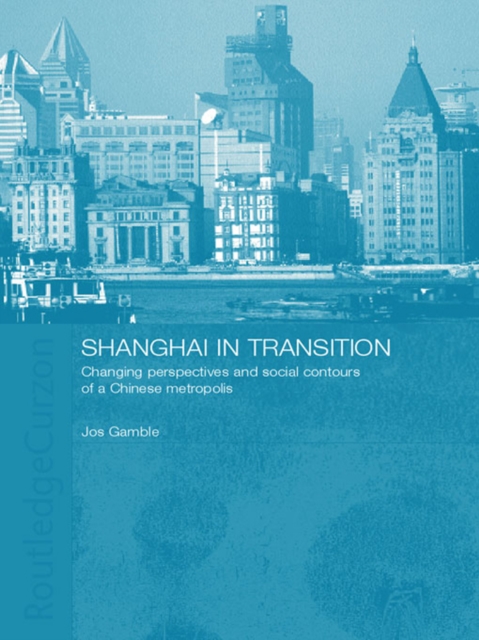
Shanghai in Transition
In the decades following the introduction of Communist Party rule in Shanghai in 1949, the city's economy, infrastructure and links with the world all atrophied. However, the past decade has seen far-reaching economic reforms implemented to recreate Shanghai as a cosmopolitan, world financial and trade centre. This book focuses on the lives of local residents and their perceptions of their changing city, and presents an evocative series of ethnographic perspectives of the city's shifting sociological landscape in this period of transition.
'The best English language work to date on Shanghai in the post-1978 era ... a very impressive first book with much to offer in terms of both data and insight.' - China Quarterly
Jos Gamble trained as an anthropologist at the School of Oriental and African Studies, University of London. He has visited China on many occasions since 1984, and has lived in Shanghai for over four years. Dr Gamble is now a Lecturer in Asia Pacific Business in the School of Management of Royal Holloway, University of London. He is currently researching British retail operations in the Asia Pacific region.
eBook