
Catalogue Search | MBRL


Are you sure you want to remove the book from the shelf?

{{itemTitle}}
3,072
result(s) for
"Sharing -- Social aspects"
Sort by:

The age of sharing
\"Sharing is central to how we live today: it is what we do online; it is a model of economic behavior; and it is also a type of therapeutic talk. Sharing always comes with a warm glow around it, embodying positive values such as empathy, communication, fairness, openness and equality. The Age of Sharing shows how and when sharing became caring, and explains how its meanings have changed in the digital age. Sharing, though, is also a word used to camouflage commercial or even exploitive relations, leading many to bemoan that 'It isn't really sharing'. Websites say they share data with advertisers, though actually they sell it, while parts of the sharing economy look much like rental services. But The Age of Sharing ultimately argues that practices described as sharing and critiques of those practices have common roots. Consequently, the powerful metaphor of sharing now constructs significant swathes of our social practices and provides the grounds for critiquing them; it is a mode of participation in the capitalist order and a way of resisting it. Taking in nineteenth century literature, Alcoholics Anonymous, the American counterculture, reality TV, hackers, Airbnb, Facebook and more, The Age of Sharing offers a rich account of a complex contemporary keyword. The Age of Sharing will appeal to students and scholars of the Internet, digital culture, and linguistics\"-- Provided by publisher.
Book

Sharing Cities
How cities can build on the “sharing economy” and smart technology to deliver a “sharing paradigm” that supports justice, solidarity, and sustainability.
The future of humanity is urban, and the nature of urban space enables, and necessitates, sharing—of resources, goods and services, experiences. Yet traditional forms of sharing have been undermined in modern cities by social fragmentation and commercialization of the public realm. In Sharing Cities, Duncan McLaren and Julian Agyeman argue that the intersection of cities' highly networked physical space with new digital technologies and new mediated forms of sharing offers cities the opportunity to connect smart technology to justice, solidarity, and sustainability. McLaren and Agyeman explore the opportunities and risks for sustainability, solidarity, and justice in the changing nature of sharing.
McLaren and Agyeman propose a new “sharing paradigm,” which goes beyond the faddish “sharing economy”—seen in such ventures as Uber and TaskRabbit—to envision models of sharing that are not always commercial but also communal, encouraging trust and collaboration. Detailed case studies of San Francisco, Seoul, Copenhagen, Medellín, Amsterdam, and Bengaluru (formerly Bangalore) contextualize the authors' discussions of collaborative consumption and production; the shared public realm, both physical and virtual; the design of sharing to enhance equity and justice; and the prospects for scaling up the sharing paradigm though city governance. They show how sharing could shift values and norms, enable civic engagement and political activism, and rebuild a shared urban commons. Their case for sharing and solidarity offers a powerful alternative for urban futures to conventional “race-to-the-bottom” narratives of competition, enclosure, and division.
eBook

Building communities through food : strengthening communication, families, and social capital
\"This book examines the power of food as a communicative tool to bring people of diverse backgrounds together. The author argues that food enables people to look past their differences and focus on their similarities, thus creating a stronger sense of community via the sharing of a meal\"-- Provided by publisher.
Book
File-Sharers and Copyright-Infringers
Whether you choose to call it file sharing, copyright infringement, or digital piracy, downloading non-licensed music, movies, software, and other forms of digital content is common worldwide. Despite the widespread nature of this phenomenon, much remains unknown about it. Is \"digital piracy\" truly having a negative impact on society? Does enforcement actually deter would-be downloaders? Gunter examines these issues, providing both an analysis of the historical aspects of copyright and of newly collected data on downloaders. His findings lead into a critique of the pros and cons of the current state of copyright law and enforcement.
eBook

The sharing economy and the relevance for transport
\"The Sharing Economy and the Relevance for Transport, Volume Four in the Advances in Transport Policy and Planning series, assesses both successful and unsuccessful practices and policies from around the world. Individual chapters in this new release include Cars and cities in the sharing economy, The future of public transport within the sharing economy, Sharing vehicles and sharing rides in real time: opportunities for self-driving fleets, Car parking in the future, Car share's impact and future, Bike Share, and much more.\"-- Publisher's website.
Book

Logistical Challenges for Sharing Economies
Cover -- Guest editorial -- Towards a taxonomy of crowdsourced delivery business models -- Crowd-shipping for urban food rescue logistics -- Last-mile logistics in sharing economy: sustainability paradoxes -- Exploring shippers' motivations to adopt collaborative truck-sharing initiatives.
eBook


Together : the rituals, pleasures and politics of cooperation
Living with people who differracially, ethnically, religiously, or economicallyis the most urgent challenge facing civil society today. We tend socially to avoid engaging with people unlike ourselves, and modern politics encourages the politics of the tribe rather than of the city. In this thought-provoking book, Richard Sennett discusses why this has happened and what might be done about it.Sennett contends that cooperation is a craft, and the foundations for skillful cooperation lie in learning to listen well and discuss rather than debate. In Together he explores how people can cooperate online, on street corners, in schools, at work, and in local politics. He traces the evolution of cooperative rituals from medieval times to today, and in situations as diverse as slave communities, socialist groups in Paris, and workers on Wall Street. Divided into three parts, the book addresses the nature of cooperation, why it has become weak, and how it could be strengthened. The author warns that we must learn the craft of cooperation if we are to make our complex society prosper, yet he reassures usand#160;that we can do this, for the capacity for cooperation is embedded in human nature.
eBook
Inviting happiness : food sharing in Mongolia
\"For Mongols, sharing food is more than just eating meals. Through a process of \"opening\" and \"closing\", on a daily basis or at events, in the family circle or with visitors, sharing food guarantees the proper order of social relations. It also ensures the course of the seasons and the cycle of human life. Through food sharing, humans thus invite happiness to their families and herds. Sandrine Ruhlmann has lived long months, since 2000, in the Mongolian steppe and in the city. She describes and analyzes in detail the contemporary food system and recognizes intertwined ideas and values inherited from shamanism, Buddhism and communist ideology. Through meat-on-the-bone, creamy milk skin, dumplings or sole-shaped cakes, she highlights a whole way of thinking and living\"-- Provided by publisher.
Book
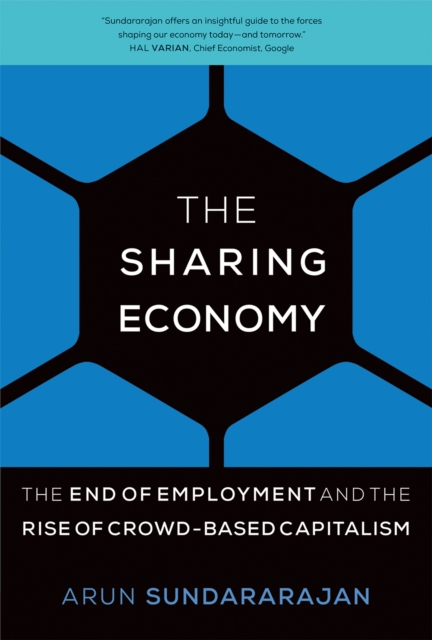
The Sharing Economy
Sharing isn't new. Giving someone a ride, having a guest in your spare room, running errands for someone, participating in a supper club -- these are not revolutionary concepts. What is new, in the \"sharing economy,\" is that you are not helping a friend for free; you are providing these services to a stranger for money. In this book, Arun Sundararajan, an expert on the sharing economy, explains the transition to what he describes as \"crowd-based capitalism\" -- a new way of organizing economic activity that may supplant the traditional corporate-centered model. As peer-to-peer commercial exchange blurs the lines between the personal and the professional, how will the economy, government regulation, what it means to have a job, and our social fabric be affected?Drawing on extensive research and numerous real-world examples -- including Airbnb, Lyft, Uber, Etsy, TaskRabbit, France's BlaBlaCar, China's Didi Kuaidi, and India's Ola, Sundararajan explains the basics of crowd-based capitalism. He describes the intriguing mix of \"gift\" and \"market\" in its transactions, demystifies emerging blockchain technologies, and clarifies the dizzying array of emerging on-demand platforms. He considers how this new paradigm changes economic growth and the future of work. Will we live in a world of empowered entrepreneurs who enjoy professional flexibility and independence? Or will we become disenfranchised digital laborers scurrying between platforms in search of the next wedge of piecework? Sundararajan highlights the important policy choices and suggests possible new directions for self-regulatory organizations, labor law, and funding our social safety net.
eBook