
Catalogue Search | MBRL


Are you sure you want to remove the book from the shelf?

{{itemTitle}}
10,929
result(s) for
"Shaw, George Bernard"
Sort by:
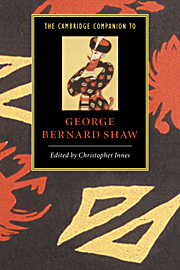
The Cambridge Companion to George Bernard Shaw
The Cambridge Companion to George Bernard Shaw is an indispensable guide to one of the most influential and important dramatists of the theatre. The volume offers a broad-ranging study of Shaw with essays by a team of leading scholars. The Companion covers all aspects of Shaw's drama, focusing on both the political and theatrical context, while the extensive illustrations showcase productions from the Shaw Festival in Canada. In addition to situating Shaw's work in its own time, the Companion demonstrates its continuing relevance, and applies some of the newest critical approaches. Topics include Shaw and the publishing trade, Shaw and feminism, and Shaw and the Empire, as well as analyses of the early plays, discussion plays and history plays.
eBook

Shifting Profile of Africa in Twenty-First Century Black Canadian Writing
The affective link with Africa was visible in those Black Canadian works composed in the late 1980s and early 1990s. In contrast, the profile of Africa has shifted for younger generations of Black diasporan writers in Canada. The purpose of this article is to open up a conversation into how Black Canadian affects, both concerning national identity and homeland connection, seem to have shifted roughly after 2000. In order to do so I analyse The Adventures of the Black Girl in Her Search for God (2017), a reinterpretation by Black Canadian playwright Lisa Codrington of George Bernard Shaw's 1932 short story of the same title. Her play was a milestone in the history of Black Canadian writing, because for the first time a Black Canadian playwright (and a woman, too) was invited to participate in one of Canada's most prestigious and longest-established theatre festivals, the Shaw Festival.
Journal Article

Margaret Macnamara: a ‘New Woman’ of the Independent Theatre Movement
In this article Patricia Lufkin examines the work of Margaret Macnamara, a remarkable feminist playwright whose work has fallen into obscurity but who deserves attention as an important female participant in the Independent Theatre Movement and the Fabian Society. Macnamara’s associations and collaborations with key figures of the time, including George Bernard Shaw, are explored, and her progressive thought and participation in key organizations demonstrated. Importantly, Lufkin analyzes Macnamara’s play The Gates of the Morning (1908), highlighting its feminist critique of religion and its patriarchal influence. The critical response to her work was mixed, yet both positive and hostile reviews acknowledged that the play was a competent and stirring example of the new drama of progressive ideas, and helped to bring the ‘woman question’ to the forefront of people’s minds. Patricia Lufkin received her PhD from Louisiana State University, and is now teaching at Arkansas State University Mid-South. Her research focuses on early twentieth-century British theatre, most significantly on the life and work of Macnamara and Samuel Beckett.
Journal Article
Shaw, in Famous Authors
Shaw was born into a protestant family in Catholic Dublin. His family was slowly sliding down the social ladder. He left school at 15 to become a clerk. Then aged twenty three he went off to London to become a writer. Blessed with a brilliant wit and a capacity for hard work he became the most prominent dramatist of his age. The film covers his life and background. Shaw was born into a protestant family in Catholic Dublin. His family was slowly sliding down the social ladder. He left school at 15 to become a clerk. Then aged twenty three he went off to London to become a writer. Blessed with a brilliant wit and a capacity for hard work he became the most prominent dramatist of his age. The film covers his life and background.
Streaming Video

Play Doctor, Doctor Death: Shaw, Ibsen, and Modern Tragedy
From its inception, therefore, The Doctor's Dilemma was linked directly to Shaw's intellectual relationship with the work of Ibsen. Because of the direct relationship of The Doctor's Dilemma to Ibsen's drama, Shaw's Quintessence of Ibsenism (1891) is particularly relevant in this context, for it provides the most extensive commentary on the nature of drama that Shaw wrote outside of his plays themselves.
Journal Article

Gendered Information Networks and the Telephone Voice in Shaw's \Pygmalion\ and \Village Wooing\
This article considers women's contributions to the work of linguistic purification through their enforcement of the \"telephone voice,\" a strict method of articulation taught to switchboard operators. Situating George Bernard Shaw's Pygmalion and Village Wooing in their technological climate, it argues that these plays imagine the new experience women might have with language in a telephonic world while also searching out a mode of acoustic inscription modeled on the telephone voice that might narrow the gap between script and performance.
Journal Article

Cuerpo, espacio e intimidad: una genealogía de las cabinas y los gabinetes en el arte y la arquitectura
Spaces designed for a single individual have historically embodied introspection, privacy, and inner dialogue. This article examines how such spaces have gradually lost relevance within contemporary architecture, even as they have been the subject of deeper inquiry in the field of art. The abrupt disappearance of telephone booths, for example, cannot be explained solely by the rise of mobile telephony; with their decline, a genealogy of spaces etymologically linked to the notion of the booth as an individual refuge also fades. The analysis presented in this article considers how the configuration of such proximate environments continues to shape the individual's sensory experience and thus retains significance today, positioning proxemics as one of the most productive and meaningful areas for contemporary architectural development. Los espacios concebidos específicamente para una única persona han sido, históricamente, representativos de la introspección, la privacidad y el diálogo interior. Este artículo examina cómo dichos espacios han ido perdiendo relevancia dentro del ámbito de la arquitectura contemporánea, mientras han sido explorados con mayor profundidad en el campo del arte. En este contexto, la abrupta desaparición de las cabinas telefónicas no se puede atribuir únicamente al auge de la telefonía móvil; con ellas se desvanece también una genealogía de espacios vinculados etimológicamente al término cabina como reducto individual. El artículo examina cómo la configuración de estos entornos de lo próximo continúa influyendo en la experiencia sensorial del individuo y, por tanto, no ha perdido vigencia, situando a la disciplina de la proxémica como uno de los territorios de desarrollo más relevantes y productivos para la propia arquitectura actual.
Journal Article

Unpleasant Operas or French Music Drama as Heard by Corno Di Bassetto
The status of George Bernard Shaw as an opera critic—a position he filled under the pen-name ‘Corno Di Bassetto’ in different periodicals such as The Star and The World—has been somewhat overlooked in the canon of late Victorian journalism. However, his critique of the 1880–1890 opera performances stands alone in its own right as the most influential early modern critical discourse on music drama in the British milieu. In the wake of his early enthusiasm for Wagner—a trait that pervades his writings on music during the late 1800s but nonetheless declines with the turn of the century—Shaw’s opera criticism suggests a new theory of music drama the author applies methodically to sundry opera traditions. However, this theory changes dramatically when Shaw addresses French authors, ranging from Léo Delibes, Jules Massenet and Georges Bizet to Charles Gounod. This essay examines how Shaw’s vision of the genre changes after his development of the Life Force theory, which, in turn, compels the reader to reassess Shaw’s understanding of the French opera tradition in the late 1880s and 1890s. This probing into Shaw’s evaluation of French music drama will serve to determine its actual influence on Shaw’s opera criticism.
Journal Article

Acts of Revision: Bernard Shaw, Noël Coward, and “Born Bosses”
Bernard Shaw and Noel Coward both achieved uncanny success in constructing and sustaining mythic authorial personae but the differences between them seem stark: Coward all subtext and small talk, Shaw all paratext and big talk. Critics have occasionally treated their plays in tandem, but the attention usually flows in one direction, with Coward always described as Shaw's “inheritor.” However, putting Shaw's The Millionairess (1934) in dialogic play with Coward's Private Lives (1930) reveals the older playwright's attentiveness to his younger contemporary. Shaw's high comedy transposes Coward's distinctive camp idiom into a Shavian key to produce a “post-Coward” Shaw. Both plays reflect their authors' views on the dangers of unchecked absolutism, although Shaw's taste for Mussolini and Stalin has no equivalent in Coward.
Journal Article
G. B. Shaw's \Heartbreak House\ and Harold Pinter's \The Homecoming\: Comedies of Implosion
Roy offers a side-by-side comparison of George Bernard Shaw's \"Heartbreak House\" and Harold Pinter's \"The Homecoming\" in order to illuminate their similar underlying preoccupations with formal and social values. He touches on the sexual allure of women; violence stemming from sexual frustration; the scarcity of food and drink linked to lovelessness; the use of clothing; and the two playwrights' \"hollowing out\" of the convention of the well-made play.
Journal Article