
Catalogue Search | MBRL


Are you sure you want to remove the book from the shelf?

{{itemTitle}}
13,093
result(s) for
"Shiites"
Sort by:

The Shiʻa of Lebanon : clans, parties and clerics
\"The Shi'a of Lebanon have emerged in the last 20 years to become a major force in Lebanese politics, having long been a marginalised political community. Rodger Shanahan's book examines the reasons behind this transformation from a largely rural population dominated by a handful of elite families, to an assertive sectarian force whose new found power is exemplified by the emergence of Shi'a parties such as Amal and Hizballah. In this highly useful and timely study Rodger Shanahan explores the development of the Shi'a community from the imposition of French mandatory rule, through independence and the bloody civil war to the withdrawal of Israeli forces from South Lebanon in 2000\"--Jacket.

Nourrir les vivants par la grace des saints: La nourriture et le sacre dans le chiisme iranien/Feed the Living by the Grace of the Saints: Food and Sacredness in Iranian Shiism
En Iran, le don de nourriture pour une intention religieuse est un acte très répandu chez les croyants chiites, que l'on peut observer quotidiennement en ville comme à la campagne, dans les milieux aisés comme dans les milieux populaires. Pour comprendre les vertus sociales, matérielles et spirituelles d'une telle nourriture dans la vie pratique et la vision du monde des pieux chiites, cet article propose d'analyser le processus de préparation et de sacralisation de cette nourriture, et d'étudier quelques occasions importantes de don de nourriture votive dans la vie des croyants. Les données de cet article proviennent de recherches précédemment effectuées dans les milieux populaires iraniens, dans quelques sanctuaires chiites et au cimetière de Behesht Zahra de Téhéran, ainsi que d'entretiens réalisés à cette fin précise. Mots clés: Don/contre don, imams impeccables, it'âm, nazr, nourriture votive, offrande aux morts, pur et impur In Iran, the giving of food for a religious purpose is a widespread act among Shiite believers, which can be observed daily in the city and in the villages, in both affluent and popular milieus. In order to understand the social, material and spiritual virtues of such food in the everyday life and worldview of Shiite devotees, this article proposes to analyse the process of preparation and sacredness of such food, and to study some important occasions of votive food giving in the lives of believers. The information in this article comes from previous research carried out in Iranian popular milieus, in some Shiite shrines and at the Behesht Zahra cemetery in Tehran, as well as from interviews conducted for this specific purpose. Keywords: Gift/counter gift, impeccable imams, itam, nazr, pure and impure, votive food, offering to the dead
Journal Article
Nourrir les vivants par la grace des saints: La nourriture et le sacre dans le chiisme iranien/Feed the Living by the Grace of the Saints: Food and Sacredness in Iranian Shiism
En Iran, le don de nourriture pour une intention religieuse est un acte très répandu chez les croyants chiites, que l'on peut observer quotidiennement en ville comme à la campagne, dans les milieux aisés comme dans les milieux populaires. Pour comprendre les vertus sociales, matérielles et spirituelles d'une telle nourriture dans la vie pratique et la vision du monde des pieux chiites, cet article propose d'analyser le processus de préparation et de sacralisation de cette nourriture, et d'étudier quelques occasions importantes de don de nourriture votive dans la vie des croyants. Les données de cet article proviennent de recherches précédemment effectuées dans les milieux populaires iraniens, dans quelques sanctuaires chiites et au cimetière de Behesht Zahra de Téhéran, ainsi que d'entretiens réalisés à cette fin précise.
Journal Article

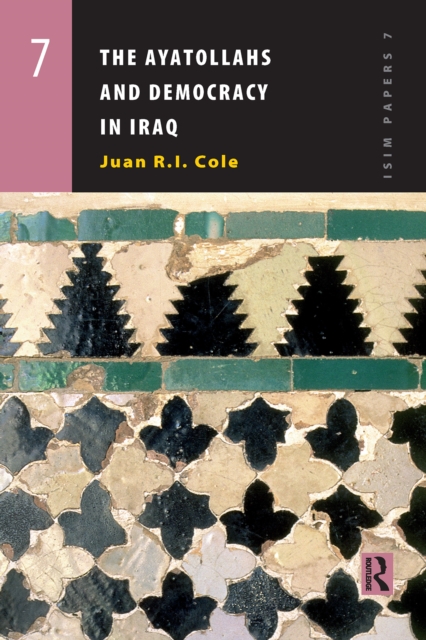
The Ayatollahs and democracy in Iraq
Iraqi Shiism is undergoing profound changes, leading to new elaborations of the relationship between clerics and democratic principles in an Islamic state. The Najaf tradition of thinking about Shiite Islam and the modern state in Iraq, which first developed during the Iranian constitutional revolution of 1905-1911, rejects the principle that supreme power in an Islamic state must be in clerical hands. Grand Ayatollah Ali Sistani of Iraq stands in this tradition, and he has striven to uphold and develop it since the fall of Saddam Hussein. At key points he came into conflict with the Bush administration, which was not eager for direct democracy. Parliamentary politics have also drawn in clerics of the Dawa Party, the Sadr movement, and the Supreme Council for Islamic Revolution in Iraq, all of which had earlier been authoritarian in outlook. Is Iraqi Shiism experiencing its enlightenment moment? This text offers a seminal analysis of the most recent developments in Iraqi Shiism.
eBook

Isfahan and its palaces : statecraft, Shi'ism and the architecture of conviviality in early modern Iran
This illustrated history of Safavid Isfahan (1501-1722) explores the architectural and urban forms and networks of socio-cultural action that reflected a distinctly early-modern and Perso-Shi'i practice of kingship.
Book


Ismailism and Islam in modern South Asia : community and identity in the age of religious internationals
\"Explores the evolution of a Shia Ismaili identity in modern South Asia and traces the genealogies of conceptual categories and institutions that conditioned the historical process\"-- Provided by publisher.
Book
