
Catalogue Search | MBRL


Are you sure you want to remove the book from the shelf?

{{itemTitle}}
1,055
result(s) for
"Ship propulsion."
Sort by:

Marine propulsion simulation : methods and results
This book describes the main steps in developing a multi-physics simulation platform, representing the dynamics of a twin screw ship in six degrees of freedom. The interaction between the propulsion system and automation effects is also considered. The presented simulation methodology can be used in the preliminary ship design to analyse propulsion and control system action. Further applications can concern design optimization and crew training.
Book


Battery Energy Storage Systems in Ships’ Hybrid/Electric Propulsion Systems
The shipping industry is going through a period of technology transition that aims to increase the use of carbon-neutral fuels. There is a significant trend of vessels being ordered with alternative fuel propulsion. Shipping’s future fuel market will be more diverse, reliant on multiple energy sources. One of very promising means to meet the decarbonisation requirements is to operate ships with sustainable electrical energy by integrating local renewables, shore connection systems and battery energy storage systems (BESS). With the increasing number of battery/hybrid propulsion vessels in operation and on order, this kind of vessel propulsion is becoming more common, especially in the segment of short range vessels. This paper presents review of recent studies of electrification or hybridisation, different aspects of using the marine BESS and classes of hybrid propulsion vessels. It also reviews several types of energy storage and battery management systems used for ships’ hybrid propulsion. The article describes different marine applications of BESS systems in relation to peak shaving, load levelling, spinning reserve and load response. The study also presents the very latest developments of hybrid/electric propulsion systems offered by leading maritime market manufacturers.
Journal Article
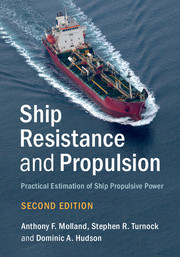
Ship Resistance and Propulsion
This second edition provides a comprehensive and scientific approach to evaluating ship resistance and propulsion. Written by experts in the field, it includes the latest developments in CFD, experimental techniques, and guidance for the practical estimation of ship propulsive power. It addresses the increasing emphasis on improving energy efficiency and reducing emissions, including the introduction of the Energy Efficiency Design Index (EEDI). The text also includes sufficient published standard series data for hull resistance and propeller performance to enable practitioners to make ship power predictions based on material and data within the book, and numerous fully worked examples illustrate applications for cargo and container ships, tankers, bulk carriers, ferries, warships, work boats, planing craft, yachts, hydrofoils, submarines and AUVs. The book is ideal for practicing naval architects and marine engineers, sea-going officers, small craft designers, undergraduate and postgraduate students, and professionals in transportation, transport efficiency and eco-logistics.
eBook

A study on the development of job training curriculum for operation of electric propulsion ships
In order to reduce the emission of pollutants from ships, the need to introduce eco-friendly ships is gradually increasing. Recently built ships are being applied with eco-friendly ship propulsion systems that can replace the existing propulsion systems. The number of ships to which an electric propulsion system, which is a kind of eco-friendly ship propulsion system, is applied is increasing. In addition, an electric propulsion system is attracting attention as a propulsion system suitable for autonomously operated ships to which the digital twin system is applied. Electric propulsion ships have many differences from ships to which the existing propulsion system is applied in terms of equipment and systems mounted thereon. Overseas, job training is being conducted for seamen who onboard electric powered ships for the safe operation of ships, but there is no systematic training course for electric powered ships in Korea. In this paper, we analyze in detail the current educational cases related to electric powered ships in various countries, and propose a curriculum and contents for the mandatory dutied of electric powered ships that can be applied in Korea based on the standard education curriculum of the International Maritime Organization.
Journal Article

Against the Tide
Admiral Hyman Rickover personally revolutionized naval warfare and altered the outcome of the Cold War. Concurrently he drove innovation into American industry -- which in the decades since has proven to be a wellspring of power for American technology. As a touchstone of his success, during Rickover's stewardship the Russians had literally dozens of reactor accidents, but Rickover's single-minded focus on safety protected Americans as well as and our lands from nuclear contamination. Rickover did all of this initially by the force of his own personality and eventually by insisting on radical culture change. The author had the good fortune to personally know and be involved with Admiral Rickover as well as many of the most interesting players and protagonists during much of this thirty year process of wrenching cultural upheaval. The author leaves detailed biographical details of Rickover to others, instead focusing on previously unknown historical events in which he personally participated or had unique knowledge which highlight the management and leadership principles behind Rickover's achievements and place important events (President Eisenhower choosing nuclear submarines to counter Sputnik, development of the Polaris Fleet, the relationship of Admirals Zumwalt and Rickover, the loss of USS Scorpion, the superiority of the American submarines over the Soviet fleet, etc.) in an historical perspective. Because of his life's work, the author is uniquely qualified to apply many of Rickover's principles to other situations. For example, Dave well understands the particular navy culture Rickover had to destroy for the author began his own career on a diesel boat. Similarly since the author spent a decade in US industry as either the Chief Executive Officer or the Chief Operating Officer, he understands how to identify situations where Rickover's
principles can be applied to industry circumstances. This is done at the end of each chapter in the book, thus providing a starting point for any who wish to use this source for case studies.
eBook

Fuel Consumption and Emissions of Ocean-Going Cargo Ship with Hybrid Propulsion and Different Fuels over Voyage
Hybrid propulsion and using liquefied natural gas (LNG) as the alternative fuel have been applied on automobiles and some small ships, but research investigating the fuel consumption and emissions over the total voyage of ocean-going cargo ships with a hybrid propulsion and different fuels is limited. This paper tries to fill the knowledge gap by investigating the influence of the ship mission profile, propulsion modes and effects of different fuels on the fuel consumption and emissions of the ship over the whole voyage, including transit in open sea and manoeuvring in close-to-port areas. Results show that propulsion control and electric power generation modes have a notable influence on the ship’s fuel consumption and emissions during the voyage. During close-to-port manoeuvres, propelling the ship in power-take-in (PTI) mode and generating the electric power by auxiliary engines rather than the main engine will reduce the local NOx and HC (hydrocarbons) emissions significantly. Sailing the ship on LNG will reduce the fuel consumption, CO2 and NOx emissions notably while producing higher HC emissions than traditional fuels. The hybridisation of the ship propulsion and using LNG together with ship voyage optimisation, considering the ship mission, ship operations and sea conditions, will improve the ship’s fuel consumption and emissions over the whole voyage significantly.
Journal Article

Comparative Analysis of COsub.2 Emissions and Transport Efficiency in 174k CBM LNG Carriers with X-DF and ME-GI Propulsion
This study investigates the environmental and operational performance of X-DF and ME-GI propulsion systems in large LNG carriers, focusing on key emission and transport efficiency metrics—CO[sub.2] , the EEOI, and the CII—and their relationship with operational factors such as shaft power, vessel speed, propeller slip, and specific fuel oil consumption. Statistical methods including correlation analysis, regression modeling, outlier detection, and clustering are employed to evaluate engine behavior across the ship’s fuel gas steaming envelope and to identify critical efficiency trends. The results show that ME-GI engines deliver lower CO[sub.2] emissions and consistent efficiency under steady-load conditions, due to their higher thermal efficiency and precise control characteristics. In contrast, X-DF engines demonstrate greater adaptability, leveraging LNG combustion to achieve cleaner emissions and optimal performance in specific operational clusters. Clustering analysis highlights distinct patterns: ME-GI engines excel with optimized shaft power and RPM, while X-DF engines achieve peak efficiency through adaptive load and fuel management. These findings provide actionable insights for integrating performance indicators into SEEMP strategies, enabling targeted emission reductions and fuel optimization across diverse operating scenarios—thus supporting more sustainable maritime transport.
Journal Article
Marine Propellers and Propulsion (3rd Edition)
Propulsion technology is a complex, multidisciplinary topic with design, construction, operational and research implications. Bringing together a wealth of disparate information from the field, this book provides comprehensive and cutting edge coverage to equip marine engineers, naval architects and anyone involved in propulsion and hydrodynamics with the knowledge needed to do the job. Drawing on experience from a long and varied career in consultancy, research, design and technical investigation, author John Carlton breaks the subject into three main sections-hydrodynamic theory, materials and mechanical considerations, and design, operation and performance. Connecting essential theory to practical problems in design, analysis and operational efficiency, this is an invaluable resource, packed with hard-won insights, detailed specifications and data.
eBook
Hybrid PEM Fuel Cell Power Plants Fuelled by Hydrogen for Improving Sustainability in Shipping: State of the Art and Review on Active Projects
The interest in hybrid polymer electrolyte membrane fuel cells (PEMFC) fuelled by hydrogen in shipping has seen an unprecedented growth in the last years, as it could allow zero-emission navigation. However, technical, safety, and regulatory barriers in PEMFC ship design and operation are hampering the use of such systems on a large scale. While several studies analyse these aspects, a comprehensive and up-to-date overview on hydrogen PEMFCs for shipping is missing. Starting from the survey of past/ongoing projects on FCs in shipping, this paper presents an extensive review on maritime hydrogen PEMFCs, outlining the state of the art and future trends for hydrogen storage and bunkering, powertrain, and regulations. In addition to the need for a clear regulatory framework, future studies should investigate the development of an efficient fuel supply chain and bunkering facilities ashore. As for the onboard power system, health-conscious energy management, low-temperature heat recovery, and advancements in fuel processing have emerged as hot research topics.
Journal Article