
Catalogue Search | MBRL


Are you sure you want to remove the book from the shelf?

{{itemTitle}}
411
result(s) for
"Short stories, American 20th century."
Sort by:

Twentieth-Century American Fiction in Circulation
Twentieth-Century American Fiction in Circulation is a study of the twentieth-century linked story collection in the United States. It emphasizes how the fictional form grew out of an established publishing model—individual stories printed in magazines, revised and expanded into single-author volumes that resemble novels—which creates multiple contexts for the reception of this literature. By acknowledging the prior appearance of stories in periodicals, the book examines textual variants and the role of editorial emendation, drawing on archival records (drafts and correspondence) whenever possible. It also considers how the pages of magazines create a context for the reception of short stories that differs significantly from that of the single-author book.
The chapters explore how short stories, appearing separately then linked together, excel at representing the discontinuity of modern American life, convey the multifaceted identity of a character across episodes, mimic the qualities of oral storytelling, and illustrate struggles of belonging within and across communities. The book explains the appearance and prevalence of these narrative strategies at particular cultural moments in the evolution of the American magazine, examining a range of periodicals such as The Masses, Saturday Evening Post, Partisan Review, Esquire, and Ladies’ Home Journal. The primary linked story collections studied are Sherwood Anderson’s Winesburg, Ohio (1919), William Faulkner’s The Unvanquished (1938), Mary McCarthy’s The Company She Keeps (1942), John Barth’s Lost in the Funhouse (1968), and Amy Tan’s The Joy Luck Club (1988).
eBook

Postmodern belief
How can intense religious beliefs coexist with pluralism in America today? Examining the role of the religious imagination in contemporary religious practice and in some of the best-known works of American literature from the past fifty years, Postmodern Belief shows how belief for its own sake--a belief absent of doctrine--has become an answer to pluralism in a secular age. Amy Hungerford reveals how imaginative literature and religious practices together allow novelists, poets, and critics to express the formal elements of language in transcendent terms, conferring upon words a religious value independent of meaning.
eBook


A Reader's Companion to the Short Story in English
While the short story has existed in various forms for centuries, it has particularly flourished during the last hundred years, and especially in recent decades. Though many outstanding novels have been written in the 20th century, most of these writers have also published short fiction. And in many cases, their short stories exhibit a greater degree of coherence and integrity than their longer works. The rise of creative writing programs in the 1960s helped fuel the growth of the short story and brought academic attention to it. So, too, the emergence of multiculturalism encouraged authors of diverse backgrounds to write about their cultures. This reference is a guide to the contemporary English-language short story. Included are alphabetically arranged entries for roughly 50 English-language short story writers from around the world, such as Chinua Achebe, John Barth, Jamaica Kincaid, Salman Rushdie, and Amy Tan. More than half the American writers profiled are from historically marginalized groups, such as Jewish-Americans, African-Americans, and Asian-Americans. Most of these authors have been active since 1960, and they reflect a wide range of experiences and perspectives in their works. Each entry is written by an expert contributor and includes biographical material, a brief review of existing criticism, a lengthier analysis of specific works, and a selected bibliography of primary and secondary sources. The volume begins with a detailed introduction to the short story genre and concludes with an annotated bibliography of major works on short story theory.
eBook

White Diaspora
This is the first book to analyze our suburban literary tradition. Tracing the suburb's emergence as a crucial setting and subject of the twentieth-century American novel, Catherine Jurca identifies a decidedly masculine obsession with the suburban home and a preoccupation with its alternative--the experience of spiritual and emotional dislocation that she terms \"homelessness.\" In the process, she challenges representations of white suburbia as prostrated by its own privileges.
In novels as disparate asTarzan(written by Tarzana, California, real-estate developer Edgar Rice Burroughs), Richard Wright'sNative Son, and recent fiction by John Updike and Richard Ford, Jurca finds an emphasis on the suburb under siege, a place where the fortunate tend to see themselves as powerless. From Babbitt to Rabbit, the suburban novel casts property owners living in communities of their choosing as dispossessed people. Material advantages become artifacts of oppression, and affluence is fraudulently identified as impoverishment. The fantasy of victimization reimagines white flight as a white diaspora.
Extending innovative trends in the study of nineteenth-century American culture, Jurca's analysis suggests that self-pity has played a constitutive role in white middle-class identity in the twentieth century. It breaks new ground in literary history and cultural studies, while telling the story of one of our most revered and reviled locations: \"the little suburban house at number one million and ten Volstead Avenue\" that Edith Wharton warned would ruin American life and letters.
eBook
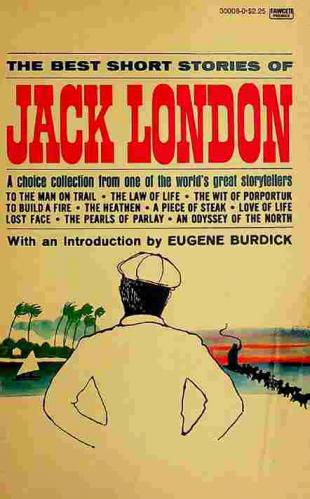
Best short stories of Jack London
A collection of short stories by author Jack London including \"To the man on trial,\" \"To build a fire,\" and \"The pearls of parlay.\"
Book

The Columbia Companion to the Twentieth-Century American Short Story
Esteemed critic Blanche Gelfant's brilliant companion gathers together lucid essays on major writers and themes by some of the best literary critics in the United States. Part 1 is comprised of articles on stories that share a particular theme, such as “Working Class Stories” or “Gay and Lesbian Stories.” The heart of the book, however, lies in Part 2, which contains more than one hundred pieces on individual writers and their work, including Fitzgerald, Hemingway, Richard Ford, Raymond Carver, Eudora Welty, Andre Debus, Zora Neal Hurston, Anne Beattie, Bharati Mukherjee, J. D. Salinger, and Jamaica Kincaid, as well as engaging pieces on the promising new writers to come on the scene.
eBook