
Catalogue Search | MBRL


Are you sure you want to remove the book from the shelf?

{{itemTitle}}
154,999
result(s) for
"Shuttles"
Sort by:

Spaceflight in the shuttle era and beyond : redefining humanity's purpose in space
An exploration of the changing conceptions of the iconic Space Shuttle and a call for a new vision of spaceflight. The thirty years of Space Shuttle flights saw contrary changes in American visions of space. Valerie Neal, who has spent much of her career examining the Space Shuttle program, uses this iconic vehicle to question over four decades' worth of thinking about, and struggling with, the meaning of human spaceflight. She examines the ideas, images, and icons that emerged as NASA, Congress, journalists, and others sought to communicate rationales for, or critiques of, the Space Shuttle missions. At times concurrently, the Space Shuttle was billed as delivery truck and orbiting science lab, near-Earth station and space explorer, costly disaster and pinnacle of engineering success. The book's multidisciplinary approach reveals these competing depictions to examine the meaning of the spaceflight enterprise. Given the end of the Space Shuttle flights in 2011, Neal makes an appeal to reframe spaceflight once again to propel humanity forward.
Book

Progress on Electrolytes Development in Dye-Sensitized Solar Cells
Dye-sensitized solar cells (DSSCs) have been intensely researched for more than two decades. Electrolyte formulations are one of the bottlenecks to their successful commercialization, since these result in trade-offs between the photovoltaic performance and long-term performance stability. The corrosive nature of the redox shuttles in the electrolytes is an additional limitation for industrial-scale production of DSSCs, especially with low cost metallic electrodes. Numerous electrolyte formulations have been developed and tested in various DSSC configurations to address the aforementioned challenges. Here, we comprehensively review the progress on the development and application of electrolytes for DSSCs. We particularly focus on the improvements that have been made in different types of electrolytes, which result in enhanced photovoltaic performance and long-term device stability of DSSCs. Several recently introduced electrolyte materials are reviewed, and the role of electrolytes in different DSSC device designs is critically assessed. To sum up, we provide an overview of recent trends in research on electrolytes for DSSCs and highlight the advantages and limitations of recently reported novel electrolyte compositions for producing low-cost and industrially scalable solar cell technology.
Journal Article

To orbit and back again : how the space shuttle flew in space
\"The Space Shuttle has been the dominant machine in the U.S. space program for thirty years and has generated a great deal of interest among space enthusiasts and engineers. This book enables readers to understand its technical systems in greater depth than they have been able to do so before. The author describes the structures and systems of the Space Shuttle, and then follows a typical mission, explaining how the structures and systems were used in the launch, orbital operations and the return to Earth. Details of how anomalous events were dealt with on individual missions are also provided, as are the recollections of those who built and flew the Shuttle. Many photographs and technical drawings illustrate how the Space Shuttle functions, avoiding the use of complicated technical jargon.\"--Publisher description.
Book
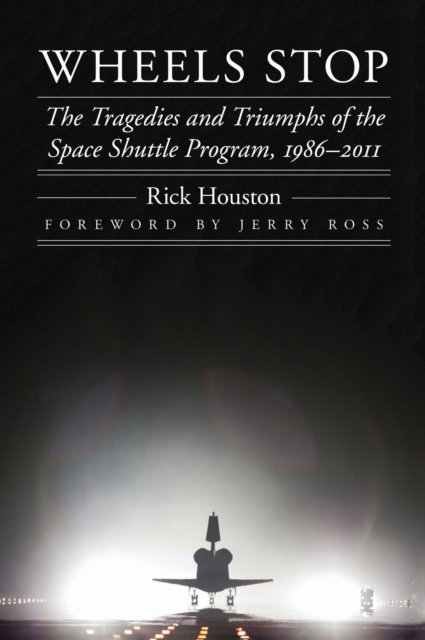
Wheels Stop: The Tragedies and Triumphs of the Space Shuttle Program, 1986-2011
Humanity's first reusable spacecraft and the most complex machine ever built, NASA's Space Shuttle debuted with great promise and as a dependable source of wonder and national pride. But with the Challenger catastrophe in 1986, the whole Space Shuttle program came into question, as did NASA itself, so long an institution that was seemingly above reproach. Wheels Stop tells the stirring story of how, after the Challenger disaster, the Space Shuttle not only recovered but went on to perform its greatest missions. From the Return to Flight mission of STS-26 in 1988 to the last shuttle mission ever on STS-135 in 2011, Wheels Stop takes readers behind the scenes as the shuttle's crews begin to mend Cold War tensions with the former Soviet Union, conduct vital research, deploy satellites, repair the Hubble Space Telescope, and assist in constructing the International Space Station. It also tells the heart-wrenching story of the Columbia tragedy and the loss of the magnificent STS-107 crew. As complex as the shuttle was, the people it carried into orbit were often more so-and this is their story, too. Close encounters with astronauts, flight controllers, and shuttle workers capture the human side of the Space Shuttle's amazing journey-and invite readers along for the ride. Browse more spaceflight books at upinspace.org.Purchase the audio edition.
eBook


A design study of deployable wing for a reusable shuttle
In recent years, with the rise of the commercial space market, there has been an increasing amount of research and breakthroughs in the field of reusable shuttles, making it a strategic focus for leading spacefaring nations. This paper presents a design of a deployable wing mechanism for a typical reusable spacecraft, enabling the shuttle to be stowed within the fairing after folding. A methodology for validating the design’s feasibility is outlined. By subjecting the critical components of the folding mechanism to structural verification and conducting a rational assessment of the weight increment introduced by the entire system, the rationality of the design has been successfully confirmed.
Journal Article

Challenger : a true story of heroism and disaster on the edge of space
\"From the New York Times bestselling author of Midnight in Chernobyl comes the definitive, dramatic, minute-by-minute story of the Challenger disaster based on fascinating new archival research and in-depth reporting-a riveting history that reads like a thriller\"-- Provided by publisher.
Book

Refractory Plasmonics
Stable at high temperatures, refractory plasmonic materials could boost existing optoelectronic technologies. Refractory materials are defined as those with a high melting point and chemical stability at temperatures above 2000°C. Applications based on refractory materials, usually nonmetallic, span a wide range of areas including industrial furnaces, space shuttle shields, and semiconductor technology. Metals have also been studied as refractories; however, the optical properties of those metals that have been tried for high-temperature applications were not good enough to be used in plasmonic applications (these are almost entirely based on noble metals, which are not good refractories). Refractory materials that exhibit reasonably good plasmonic behavior would undoubtedly enable new devices and boost such existing applications as heat-assisted magnetic recording (HAMR) ( 1 ), solar/thermophotovoltaics (S/TPV) ( 2 ), plasmon-assisted chemical vapor deposition ( 3 ), solar thermoelectric generators ( 4 ), and nanoscale heat transfer systems ( 5 ).
Journal Article


Lactate metabolism: historical context, prior misinterpretations, and current understanding
Lactate (La−) has long been at the center of controversy in research, clinical, and athletic settings. Since its discovery in 1780, La− has often been erroneously viewed as simply a hypoxic waste product with multiple deleterious effects. Not until the 1980s, with the introduction of the cell-to-cell lactate shuttle did a paradigm shift in our understanding of the role of La− in metabolism begin. The evidence for La− as a major player in the coordination of whole-body metabolism has since grown rapidly. La− is a readily combusted fuel that is shuttled throughout the body, and it is a potent signal for angiogenesis irrespective of oxygen tension. Despite this, many fundamental discoveries about La− are still working their way into mainstream research, clinical care, and practice. The purpose of this review is to synthesize current understanding of La− metabolism via an appraisal of its robust experimental history, particularly in exercise physiology. That La− production increases during dysoxia is beyond debate, but this condition is the exception rather than the rule. Fluctuations in blood [La−] in health and disease are not typically due to low oxygen tension, a principle first demonstrated with exercise and now understood to varying degrees across disciplines. From its role in coordinating whole-body metabolism as a fuel to its role as a signaling molecule in tumors, the study of La− metabolism continues to expand and holds potential for multiple clinical applications. This review highlights La−’s central role in metabolism and amplifies our understanding of past research.
Journal Article