
Catalogue Search | MBRL


Are you sure you want to remove the book from the shelf?

{{itemTitle}}
16
result(s) for
"Siblings Juvenile literature"
Sort by:

Living and Loving in Diversity
The deeply personal stories herein reflect a rainbow of experiences and emotions as diverse as the storytellers themselves. Join the Australian LGBTIQ Multicultural Council for a journey of discovery through queer multicultural multifaith Australia, with over 60 voices from across the spectrum of sexualities and genders, families and relationships.
eBook

You're all my favourites
Mummy Bear and Daddy Bear reassure their three little bears that each is equally special to them. But the little bears start to wonder: do their differences - being the smallest, not having spots, etc. - mean they are loved less? In the end they are satisfied that they really are all their parents' favourites.
Book

From the Bricks to the Hall
Situating herself on the cusp between life in her hometown of Newark, New Jersey, and her new world at Seton Hall University, Mellie Torres describes the painful awareness of a growing distance between herself, as the first to go to college, and her family. In so doing, she reveals the inherent losses of leaving home and the painful contrast between her own life story and that of her brother Isaac, who was denied the opportunity to thrive. In grieving the loss of her brother, Torres asks readers to honor his unrealized promise. (Contains 1 note.)
Journal Article
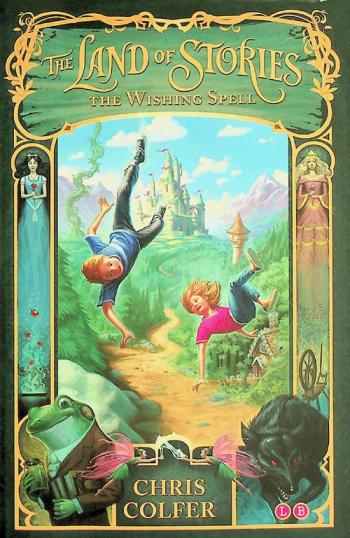
The wishing spell
\"Alex and Conner Bailey's world is about to change. When the twins' grandmother gives them a treasured fairy-tale book, they have no idea they're about to enter a land beyond all imagining: the Land of Stories, where fairy tales are real. But as Alex and Conner soon discover, the stories they know so well haven't ended in this magical land -- Goldilocks is now a wanted fugitive, Red Riding Hood has her own kingdom, and Queen Cinderella is about to become a mother! The twins know they must get back home somehow. But with the legendary Evil Queen hot on their trail, will they ever find the way?\"--Publisher's website description
BOOK

La Pétroleuse: Representing Revolution
It was common for children to be regarded as women's accomplices. [Elihu B. Washburne], for instance, announced that \"whenever it was possible, the pétroleuse, who was to receive ten francs for every ten houses burnt, would find some little boy or girl whom she would take by the hand and to whom she would give a bottle of the incendiary liquid, with instructions to scatter it in certain places.\"(26) Children who were deemed suspicious-looking, like women, were arrested and executed. Residents and journalists reported seeing the bodies of dead children as well as child prisoners. Washburne and Colonel Wickham Hoffman reported the deaths of six or eight children (their accounts vary), the eldest \"apparently not over fourteen,\" who were \"caught\" carrying petroleum in the Avenue d'Autin.(27) Georges Renard remembered seeing a row of bodies of women and children lined up along the wall of the Collège de France.(28) Edmund de Goncourt recorded in his diary on May 26, that he had seen \"a band of frightful street urchins and incendiary hooligans\" who were being held in the train station at Passy.(29) And on May 28, [M. Chastel] reported that he had seen a large number of prisoners among whom were \"women and children, who sometimes were obliged to run to keep up with the rest, or they would have been trampled on by the horses.\"(30) Fascinated rather than repelled by the women who passed through the streets of Paris as prisoners, the men who observed them frequently contrasted their behavior with that of their male comrades. Edmund de Goncourt reported that none of the arrested women whom he saw had the same \"apathetic resignation\" as the men. \"There is,\" he wrote, \"anger and irony on their faces. Many of them have the eyes of mad women.\"(40) Le Figaro reported on June 1 that the women and children in the convoys of prisoners \"marched with a hardier step than the men... The men are more solemn and seem to be asking themselves if it would not have been better to think before serving against their brothers in the army...\"(41) The Times correspondent, reflecting back on the fighting, reported that \"more courageous than the men, the women show fight to the last moment, and meet their death, according to the accounts of those who have witnessed their executions, with an undaunted courage.\"(42) The punishment meted out to the women had a sexual dimension that was absent in the treatment of the men, however. Several correspondents reported that the women were stripped (to what extent is not clear in the reports) before they were executed. On Friday, May 26, the Times's correspondent reported that thirteen women, \"caught in the act of spreading petroleum,\" had been executed \"after being publicly disgraced in the Place Vendôme.\" Although it is not possible to tell what form this humiliation took, quite likely it involved at least the ripping of the women's bodices to reveal their breasts, as indicated by Child's earlier quotation. Goncourt reported that some of the women he saw were concealed behind veils until a \"noncommissioned officer touched one of the veils with a cruel and brutal flick of his whip\" and demanded, \"'Come on, off with your veils. Let's see your hussy faces (vos visages de coquines)!'\"(47) For male prisoners, punishment included the turning of their uniform jackets (if they wore one) inside out, a form of humiliation that lacked the sexual denigration imposed upon the women.
Journal Article

The miracle & tragedy of the Dionne quintuplets
\"When they were born on May 28, 1934, quintuplets Yvonne, Annette, Câecile, âEmilie, and Marie captivated the world, defying medical history with every breath they took. In an effort to protect them from hucksters and showmen, the Ontario government took custody of the quints, sequestering them in a private, custom-built hospital across the road from their family. Here, Sarah Miller reconstructs their unprecedented upbringing with depth and subtlety, illustrating not only their resilience, but also the unique bond of their sisterhood\"-- Provided by publisher.
Book

Racial differences in youth employment
Work experience at an early age has a positive impact on labor force attachment of different racial groups. However, racial gaps in employment that are present in the early teen years seem to continue into adulthood. (Author/SK)
Journal Article

Vincent and Theo : the Van Gogh brothers
\"The true story of the relationship between brothers Theo and Vincent van Gogh\"-- Provided by publisher.
Book

Differential Perception of the Parental Relationship : A Chilean Sample
The paper reports the findings in socialization practices of deviant and \"normal\" samples in Santiago, Chile. Responses to the interviews with 60 schizophrenics, 52 juvenile delinquents, and 175 \"normals\" or \"controls\" revealed marked differences in their child rearing experiences Parental rejection, especially by the father, seemed particularly critical in the schizophrenic sample, whereas the delinquent sample had experienced both rejection and ovetly harsh discipline. The mothers were often perceived as manipulative, and with a high rate of absenteeism among the fathers, the mother often had to fulfill, however inadequately, both the instrumental and expressive roles. Despite the differences in age, sex, and social class between the three samples, the study points to varying types of emotional climate within the home as significant in personal and social adjustment.
Journal Article