
Catalogue Search | MBRL


Are you sure you want to remove the book from the shelf?

{{itemTitle}}
640
result(s) for
"Sikh diaspora"
Sort by:

Sikh diaspora philanthropy in Punjab : global giving for local good
Revised version of papers presented at an international conference at Lyallpur Khalsa College, Jalandhar, Mar. 2006.
Book

The precarious diasporas of Sikh and Ahmadiyya generations : violence, memory, and agency
This book examines the long-term effects of violence on the everyday cultural and religious practices of a younger generation of Ahmadis and Sikhs in Frankfurt, Germany and Toronto, Canada. Comparative in scope and the first to discuss contemporary articulations of Sikh and Ahmadiyya identities within a single frame of reference, the book assembles a significant range of empirical data gathered over ten years of ethnographic fieldwork. In its focus on precarious sites of identity formation, the volume engages with cutting-edge theories in the fields of critical diaspora studies, migration and refugee studies, religion, secularism, and politics. It presents a novel approach to the reading of Ahmadi and Sikh subjectivities in the current climate of anti-immigrant movements and suspicion against religious others. Michael Nijhawan also offers new insights into what animates emerging movements of the youth and their attempts to reclaim forms of the spiritual and political.
eBook


Imperialism and Sikh Migration
iiiPunjab, a region divided between India and Pakistan, has witnessed multiple nomadic, mendicant, trading and pastoral mobilities for centuries. Imperial assisted mobilities in the nineteenth century produced a category of hypermobile Sikhs, who left their villages in Punjab to seek their fortunes in Southeast Asia, Africa, Australia, America and Canada. The practices of the British, British Indian and the Canadian governments to obstruct free flows of Sikhs offer telling instances of the exercise of governmentality through which both old imperialism and the new Empire assert their sovereignty.
This book focuses on the Komagata Maru episode of 1914: this Japanese ship was chartered by Gurdit Singh, a prosperous Sikh businessman from Malaya. It carried 376 passengers from Punjab and was not permitted to land in Vancouver on grounds of a stipulation about a continuous journey from the port of departure. It was forced to return to Kolkata, where the passengers were fired at, imprisoned or kept under surveillance. The author isolates juridical procedures, tactics and apparatuses of security through which the British Empire exercised power on imperial subjects to investigate the significance of this incident to colonial and postcolonial migration. Juxtaposing public archives including newspapers, official documents and reports with private archives and interviews of descendants, the book analyses the legalities and machineries of surveillance that regulate the movements of people in the old and new Empire.
Addressing contemporary discourse on neoimperialism and resistance, nation, migration, diaspora, multiculturalism and citizenship, this book will be of interest to scholars in the field of diaspora studies, postcolonialism, minority studies, migration and mobility studies, multiculturalism and Sikh/Punjab and South Asian studies.
eBook
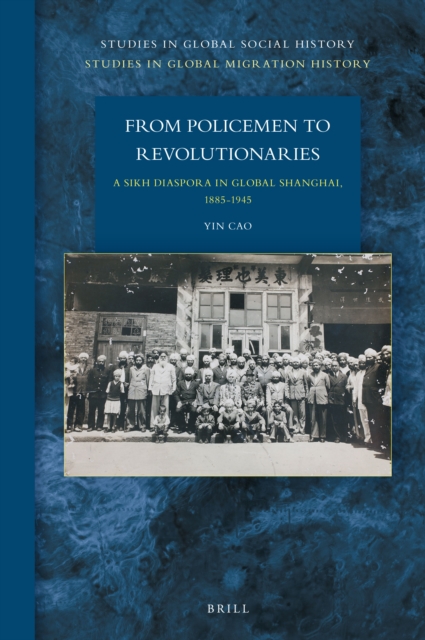
From Policemen to Revolutionaries: A Sikh Diaspora in Global Shanghai, 1885–1945
From Policemen to Revolutionaries uncovers the less-known story of Sikh emigrants in Shanghai in the late nineteenth and early twentieth centuries. Yin Cao argues that the cross-border circulation of personnel and knowledge across the British colonial and the Sikh diasporic networks, facilitated the formation of the Sikh community in Shanghai, eventually making this Chinese city one of the overseas hubs of the Indian nationalist struggle. By adopting a translocal approach, this study elaborates on how the flow of Sikh emigrants, largely regarded as subalterns, initially strengthened but eventually unhinged British colonial rule in East and Southeast Asia.
eBook

Disruptive Garb: Gender Production and Millennial Sikh Fashion Enterprises in Canada
Several North American Sikh millennials are creating online values-based fashion enterprises that seek to encourage creative expression, self-determined representation, gender equality, and ethical purchasing, while steeped in the free market economy. Exploring the innovative ways young Sikhs of the diaspora express their values and moral positions in the socio-economic sphere, one finds many fashionistas, artists, and activists who are committed to making Sikh dress accessible and acceptable in the fashion industry. Referred to as “Sikh chic”, the five outwards signs of the Khalsa Sikh—the “5 ks”—are frequently used as central motifs for these businesses (Reddy 2016). At the same time, many young Sikh fashion entrepreneurs are designing these items referencing contemporary style and social trends, from zero-waste bamboo kangas to hipster stylized turbans. Young Sikh women are challenging mainstream representations of a masculine Sikh identity by creating designs dedicated to celebrating Khalsa Sikh females. Drawing on data collected through digital and in-person ethnographic research including one-on-one interviews, participant observation, and social media, as well as fashion magazines and newsprint, I explore the complexities of this phenomenon as demonstrated by two Canadian-based Sikh fashion brands, Kundan Paaras and TrendySingh, and one Canadian-based Sikh female artist, Jasmin Kaur.
Journal Article
Sikh diaspora : theory, agency, and experience
Sikh Diaspora: Theory, Agency, and Experience is a collection of essays offering new insights into the diverse experiences of Sikhs beyond the Punjab. The essays in this volume engage with diaspora theory, agency, space, social relations, and aesthetics.
eBook
Negotiating Ambivalent Gender Spaces for Collective and Individual Empowerment: Sikh Women’s Life Writing in the Diaspora
In order to examine gender and identity within Sikh literature and culture and to understand the construction of gender and the practice of Sikhi within the contemporary Sikh diaspora in the US, I analyze a selection from creative non-fiction pieces, variously termed essays, personal narrative, or life writing, in Meeta Kaur’s edited collection, Her Name is Kaur: Sikh American Women Write About Love, Courage, and Faith. Gender, understood as a social construct (Butler, among others), is almost always inconsistent and is related to religion, which, too, is a construct and is also almost always inconsistent in many ways. Therefore, my reading critically engages with the following questions regarding life writing through a postcolonial feminist and intersectional lens: What are lived religions and how are the practices, narratives, activities and performances of ‘being’ Sikh imagined differently in the diaspora as represent in my chosen essays? What are some of the tenets of Sikhism, viewed predominantly as patriarchal within dominant cultural spaces, and how do women resist or appropriate some of them to reconstruct their own ideas of being a Sikh? In Kaur’s collection of essays, there are elements of traditional autobiography, such as the construction of the individual self, along with the formation of communal identity, in the postcolonial life writing. I will critique four narrative in Kaur’s anthology as testimonies to bear witness and to uncover Sikh women’s hybrid cultural and religious practices as reimagined and practiced by the female Sikh writers.
Journal Article
Militant and Migrant
This book is a study of the transformations in Punjab created by biotechnological revolutions, economic restructuring, persistent migrations, and political upheaval in the late 20th century. The sacred centre at Amritsar, the transnational settlement of Southall and a Doaba village form the terrain for this - three sites that can seen as metonymic spaces of identity that transcend geographic boundaries, and form the structure of this book.
Relations between the rural, the sacred and the transnational, fostered through migration, marriage and material exchange, existed well before 1984. After 1984, however, and through the violent decades of the militancy period, these three locations became connected via the circulation of political ideologies, violent deaths, financial aid, a sense of disaffection, and the migration of men. Analysis of the linkages between transnational migration and religious revival is a key theme of this study.
Conversely, the enhanced engagements of the diaspora with homeland politics became a source of support and created sanctuary spaces for political asylum seekers and transnational migrant labour. Re-analysing existing material and drawing on fieldwork-based interviews, as well as local history archives, the book presents a different framework to analyse the politics and social history of Punjab.
eBook

From Policemen to Revolutionaries
In From Policemen to Revolutionaries, Yin Cao elaborates the rise and fall of the Sikh community in Shanghai by the turn of the twentieth century.
eBook