
Catalogue Search | MBRL


Are you sure you want to remove the book from the shelf?

{{itemTitle}}
37
result(s) for
"Silent film music History and criticism."
Sort by:

The sounds of silent films : new perspectives on history, theory and practice
'The Sounds of Silent Films' is a collection of investigatory and theoretical essays that unite up-to-date research on the complex historical performance practices of silent film accompaniment with in-depth analyses of relevant case studies.
Book

Music and the silent film : contexts and case studies, 1895-1924
Most people’s view of silent film music is of a pianist playing old warhorse scores while watching the flickering screen. This innovative book shows that there was much more to silent film music and that often it was planned from the start as an integral part of the film. The first of three volumes investigating film music, this book devotes one chapter to films before 1900 and Camille Saint-Saëns’s score for L’Assassinat du Duc de Guise (1908). Another chapter looks closely at film scores composed by Walter Cleveland Simon for several films of 1912. The two main chapters are devoted to significant films of the silent period, D.W. Griffith’s The Birth of a Nation (1915) and René Clair’s Entr’acte (1924). Breil’s Birth of a Nation score was a compilation of many sources, but, when played by an orchestra accompanying the film in a theatre showing, it often matched the epic nature of the film and was one source of its great popularity.
eBook

The Rise of Spanish-Language Filmmaking
Silent film was universally understood and could be exported anywhere. But when \"talkies\" arrived, the industry began experimenting with dubbing, subtitling, and dual track productions in more than one language. Where language fractured the European film market, for Spanish-speaking countries and communities, it created new opportunities. InThe Rise of Spanish-Language Filmmaking, Lisa Jarvinen focuses specifically on how Hollywood lost ground in the lucrative international Spanish-speaking audience between 1929 and 1939.
Hollywood studios initially trained cadres of Spanish-speaking film professionals, created networks among them, and demonstrated the viability of a broadly conceived, transnational, Spanish-speaking film market in an attempt to forestall the competition from other national film industries. By the late 1930s, these efforts led to unintended consequences and helped to foster the growth of remarkably robust film industries in Mexico, Spain, and Argentina. Using studio records, Jarvinen examines the lasting effects of the transition to sound on both Hollywood practices and cultural politics in the Spanish-speaking world. She shows through case studies based on archival research in the United States, Spain, and Mexico how language, as a key marker of cultural identity, led to new expectations from audiences and new possibilities for film producers.
eBook

Seeing Sarah Bernhardt
The most famous stage actress of the nineteenth century, Sarah Bernhardt enjoyed a surprising renaissance when the 1912 multi-reel film Queen Elizabeth vaulted her to international acclaim. The triumph capped her already lengthy involvement with cinema while enabling the indefatigable actress to reinvent herself in an era of technological and generational change. Placing Bernhardt at the center of the industry's first two decades, Victoria Duckett challenges the perception of her as an anachronism unable to appreciate film's qualities. Instead, cinema's substitution of translated title cards for her melodic French deciphered Bernhardt for Anglo-American audiences. It also allowed the aging actress to appear in the kinds of longer dramas she could no longer physically sustain onstage. As Duckett shows, Bernhardt contributed far more than star quality. Her theatrical practice on film influenced how the young medium changed the visual and performing arts. Her promoting of experimentation, meanwhile, shaped the ways audiences looked at and understood early cinema. A leading-edge reappraisal of a watershed era, Seeing Sarah Bernhardt tells the story of an icon who bridged two centuries--and changed the very act of watching film.
eBook

Reuse, Misuse, Abuse
In contemporary culture, existing audiovisual recordings are constantly reused and repurposed for various ends, raising questions regarding the ethics of such appropriations, particularly when the recording depicts actual people and events. Every reuse of a preexisting recording is, on some level, a misuse in that it was not intended or at least anticipated by the original maker, but not all misuses are necessarily unethical. In fact, there are many instances of productive misuse that seem justified. At the same time, there are other instances in which the misuse shades into abuse. Documentary scholars have long engaged with the question of the ethical responsibility of documentary makers in relation to their subjects. But what happens when this responsibility is set at a remove, when the recording already exists for the taking and repurposing? Reuse, Misuse and Abuse surveys a range of contemporary films and videos that appropriate preexisting footage and attempts to theorize their ethical implications.
eBook

Film Music: A History
Film Music: A History explains the development of film music by considering large-scale aesthetic trends and structural developments alongside socioeconomic, technological, cultural, and philosophical circumstances.
The book’s four large parts are given over to Music and the \"Silent\" Film (1894--1927), Music and the Early Sound Film (1895--1933), Music in the \"Classical-Style\" Hollywood Film (1933--1960), and Film Music in the Post-Classic Period (1958--2008). Whereas most treatments of the subject are simply chronicles of \"great film scores\" and their composers, this book offers a genuine history of film music in terms of societal changes and technological and economic developments within the film industry. Instead of celebrating film-music masterpieces, it deals—logically and thoroughly—with the complex ‘machine’ whose smooth running allowed those occasional masterpieces to happen and whose periodic adjustments prompted the large-scale twists and turns in film music’s path.
Part One: Music and the \"Silent\" Film (1894–1927)
Chapter One: Origins, 1894–1905
Chapter Two: The Nickelodeon, 1905–1915
Chapter Three: Feature Films, 1915–1927
Part Two: ‘Classic’ Film Music (1927–1950)
Chapter Four: The Coming of Sound (1927–1929)
transition: Edison’s ideas
Early technologies (pre-1927) (Edison, De Forester, etc.)
Anticipations of a great future (Carl Van Vechten, George Antheil, etc.)
Problems of amplification, synchronization
Vitaphone: \"Don Juan,\" \"The Jazz Singer,\" etc.
Other systems and their costs, usefulness, adaptations, etc.
The immediate effect on the industry (cite numbers of installations, but also note persistence of ‘silent’ films in Japan, etc.)
transition: the lines/scene from 1953 \"Singin’ in the Rain\" ???
Chapter Five: Early Sound Films (1929–1933)
transition : the original \"Singin’ in the Rain’
The fad for musicals (cite the numbers)
\"Steamboat Willie\" (the Disney innovations)
anti-musical, pro-musical industry shifts ca. 1931 (draw from all the extra research done for the Gershwin article in JAMS)
Approaches/aesthetics: wall-to-wall music vs. no music at all vs. only diegetic music (mention the various approaches in USSR, England, France, Germany, Italy, etc.)
Early commentary in the trade press (on sound in general, on musicals, on music, on ‘theme songs’)
transition : negative commentary on \"theme songs\"
Chapter Six: Music in the Classical-Style Hollywood Film (1933–1950)
transition : the reference to ‘theme song’ in \"King Kong\"
Max Steiner and \"King Kong,\" \"The Informer\" (biographical info; earlier efforts) (info on how the \"KK\" score came about)
Definitions of \"classical\" style (cite Gorbman, Kalinak, Bordwell, Flinn, etc.); then offer a better definition/discussion of the idea of the ‘classical’ film; lead up to the idea of ‘classical’ = standardization
Standardization of genres
Standardization of gestures:
Standardization of production:
The composers (individuals, certainly, but holding to a standardized approach nevertheless): Stothart, Waxman, Korngold, Kaper, Carl Stallings, Newman, Rozsa, Webb, Donan, Herrmann, etc. (their early accomplishments; their backgrounds; studio-director affiliations; basic approaches/styles …)
Standardization of distribution:
transition : post-war troubles for the ‘studio system’ (the coming of television, the Supreme Court decision for divestiture, the gross revenue tax ca. 1952)
Part Three: Film Music in the Post-Classic Period (1950–2000)
Chapter Seven: Post-War Innovations; Struggle for Survival (1950–1960)
transition : disastrous economic effects on the studio system
Hollywood reaction: breakdown of ‘studio system’; epics, musicals, Technicolor, 3-D, Cinerama
The first \"soundtrack albums\" in the early 1950s (LPs)
The close relationship between Hollywood and Broadway
The rise of inexpensive scores (Ronald Stein for the Roger Corman films, etc. …)
Introduction of pop music and jazz (\"Blackboard Jungle,\" teen rock movies, Elvis films, etc.)
The sci-fi genre and electronic music (\"Forbidden Planet,\" \"Them!\", \"The Day the Earth Stood Still\" and many more) (but back up and deal with \"Spellbound\" (1945), \"The Lost Weekend\" (1945) and other theremin scores …)
Best-selling songs (\"High Noon\" (1952); Henry Mancini …)
Jazzy scores like \"On the Waterfront\" (1954), \"Baby Doll\" (1956), \"Anatomy of a Murder\" (1959), \"The Man with the Golden Arm\" (1955)
Hitchcock-Herrmann: \"Vertigo\" (1958), \"North by Northwest\" (1959), \"Psycho\" (1960)
Epics: \"Ben-Hur\" (1959), \"The Alamo,\" \"Spartacus\" (1960) : epic scores, w. overture, entr’acte, exit music.
transition: budget considerations vs. a need to compete with television
Chapter Eight: Eclecticism (1960–1980)
transition: restrictions = opportunity ???
big themes, big songs: \"Dr. No\" (1962) (certainly this features a \"big\" song in the main titles …); \"Born Free\" (1966), \"Lawrence of Arabia\" (1962), \"The Way We Were\" (1973) (the first film to feature a \"big\" song in the end credits???)
weird stuff: \"The Birds\" (1963), \"The Andromeda Strain\" (1971) \"THX 1138: (1971)
Kubrick and eclecticism: \"Lolita\" (1962), \"Dr. Strangelove\" (1964) \"2001: A Space Odyssey\" (1968), \"A Clockwork Orange\" (1971)
\"To Kill a Mockingbird\" (1962)
compilation scores: \"The Graduate\" (1967), \"Easy Rider\" (1969), \"American Graffiti\" (1973)
mixture scores (i.e., pop with classic style): \"Butch Cassidy and the Sundance Kid\" (1969)
‘modernist’ scores: \"Jaws\" (1975), \"Apocalypse Now\" (1979), \"Planet of the Apes\" (1968)
rebirth of the classic-style score: \"Star Wars\" (1977), \"Close Encounters of the Third Kind\" (1977), \"Superman\" (1978), \"Raiders of the Lost Ark\" (1981), \"E.T. – the Extraterrestrial\" (1982) [of course, these are all by John Williams; what about the other composers who jumped on the neo-classic bandwagon?]
issues: the compilation score, the re-birth of the classic-style score
transition: on to the postmodern age
Chapter Nine: (1980–2000) New Definitions and New Uses of Film Music
transition: define the \"postmodern\" as eclectic, non-linear, referential, etc.
raises the question: what, exactly, is film music, anyway? What is a film score?
mention the rise of technology that allows a composer to concoct a quasi-full score in a home studio (MIDI, sequencers, sound modules, ProTools, etc.)
note rising interest in sound effects as music …
note the new role of the ‘music supervisor’ (i.e., the acquirer of licensed materials …)
\"The Terminator\" (1984)
\"Die Hard\" (1988)
Michael Kamen, James Horner, Jerry Goldsmith, Hans Zimmer, Danny Elfman
Diverse examples: \"The Terminator\" (1984), \"Die Hard\" (1988), \"Dirty Dancing\" (1987), \"Edward Scissorhands\" (1990), \"Thelma and Louise\" (1991), \"The Thin Red Line\" (1998), \"The Gladiator\" (2000)
transition : so, where are we heading?
Epilogue: (the twenty-first century)
On the one hand, films like \"Harry Potter\" and \"Lord of the Rings\" suggest a return to tradition
On the other hand, things, like \"Moulin Rouge\" (2001), \"Run, Lola, Run\" (1998), \"Kill Bill\" (2003) suggest an embrace of the \"postmodern condition\" by the film audience (at least, by the younger members thereof)
James Wierzbicki is a musicologist who teaches at the University of Michigan and serves as executive editor of the American Musicological Society's Music of the United States of America series of scholarly editions. His current research focuses on twentieth-century music in general and film music and electronic music in particular.
eBook
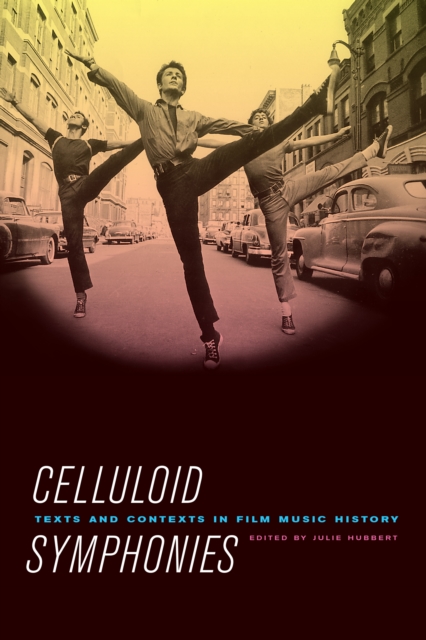
Celluloid symphonies
Celluloid Symphonies is a unique sourcebook of writings on music for film, bringing together fifty-three critical documents, many previously inaccessible. It includes essays by those who created the music--Max Steiner, Erich Korngold, Jerry Goldsmith, Elmer Bernstein and Howard Shore--and outlines the major trends, aesthetic choices, technological innovations, and commercial pressures that have shaped the relationship between music and film from 1896 to the present. Julie Hubbert's introductory essays offer a stimulating overview of film history as well as critical context for the close study of these primary documents. In identifying documents that form a written and aesthetic history for film music, Celluloid Symphonies provides an astonishing resource for both film and music scholars and for students.
eBook

Celluloid Symphonies
Celluloid Symphonies is a unique sourcebook of writings on music for film, bringing together fifty-three critical documents, many previously inaccessible. It includes essays by those who created the music—Max Steiner, Erich Korngold, Jerry Goldsmith, Elmer Bernstein and Howard Shore—and outlines the major trends, aesthetic choices, technological innovations, and commercial pressures that have shaped the relationship between music and film from 1896 to the present. Julie Hubbert’s introductory essays offer a stimulating overview of film history as well as critical context for the close study of these primary documents. In identifying documents that form a written and aesthetic history for film music, Celluloid Symphonies provides an astonishing resource for both film and music scholars and for students.
eBook

Brakhage and the Birth of Silence
Discussions of \"silent cinema\" have generally focused on films made during the silent era (1894–1929). Even after the spread of synchronized sound, however, several experimental filmmakers created films without soundtracks, purely visual experiences that challenged cinema's status as a multisensory medium. This article gives close attention to Stan Brakhage's 1959 film Window Water Baby Moving as a way of outlining some of the effects of cinematic silence, such as aesthetic ambiguity and a heightened awareness of cinema's visual rhythms.
Journal Article
Keeping Quiet
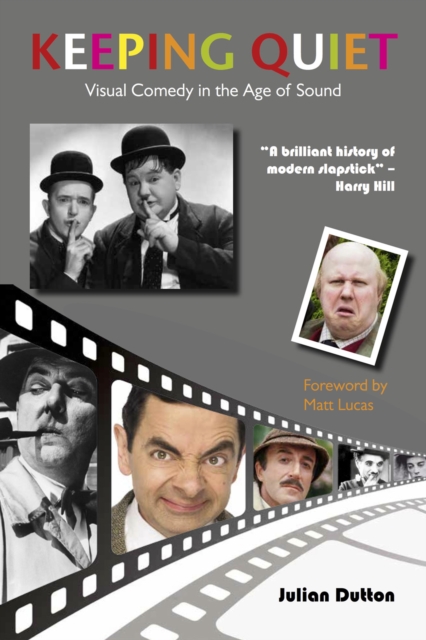
Keeping Quiet is a love-letter to the modern sight-gag on film and television, tracing the history of physical clowning since the advent of sound. Taking up the story of visual humour where Paul Merton's Silent Comedy leaves off, Julian Dutton charts the lives and work of all the great comedians who chose to remain silent, from Charlie Chaplin - who was determined to resist the 'talkies' - right through to the slapstick of modern-day performers such as Rowan Atkinson, Matt Lucas and Harry Hill. This fascinating chronicle - spanning nine decades - shows how physical comedy, at first overshadowed by dialogue-films in the 1930s, reinvented itself and how this revival was spearheaded by a Frenchman: Jacques Tati.Julian Dutton draws on his own experience as a comedy writer and performer to give an expert analysis of the screen persona and the comedy style of dozens of the screen's best-loved performers including Laurel & Hardy, Buster Keaton, Harpo Marx, Norman Wisdom, Jerry Lewis,.
eBook