
Catalogue Search | MBRL


Are you sure you want to remove the book from the shelf?

{{itemTitle}}
5,436
result(s) for
"Since 1971"
Sort by:

Collision Course
The notion of ever-expanding economic growth has been promoted so relentlessly that \"growth\" is now entrenched as the natural objective of collective human effort. The public has been convinced that growth is the natural solution to virtually all social problems -- poverty, debt, unemployment, and even the environmental degradation caused by the determined pursuit of growth. Meanwhile, warnings by scientists that we live on a finite planet that cannot sustain infinite economic expansion are ignored or even scorned. InCollision Course,Kerryn Higgs examines how society's commitment to growth has marginalized scientific findings on the limits of growth, casting them as bogus predictions of imminent doom.Higgs tells how in 1972,The Limits to Growth-- written by MIT researchers Donella Meadows, Dennis Meadows, Jorgen Randers, and William Behrens III -- found that unimpeded economic growth was likely to collide with the realities of a finite planet within a century. Although the book's arguments received positive responses initially, before long the dominant narrative of growth as panacea took over. Higgs explores the resistance to ideas about limits, tracing the propagandizing of \"free enterprise,\" the elevation of growth as the central objective of policy makers, the celebration of \"the magic of the market,\" and the ever-widening influence of corporate-funded think tanks--a parallel academic universe dedicated to the dissemination of neoliberal principles and to the denial of health and environmental dangers from the effects of tobacco to global warming. More than forty years afterThe Limits to Growth, the idea that growth is essential continues to hold sway, despite the mounting evidence of its costs -- climate destabilization, pollution, intensification of gross global inequalities, and depletion of the resources on which the modern economic edifice depends.
eBook
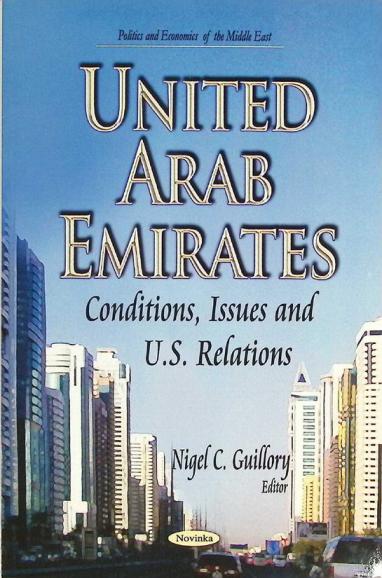
United Arab Emirates : conditions, issues and U.S. relations
\"United Arab Emirates: Conditions, Issues and U.S. Relations\" is a comprehensive policy-oriented volume that examines the multifaceted strategic partnership between the UAE and the United States. Edited by Nigel C. Guillory, the work synthesizes reports from the Congressional Research Service (CRS) and various defense analysts to provide a nuanced portrait of a nation that has transitioned from a regional player to a proactive \"middle power.\" The text delves into the internal political dynamics of the seven emirates, the nation’s economic diversification strategies, and its role as a pivotal hub for U.S. military operations and counterterrorism efforts in the Middle East
BOOK
Collision course
Economic growth : origins -- Economic growth : perceptions -- The limits to growth debate : precursors and beginnings -- The limits to growth and its critics -- Growth and consumerism -- The rise of free market fundamentalism -- \"Development\" and globalisation : exporting growth -- Growth and \"sustainable development\" -- Growth and its outcomes for the poor -- Propaganda : \"business finds its voice\" -- Sleight of the invisible hand -- The free market assault on environmental science -- International brakes on environmental priorities -- Limits after 40 years -- Conclusion : the planet and the pie -- Appendix: Selected critics of growth, 2013
Book


Haiti: Poverty Reduction Strategy Paper
In recent years, the IMF has released a growing number of reports and other documents covering economic and financial developments and trends in member countries. Each report, prepared by a staff team after discussions with government officials, is published at the option of the member country.
Book

Ideal Minds
Following the 1960s, that decade's focus on
consciousness-raising transformed into an array of intellectual
projects far afield of movement politics. The mind's powers came to
preoccupy a range of thinkers and writers: ethicists pursuing
contractual theories of justice, radical ecologists interested in
the paleolithic brain, seventies cultists, and the devout of both
evangelical and New Age persuasions. In Ideal Minds ,
Michael Trask presents a boldly revisionist argument about the
revival of subjectivity in postmodern American culture, connecting
familiar figures within the seventies intellectual landscape who
share a commitment to what he calls \"neo-idealism\" as a weapon in
the struggle against discredited materialist and behaviorist
worldviews.
In a heterodox intellectual and literary history of the 1970s,
Ideal Minds mixes ideas from cognitive science, philosophy
of mind, moral philosophy, deep ecology, political theory, science
fiction, neoclassical economics, and the sociology of religion.
Trask also delves into the decade's more esoteric branches of
learning, including Scientology, anarchist theory, rapture
prophesies, psychic channeling, and neo-Malthusianism. Through this
investigation, Trask argues that a dramatic inflation in the value
of consciousness and autonomy beginning in the 1970s accompanied a
growing argument about the state's inability to safeguard such
values. Ultimately, the thinkers Trask analyzes-John Rawls, Arne
Naess, L. Ron Hubbard, Hal Lindsey, Philip Dick, Ursula Le Guin,
Edward Abbey, William Burroughs, John Irving, and James
Merrill-found alternatives to statism in conditions that would lend
intellectual support to the consolidation of these concepts in the
radical free market ideologies of the 1980s.
eBook

Disasters, vulnerability, and narratives : writing Haiti's futures
This book uses narrative responses to the 2010 Haiti earthquake as a starting point for an analysis of notions of disaster, vulnerability, reconstruction and recovery. The turn to a wide range of literary works enables a composite comparative analysis, which encompasses the social, political and individual dimensions of the earthquake. This book focuses on a vision of an open-ended future, otherwise than as a threat or fear. Mika turns to concepts of hinged chronologies, slow healing and remnant dwelling. Weaving theory with attentive close-readings, the book offers an open-ended framework for conceptualising post-disaster recovery and healing. These processes happen at different times and must entail the elimination of compound vulnerabilities that created the disaster in the first place. Challenging characterisations of the region as a continuous catastrophe this book works towards a bold vision of Haiti's and the Caribbean's futures. The study shows how narratives can extend some of the key concepts within discipline-bound approaches to disasters, while making an important contribution to the interface between disaster studies, postcolonial ecocriticism and Haitian Studies.
Book
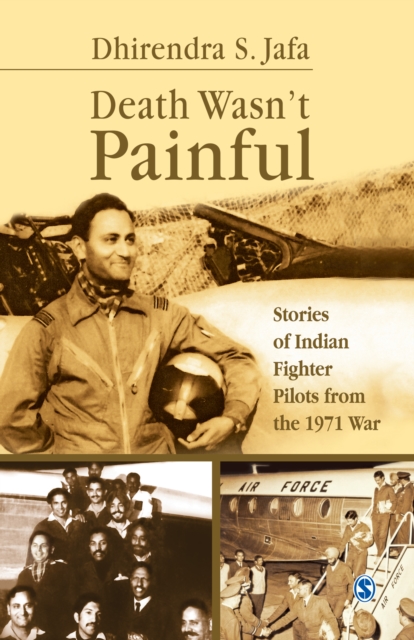
Death Wasn't Painful
Death Wasn't Painful is a true account of the experiences of a former Indian fighter pilot, who was taken prisoner during the 1971 Indo-Pak/Bangladesh Liberation War. While depicting the intrepid life of fighter pilots in active combat, the book also has an introspective side where it portrays the soldier's reactions to the terrifying realities of war. The experiences of prisoners of war are finely drawn, as we share the emotions of war-death, alienation, loneliness and grief. Through heart-warming anecdotes and conversational passages of interactions with Pakistani interrogators, attendants, jailors and civilians, the book juxtaposes the metaphor of physical battles in the sky with the conflict of minds between two nations.
eBook