
Catalogue Search | MBRL


Are you sure you want to remove the book from the shelf?

{{itemTitle}}
832
result(s) for
"Sistani, Ali"
Sort by:

Democratic authority, public Islam, and Shi’i jurisprudence in Iran and Iraq: Hussain Ali Montazeri and Ali Sistani
This article compares the democratic thought and practice of two influential Shi’i Muslim theologians in Iran and Iraq. It argues that a new conception of Shi’i traditional authority has been developed by senior clerics Hussain Ali Montazeri and Ali Sistani offering a new model of clerical authority closely connected to the democratic values of popular sovereignty and accountability: ‘democratic Usulism.’ Such a new paradigm envisions a form of religious legitimization that is led by elected rulers who are ultimately ‘guided’ by the sacred law of Islamic legal norms, while being held accountable to the people. The paradigm operates either as a counter-discourse to theocratic authoritarianism, currently prevalent in Iran, or as a democratic theology of citizenship and electoral participation, as in the case of Iraq. In broad terms, the two cases represent a major trend in Shi’i political theology that can be viewed as part of the global upsurge of public religions, some of which serve to counter authoritarianism (both secular and theocratic) and promote democratic rule.
Journal Article
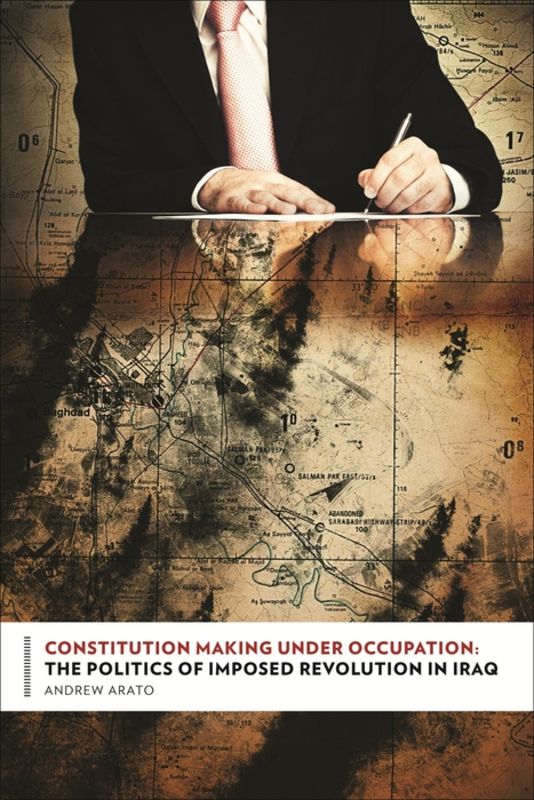
Constitution Making Under Occupation
The attempt in 2004 to draft an interim constitution in Iraq and the effort to enact a permanent one in 2005 were unintended outcomes of the American occupation, which first sought to impose a constitution by its agents. This two-stage constitution-making paradigm, implemented in a wholly unplanned move by the Iraqis and their American sponsors, formed a kind of compromise between the populist-democratic project of Shi'ite clerics and America's external interference.
As long as it was used in a coherent and legitimate way, the method held promise. Unfortunately, the logic of external imposition and political exclusion compromised the negotiations. Andrew Arato is the first person to record this historic process and analyze its special problems. He compares the drafting of the Iraqi constitution to similar, externally imposed constitutional revolutions by the United States, especially in Japan and Germany, and identifies the political missteps that contributed to problems of learning and legitimacy.
Instead of claiming that the right model of constitution making would have maintained stability in Iraq, Arato focuses on the fragile opportunity for democratization that was strengthened only slightly by the methods used to draft a constitution. Arato contends that this event would have benefited greatly from an overall framework of internationalization, and he argues that a better set of guidelines (rather than the obsolete Hague and Geneva regulations) should be followed in the future. With access to an extensive body of literature, Arato highlights the difficulty of exporting democracy to a country that opposes all such foreign designs and fundamentally disagrees on matters of political identity.
eBook

THE SISTANI FACTOR
Al-Rahim looks beyond the vote tallies and poll results to understand the meaning of the recent elections in Iraq--both for the country and the wider Arab and Islamic world. Among other things, he mentions that for the Shi'ite majority and its senior religious leader, Grand Ayatollah Sayyid Ali Sistani, the January elections played out against the background of a longing for justice that has deep spiritual sources a well as more recent socio-political roots.
Journal Article

Political mobilization and the Shi'i religious establishment (marja'iyya)
Since the fall of the Ba'athist regime in 2003, the Shi'i religious establishment in Iraq has come to the fore as a significant political force, intervening, guiding, supporting and opposing various types of developments. Its prominence has been directly related to the realization that the Shi'a constitute an absolute majority in Iraq and hence would have the primary influence in a democratic state. Alongside the recognition of its importance, some analysts tend to assume that the Shi'a are more inclined than others in Iraq to follow their religious and cultural leadership. This article attempts to clarify a number of issues pertaining to the actual attitudes and relationships between the marja 'iyya and politics in Iraq. First, it examines three important approaches to an activist understanding of the role of the marja 'iyya in politics and comments on the actual political movements that arise from them. Second, the article analyzes the role of the paramount figure in the marja'iyya in Najaf, Ayatollah Ali Sistani and his attitudes towards politics and some of his active interventions in Iraqi politics. Finally, it comments on outstanding problems and failures within the leadership of Shi'i politics and the limitations of the marja'iyya in promoting democratic and civic politics. Any political actors in contemporary Iraq must take cognizance of the role of the marja 'iyya but also account for the deficits that need to be overcome to propel Iraq beyond a compromise of ethnic and confessional affiliations.
Journal Article

Iran's Reformists and Activists: Internet Exploiters
Examines the political use of the Internet in Iran, demonstrating how the technology fosters new civil spheres or \"virtual domains\" to oppose authoritarianism. Focus is on Internet use by two social movements, the reformist ulama (clerics) & women's right activists, particularly following the 2005 hardliner electoral victory. The views, objectives, & actions of the reformist ulama are described. The centrality of a democratic tradition for the ulama is noted. It is argued that the Internet created personalized spaces in the form of Web sites & blogs for the ulama to communicate & provided them access to information & a means to communicate with a regional & global reach. The cases of Grand Ayatollah Morteza Montazeri & Grand Ayatollah Ali Sistani are used to illustrate. Attention turns to tracing the development of the Iranian women's rights movement. How the movement used the Internet to report on a police clampdown of a peaceful demonstration is discussed, along with how the younger generation of activists pursued its own audience with the One Million Signature Campaign given its clash with the older generation of activists. While the two movements appear to be quite different, it is contended that they actually share ideals & strategies, especially when it comes to the Internet, which both use to spread ideas, recruit members, & attract international attention. D. Edelman
Journal Article
Iraqi regime has decided to shed its military dependence on the United States
The degree of cooperation with the al-Maliki regime against the Sadrists was so close that the [Bush] administration even accepted for a brief period in late 2007 the al-Maliki regime's argument that Iran was restraining the Mahdi Army by pressing Sadr to issue his August 2007 ceasefire order. In November, Bush and al-Maliki agreed on a set of principles as the basis for negotiating agreements on stationing of U.S. forces and bilateral cooperation, including a U.S. guarantee of Iraq's security and territorial integrity. In February 2008, U.S. and Iraqi military planners were already preparing for a U.S.-British-Iraqi military operation later in the summer to squeeze the Sadrists out of Basra. Iran was able to exploit a deep vein of Iraqi Shiite suspicion that the U.S. might still try to overthrow the Shiite regime, using former Prime Minister Iyad Allawi and some figures in the Iraqi Army. When the U.S. draft dropped an earlier U.S. commitment to defend Iraq against external aggression and pledged only to \"consult\" in the event of an external threat, Iran certainly exploited the opening to push al-Maliki to reject the agreement.
Newsletter

Reaching for Power
As the world focuses on the conflict in Iraq, the most important political players in that country today are not the Sunni insurgents. Instead, they are Iraq's Shi'I majority--part of the Middle East's ninety million Shi'I Muslims who hold the key to the future of the region and the relations between Muslim and Western societies. So contends Yitzhak Nakash, one of the world's foremost experts on Shi'ism.
eBook

THE SANCTIONS-ERA ROOTS OF POSTINVASION DEVELOPMENTS
There is a growing consensus among analysts of Iraq that the roots of the post-2003 rise of religious actors and sectarian politics must be attributed in part to social and political changes during the sanctions period, from 1990 to 2003. Some see continuities before and after regime change, arguing that a weakening of the Iraqi state and the destitution caused by sanctions led to the growth of groups that maintained an uninterrupted trajectory, more or less, from the sanctions era to the postinvasion period. Peter Harling, for example, writes, “The invasion revealed, enabled, and exacerbated pre-existing phenomena more often than
Book Chapter
AYATOLLAHS’ NETWORKS AND NATIONAL AUTHORITY
Why was Shiʿi political identity both salient and relatively cohesive in post-Baʿthist Iraq while Sunni Arabs remained fractured? Why was it Ali Sistani and Moqtada al-Sadr who unexpectedly emerged as Iraq’s most influential political entrepreneurs, instead of richly endowed elites, both religious and secular? The answer to these questions lies partly in the past; the rise of religious actors and the saliency of sectarianism postinvasion have roots in changes in Iraqi society in the 1991 to 2003 sanctions era. But those roots grew in particular ways because of Iraqis’ need to order their world after the state collapsed and the
Book Chapter
Shiism and Ethnic Politics in Iraq
Traces the political history of the Iraqi Shiites. Discussion begins with a brief historical overview of Iraq since antiquity, looking at Mesopotamia, the Ottoman Empire, the colonial period, & the rise of the Baathists. Saddam Hussein's relationship with the Sunni tribes is described, highlighting how his strengthening of their power fostered tension between them & the Shiite community. Attention is then given to how the Shiites aligned with the Sunnis in the 1920s revolt against the British occupation, their oppression at the hands of the Sunnis under monarchy & republic, the Baathists' harsh treatment of them, particularly after the 1979 Iranian revolution. Focus turns to profiling Shiite Ayatollah Sistani & examining his central role in Iraqi politics amid the US occupation, a time when the Shiites have a political opportunity to shape the future of Iraq. D. Edelman
Journal Article