
Catalogue Search | MBRL


Are you sure you want to remove the book from the shelf?

{{itemTitle}}
121
result(s) for
"Sklave."
Sort by:

West African warfare in Bahia and Cuba : soldier slaves in the Atlantic world, 1807-1844
\"Examines the extent to which a series of African-led plots and armed movements that took place in western Cuba and Bahia between 1807 and 1844 were the result--or a continuation--of events that had occurred in and around the Yoruba and Hausa kingdoms in the same period.\"--Book jacket
Book

Forging a Christian order : South Carolina Baptists, race, and slavery, 1696-1860
A significant contribution to the historiography of religion in the U.S. south, Forging a Christian Order challenges and complicates the standard view that eighteenth-century evangelicals exerted both religious and social challenges to the traditional mainstream order, not maturing into middle-class denominations until the nineteenth century. Instead, Kimberly R. Kellison argues, eighteenth-century White Baptists in South Carolina used the Bible to fashion a Christian model of slavery that recognized the humanity of enslaved people while accentuating contrived racial differences. Over time
this model evolved from a Christian practice of slavery to one that expounded on slavery as morally right.
Elites who began the Baptist church in late-1600s Charleston closely valued hierarchy. It is not surprising, then, that from its formation the church advanced a Christian model of slavery. The American Revolution spurred the associational growth of the denomination, reinforcing the rigid order of the authoritative master and subservient enslaved person, given that the theme of liberty for all threatened slaveholders' way of life. In lowcountry South Carolina in the 1790s, where a White minority population lived in constant anxiety over control of the bodies of enslaved men and women, news of revolt in St. Domingue (Haiti) led to heightened fears of Black violence. Fearful of being associated with antislavery evangelicals and, in turn, of being labeled as an enemy of the planter and urban elite, White ministers orchestrated a major transformation in the Baptist construction of paternalism.
Forging a Christian Order provides a comprehensive examination of the Baptist movement in South Carolina from its founding to the eve of the Civil War and reveals that the growth of the Baptist church in South Carolina paralleled the growth and institutionalization of the American system of slavery-accommodating rather than challenging the prevailing social order of the economically stratified Lowcountry.
eBook

Slavery and the culture of taste
It would be easy to assume that, in the eighteenth century, slavery and the culture of taste--the world of politeness, manners, and aesthetics--existed as separate and unequal domains, unrelated in the spheres of social life. But to the contrary,Slavery and the Culture of Tastedemonstrates that these two areas of modernity were surprisingly entwined. Ranging across Britain, the antebellum South, and the West Indies, and examining vast archives, including portraits, period paintings, personal narratives, and diaries, Simon Gikandi illustrates how the violence and ugliness of enslavement actually shaped theories of taste, notions of beauty, and practices of high culture, and how slavery's impurity informed and haunted the rarified customs of the time.
Gikandi focuses on the ways that the enslavement of Africans and the profits derived from this exploitation enabled the moment of taste in European--mainly British--life, leading to a transformation of bourgeois ideas regarding freedom and selfhood. He explores how these connections played out in the immense fortunes made in the West Indies sugar colonies, supporting the lavish lives of English barons and altering the ideals that defined middle-class subjects. Discussing how the ownership of slaves turned the American planter class into a new aristocracy, Gikandi engages with the slaves' own response to the strange interplay of modern notions of freedom and the realities of bondage, and he emphasizes the aesthetic and cultural processes developed by slaves to create spaces of freedom outside the regimen of enforced labor and truncated leisure.
Through a close look at the eighteenth century's many remarkable documents and artworks,Slavery and the Culture of Tastesets forth the tensions and contradictions entangling a brutal practice and the distinctions of civility.
eBook
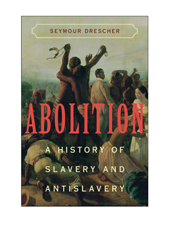
Abolition
In one form or another, slavery has existed throughout the world for millennia. It helped to change the world, and the world transformed the institution. In the 1450s, when Europeans from the small corner of the globe least enmeshed in the institution first interacted with peoples of other continents, they created, in the Americas, the most dynamic, productive, and exploitative system of coerced labor in human history. Three centuries later these same intercontinental actions produced a movement that successfully challenged the institution at the peak of its dynamism. Within another century a new surge of European expansion constructed Old World empires under the banner of antislavery. However, twentieth-century Europe itself was inundated by a new system of slavery, larger and more deadly than its earlier system of New World slavery. This book examines these dramatic expansions and contractions of the institution of slavery and the impact of violence, economics, and civil society in the ebb and flow of slavery and antislavery during the last five centuries.
eBook

Captives
InCaptives: How Stolen People Changed the Worldarchaeologist Catherine M. Cameron provides an eye-opening comparative study of the profound impact that captives of warfare and raiding have had on small- scale societies through time. Cameron provides a new point of orientation for archaeologists, anthropologists, historians, and other scholars by illuminating the impact that captive-taking and enslavement have had on cultural change, with important implications for understanding the past.Focusing primarily on indigenous societies in the Americas while extending the comparative reach to include Europe, Africa, and Island Southeast Asia, Cameron draws on ethnographic, ethnohistoric, historic, and archaeological data to examine the roles that captives played in small-scale societies. In such societies, captives represented an almost universal social category consisting predominantly of women and children and constituting 10 to 50 percent of the population in a given society. Cameron demonstrates how captives brought with them new technologies, design styles, foodways, religious practices, and more, all of which changed the captor culture.This book provides a framework that will enable archaeologists to understand the scale and nature of cultural transmission by captives and it will also interest anthropologists, historians, and other scholars who study captive-taking and slavery. Cameron's exploration of the peculiar amnesia that surrounds memories of captive-taking and enslavement around the world also establishes a connection with unmistakable contemporary relevance.
eBook
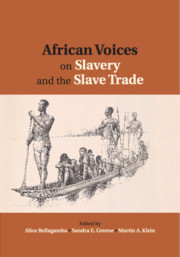
African Voices on Slavery and the Slave Trade
What were the experiences of those in Africa who suffered from the practice of slavery, those who found themselves captured and sold from person to person, those who died on the trails, those who were forced to live in fear? And what of those Africans who profited from the slave trade and slavery? What were their perspectives? How do we access any of these experiences and views? This volume explores diverse sources such as oral testimonies, possession rituals, Arabic language sources, European missionary, administrative and court records and African intellectual writings to discover what they can tell us about slavery and the slave trade in Africa. Also discussed are the methodologies that can be used to uncover the often hidden experiences of Africans embedded in these sources. This book will be invaluable for students and researchers interested in the history of slavery, the slave trade and post-slavery in Africa.
eBook

Between blood and gold
A comparative study analyzing the debates within France and Great Britain relating to the question of compensation to former slaveholders. It lays out the philosophical, legal-political, and economic factors at play. It establishes a powerful new model for understanding the aftermath of slavery in the Americas.
eBook

Toussaint Louverture and the American Civil War
At the end of the eighteenth century, a massive slave revolt rocked French Saint Domingue, the most profitable European colony in the Americas. Under the leadership of the charismatic former slave François Dominique Toussaint Louverture, a disciplined and determined republican army, consisting almost entirely of rebel slaves, defeated all of its rivals and restored peace to the embattled territory. The slave uprising that we now refer to as the Haitian Revolution concluded on January 1, 1804, with the establishment of Haiti, the first \"black republic\" in the Western Hemisphere. The Haitian Revolution cast a long shadow over the Atlantic world. In the United States, according to Matthew J. Clavin, there emerged two competing narratives that vied for the revolution's legacy. One emphasized vengeful African slaves committing unspeakable acts of violence against white men, women, and children. The other was the story of an enslaved people who, under the leadership of Louverture, vanquished their oppressors in an effort to eradicate slavery and build a new nation.Toussaint Louverture and the American Civil Warexamines the significance of these competing narratives in American society on the eve of and during the Civil War. Clavin argues that, at the height of the longstanding conflict between North and South, Louverture and the Haitian Revolution were resonant, polarizing symbols, which antislavery and proslavery groups exploited both to provoke a violent confrontation and to determine the fate of slavery in the United States. In public orations and printed texts, African Americans and their white allies insisted that the Civil War was a second Haitian Revolution, a bloody conflict in which thousands of armed bondmen, \"American Toussaints,\" would redeem the republic by securing the abolition of slavery and proving the equality of the black race. Southern secessionists and northern anti-abolitionists responded by launching a cultural counterrevolution to prevent a second Haitian Revolution from taking place.
eBook

Slavery behind the Wall
Cuba had the largest slave society of the Spanish colonial empire and thus the most plantations. The lack of archaeological data for interpreting these sites is a glaring void in slavery and plantation studies. Theresa Singleton helps to fill this gap with the presentation of the first archaeological investigation of a Cuban plantation written by an English speaker.
At Santa Ana de Biajacas, where the plantation owner sequestered slaves behind a massive masonry wall, Singleton explores how elite Cuban planters used the built environment to impose a hierarchical social order upon slave laborers. Behind the wall, slaves reclaimed the space as their own, forming communities, building their own houses, celebrating, gambling, and even harboring slave runaways. What emerged there is not just an identity distinct from other North American and Caribbean plantations, but a unique slave culture that thrived despite a spartan lifestyle.
Singleton's study provides insight into the larger historical context of the African diaspora, global patterns of enslavement, and the development of Cuba as an integral member of the larger Atlantic World.
eBook

Christians in Caesar’s Household
In this volume, Michael Flexsenhar III advances the argument that imperial slaves and freedpersons in the Roman Empire were essential to early Christians’ self-conception as a distinct people in the Mediterranean and played a multifaceted role in the making of early Christianity.
Scholarship in early Christianity has for centuries viewed Roman emperors’ slaves and freedmen as responsible for ushering Christianity onto the world stage, traditionally using Paul’s allusion to “the saints from Caesar’s household” in Philippians 4:22 as a core literary lens. Merging textual and material evidence with diaspora and memory studies, Flexsenhar expands on this narrative to explore new and more nuanced representations of this group, showing how the long-accepted stories of Christian slaves and freepersons in Caesar’s household should not be taken at face value but should instead be understood within the context of Christian myth- and meaning-making. Flexsenhar analyzes textual and material evidence from the first to the sixth century, spanning Roman Asia, the Aegean rim, Gaul, and the coast of North Africa as well as the imperial capital itself. As a result, this book shows how stories of the emperor’s slaves were integral to key developments in the spread of Christianity, generating origin myths in Rome and establishing a shared history and geography there, differentiating and negotiating assimilation with other groups, and expressing commemorative language, ritual acts, and a material culture.
With its thoughtful critical readings of literary and material sources and its fresh analysis of the lived experiences of imperial slaves and freedpersons, Christians in Caesar’s Household is indispensable reading for scholars of early Christianity, the origins of religion, and the Roman Empire.
eBook