
Catalogue Search | MBRL


Are you sure you want to remove the book from the shelf?

{{itemTitle}}
6
result(s) for
"Slaveholders Virginia Biography."
Sort by:

The widow Washington : the life of Mary Washington
\"Biography of Mary Ball Washington, George Washington's mother. Places her life as an orphan, a young wife in rural Virginia, a slaveholder, a widow, and mother to the first president in the context of the changing economic circumstances and cultural values of colonial Virginia and a young nation\"-- Provided by publisher.
BOOK

The American Dreams of John B. Prentis, Slave Trader
As a young man, John B. Prentis (1788-1848) expressed outrage over slavery, but by the end of his life he had transported thousands of enslaved persons from the upper to the lower South. Kari J. Winter's life-and-times portrayal of a slave trader illuminates the clash between two American dreams: one of wealth, the other of equality. Prentis was born into a prominent Virginia family. His grandfather, William Prentis, emigrated from London to Williamsburg in 1715 as an indentured servant and rose to become the major shareholder in colonial Virginia's most successful store. William's son Joseph became a Revolutionary judge and legislator who served alongside Thomas Jefferson, Patrick Henry, and James Madison. Joseph Jr. followed his father's legal career, whereas John was drawn to commerce. To finance his early business ventures, he began trading in slaves. In time he grew besotted with the high-stakes trade, appeasing his conscience with the populist platitudes of Jacksonian democracy, which aggressively promoted white male democracy in conjunction with white male supremacy. Prentis's life illuminates the intertwined politics of labor, race, class, and gender in the young American nation. Participating in a revolution in the ethics of labor that upheld Benjamin Franklin as its icon, he rejected the gentility of his upbringing to embrace solidarity with \"mechanicks,\" white working-class men. His capacity for admirable thoughts and actions complicates images drawn by elite slaveholders, who projected the worst aspects of slavery onto traders while imagining themselves as benign patriarchs. This is an absorbing story of a man who betrayed his innate sense of justice to pursue wealth through the most vicious forms of human exploitation.
eBook

Narrative of the Life of Henry Box Brown, Written by Himself
It is the most celebrated escape in the history of American slavery. Henry Brown had himself sealed in a three-foot-by-two-foot box and shipped from Richmond, Virginia, to Philadelphia, a twenty-seven-hour journey to freedom. InNarrative of the Life of Henry Box Brown, Written by Himself, Brown not only tells the story of his famed escape, but also recounts his later life as a black man making his way through white American and British culture. Most important, he paints a revealing portrait of the reality of slavery, of the wife and children sold away from him, the home to which he could not return, and his rejection of the slaveholders' religion--painful episodes that fueled his desire for freedom.This edition comprises the most complete and faithful representation of Brown's life, fully annotated for the first time. John Ernest also provides an insightful introduction that places Brown's life in its historical setting and illuminates the challenges Brown faced in an often threatening world, both before and after his legendary escape.
eBook

Strategies for Survival
Strategies for Survivalconveys the experience of bondage through the words of former slaves themselves. The interviews-conducted in Virginia in 1937 by WPA interviewers-are considered among the most valuable of the WPA interviews because in Virginia the interviewers were almost all African Americans; thus the interviewees almost certainly spoke more frankly than they would otherwise have done. Dusinberre uses the interviews to assess the strategies by which slaves sought to survive, despite the severe constrictions bondage imposed upon their lives. Religion and escape were common means of coping with the indignity of family disruption, contempt, and the harsh realities of slavery. However, while Dusinberre recognizes the creativity and variety of slaves' responses to oppression, he acknowledges the dispiriting realities of the limits of slave resistance and agency.
eBook

Freeing Charles
Freeing Charles recounts the life and epic rescue of captured fugitive slave Charles Nalle of Culpeper, Virginia, who was forcibly liberated by Harriet Tubman and others in Troy, New York, on April 27, 1860. Scott Christianson follows Nalle from his enslavement by the Hansborough family in Virginia through his escape by the Underground Railroad and his experiences in the North on the eve of the Civil War. This engaging narrative represents the first in-depth historical study of this crucial incident, one of the fiercest anti-slavery riots after Harpers Ferry. Christianson also presents a richly detailed look at slavery culture in antebellum Virginia and probes the deepest political and psychological aspects of this epic tale. His account underscores fundamental questions about racial inequality, the rule of law, civil disobedience, and violent resistance to slavery in the antebellum North and South.
eBook
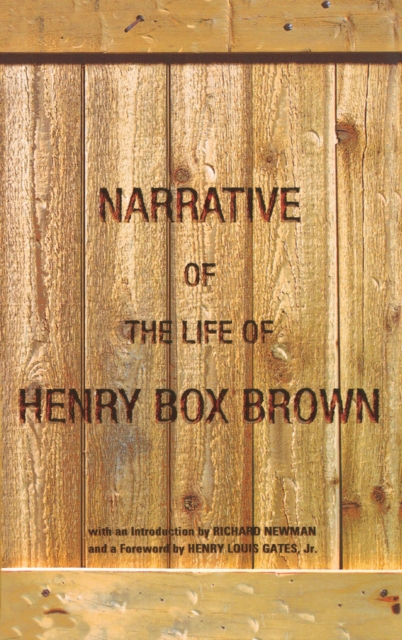
Narrative of the Life of Henry Box Brown
In 1849, Henry Brown escaped from slavery by shipping himself in a crate from Virginia to an anti-slavery office in Philadelphia. Twenty seven hours and three hundred and fifty miles later, Brown stepped out of his box to begin a new life. This is the memoir, originally published in 1851 in England, as fresh and compelling today as it was one hundred and fifty years ago. This extraordinary narrative paints an indelible portrait of life in slavery, and describes one of the most audacious, creative escapes ever completed. With a keen sense of irony, Brown examines the \"peculiar institution\" - from the hypocrisy of slave-owning Christian preachers, to the system of bribery that forced slaves to purchase the rights to their own belongings, to the practice of separating slave families with no warning. Indeed, it was when his own wife and children were sold away that he became determined to escape, and he enlisted the aid of a friend, who nailed him into a three-foot-by-two-foot wooden box. He travelled by railroad car, steamboat and horse cart - to the free state of Pennsylvania. His unprecedented manner of arrival made him a public sensation in the North, and a celebrity on the anti-slavery lecture circuit. With an introduction by Richard Newman and a foreword by Henry Louis Gates, Jr., The Narrative of the Life of Henry \"Box\" Brown conveys the unquenchable spirit of a hero who risked death rather than live a slave. A classic slave narrative, it makes unforgettable reading.
eBook