
Catalogue Search | MBRL


Are you sure you want to remove the book from the shelf?

{{itemTitle}}
64
result(s) for
"Slavery Moral and ethical aspects."
Sort by:

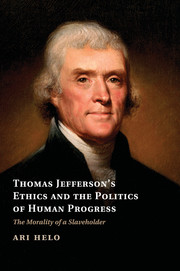
Thomas Jefferson's Ethics and the Politics of Human Progress
Could Jefferson claim any consistency in his advocacy of democracy and the rights of man while remaining one of the largest slaveholders in Virginia? This extensive study of Jefferson's intellectual outlook suggests that, once we fully acknowledge the premises of his ethical thought and his now outdated scientific views, he could. Jefferson famously thought the human mind to be 'susceptible of much improvement … most of all, in matters of government and religion'. Ari Helo's thorough analysis of Jefferson's understanding of Christian morality, atheism, contemporary theories of moral sentiments, ancient virtue ethics, natural rights, and the principles of justice and benevolence suggests that Jefferson refused to be a philosopher, and did so for moral reasons. This book finds Jefferson profoundly political in his understanding of individual moral responsibility and human progress.
eBook


Polemical pain : slavery, cruelty, and the rise of humanitarianism
In 2008 and 2009, the United States Congress apologized for the \"fundamental injustice, cruelty, brutality, and inhumanity of slavery.\" Today no one denies the cruelty of slavery, but few issues inspired more controversy in the eighteenth and nineteenth centuries. Abolitionists denounced the inhumanity of slavery, while proslavery activists proclaimed it both just and humane. Margaret Abruzzo delves deeply into the slavery debate to better understand the nature and development of humanitarianism and how the slavery issue helped shape modern concepts of human responsibility for the suffering of others. Abruzzo first traces the slow, indirect growth in the eighteenth century of moral objections to slavery's cruelty, which took root in awareness of the moral danger of inflicting unnecessary pain. Rather than accept pain as inescapable, as had earlier generations, people fought to ease, discredit, and abolish it. Within a century, this new humanitarian sensibility had made immoral the wanton infliction of pain. Abruzzo next examines how this modern understanding of humanity and pain played out in the slavery debate. Drawing on shared moral-philosophical concepts, particularly sympathy and benevolence, pro- and antislavery writers voiced starkly opposing views of humaneness. Both sides constructed their moral identities by demonstrating their own humanity and criticizing the other's insensitivity. Understanding this contest over the meaning of humanity—and its ability to serve varied, even contradictory purposes—illuminates the role of pain in morality. Polemical Pain shows how the debate over slavery's cruelty played a large, unrecognized role in shaping moral categories that remain pertinent today.
eBook


Lincoln's tragic pragmatism : Lincoln, Douglas, and moral conflict
A New York Times Book Review Editors' Choice In 1858, challenger Abraham Lincoln debated incumbent Stephen Douglas seven times in the race for a U.S. Senate seat from Illinois. More was at stake than slavery in those debates. In Lincoln's Tragic Pragmatism, John Burt contends that the very legitimacy of democratic governance was on the line. In a United States stubbornly divided over ethical issues, the overarching question posed by the Lincoln-Douglas debates has not lost its urgency: Can a liberal political system be used to mediate moral disputes? And if it cannot, is violence inevitable? \"John Burt has written a work that every serious student of Lincoln will have to read...Burt refracts Lincoln through the philosophy of Kant, Rawls and contemporary liberal political theory. His is very much a Lincoln for our time.\" —Steven B. Smith, New York Times Book Review \"I'm making space on my overstuffed shelves for Lincoln's Tragic Pragmatism. This is a book I expect to be picking up and thumbing through for years to come.\" —Jim Cullen, History News Network \"Burt treats the [Lincoln-Douglas] debates as being far more significant than an election contest between two candidates. The debates represent profound statements of political philosophy and speak to the continuing challenges the U.S. faces in resolving divisive moral conflicts.\" —E. C. Sands, Choice
eBook

Enslaved Archives
Explores the relationship between the production of enslaved property and the production of the past in the antebellum United States.It is extraordinarily difficult for historians to reconstruct the lives of individual enslaved people. Records—where they exist—are often fragmentary, biased, or untrue. In Enslaved Archives, Maria R. Montalvo investigates the legal records, including contracts and court records, that American antebellum enslavers produced and preserved to illuminate enslavers' capitalistic motivations for shaping the histories of enslaved people. The documentary archive was not simply a by-product of the business of slavery, but also a necessary tool that enslavers used to exploit the people they enslaved. Building on Montalvo's analysis of more than 18,000 sets of court records, Enslaved Archives is a close study of what we can and cannot learn about enslaved individuals from the written record. By examining five lawsuits in Louisiana, Montalvo deconstructs enslavers' cases—the legal arguments and rhetorical strategies they used to produce information and shape perceptions of enslaved people. Commodifying enslaved people was not simply a matter of effectively exploiting their labor. Enslavers also needed to control information about those people. Enslavers' narratives—carefully manipulated, prone to omissions, and sometimes false—often survive as the only account of an enslaved individual's life. In working to historicize the people at the center of enslavers' manipulations, Montalvo outlines the possibilities and limits of the archive, providing a glimpse of the historical and contemporary consequences of commodification. Enslaved Archives makes a significant intervention in the history of enslaved people, legal history, and the history of slavery and capitalism by adding a qualitative dimension to the analysis of how enslavers created and maintained power.
eBook


The Civil War as a theological crisis
Viewing the Civil War as a major turning point in American religious thought, Mark A. Noll examines writings about slavery and race from Americans both white and black, northern and southern, and includes commentary from Protestants and Catholics in Europe and Canada. Though the Christians on all sides agreed that the Bible was authoritative, their interpretations of slavery in Scripture led to a full-blown theological crisis.
eBook