
Catalogue Search | MBRL


Are you sure you want to remove the book from the shelf?

{{itemTitle}}
23
result(s) for
"Sleep disorders Popular works."
Sort by:


The Politics of Happiness
During the past forty years, thousands of studies have been carried out on the subject of happiness. Some have explored the levels of happiness or dissatisfaction associated with typical daily activities, such as working, seeing friends, or doing household chores. Others have tried to determine the extent to which income, family, religion, and other factors are associated with the satisfaction people feel about their lives. The Gallup organization has begun conducting global surveys of happiness, and several countries are considering publishing periodic reports on the growth or decline of happiness among their people. One nation, tiny Bhutan, has actually made \"Gross National Happiness\" the central aim of its domestic policy. How might happiness research affect government policy in the United States--and beyond? In The Politics of Happiness, former Harvard president Derek Bok examines how governments could use the rapidly growing research data on what makes people happy--in a variety of policy areas to increase well-being and improve the quality of life for all their citizens.
eBook

Snooze : the lost art of sleep
\"A profound exploration of the precious resource of sleep and of the causes and consequences of getting too little of it.\"-- Dust jacket.
Book

Overcoming Insomnia
This treatment program uses cognitive-behavioral therapy methods to correct those poor sleep habits. CBT has been proven in multiple studies to improve sleep hygiene by reducing time spent in bed before sleep onset, reducing time spent awake after first sleep onset, and increasing the quality and efficiency of sleep. Developed by the authors, this evidence based treatment can be used for both primary and secondary insomnia sufferers. Patients are first given information about healthy sleep and the reasons for improving sleep habits, then a behavioral program is developed to address that patient's specific sleep problems. Use of sleep logs, assessment forms, and other homework (all provided in the corresponding workbook) allows client and therapist to work together to develop an effective sleep regimen tailored specifically for each client. Finally, several sessions are dedicated to increasing compliance and problem-solving.
eBook

Mindfulness for insomnia : a four-week guided program to relax your body, calm your mind, and get the sleep you need
The authors present their professional insights and techniques for resolving insomnia by employing the Guided Mindfulness with Acceptance Treatment for Insomnia (or GMATI) program.
Book

Overcoming Insomnia
It is estimated that one in ten U.S. adults suffers from chronic insomnia. If left untreated, chronic insomnia reduces quality of life and increases risk for psychiatric and medical disease, especially depression and anxiety. There are two forms of insomnia: secondary insomnia, in which it is comorbid with another condition such as psychiatric disorders, chronic pain conditions, or cardiopulmonary disorders, and primary insomnia, which does not coexist with any other disorder, Though insomnia may be caused by any number of things, it is primarily sustained by the development of poor sleep habits (such as varying sleep-wake schedule, daytime napping, and spending excessive time in bed) as an attempt to manage the problem. This treatment program uses cognitive-behavioral therapy methods to correct those poor sleep habits. CBT has been proven in multiple studies to improve sleep hygiene by reducing time spent in bed before sleep onset, reducing time spent awake after first sleep onset, and increasing the quality and efficiency of sleep. Developed by the authors, this evidence based treatment can be used for both primary and secondary insomnia sufferers. Patients are first given information about healthy sleep and the reasons for improving sleep habits, then a behavioral program is developed to address that patient's specific sleep problems. Use of sleep logs, assessment forms, and other homework (all provided in the corresponding workbook) allows client and therapist to work together to develop an effective sleep regimen tailored specifically for each client. Finally, several sessions are dedicated to increasing compliance and problem-solving.
eBook

Change your schedule, change your life : how to harness the power of clock genes to lose weight, optimize your workout, and finally get a good night's sleep
\"An eye-opening handbook from a leading Ayurvedic physician that blends cutting-edge science on \"clock genes\" with ancient eastern wisdom to help us understand how to harness the power of chronobiology to effortlessly lose weight, sleep better, exercise stronger, reduce stress, and boost our well being. \"It's not you, it's your schedule.\" Does it sound like magic? It's not. We've all heard of circadian rhythms--those biological processes that give us jet lag and make us night owls or early birds. But few of us know just how profoundly these diurnal patterns affect our overall health. Bad habits like skipping meals, squeezing in workouts when it's convenient, working late into the night to maximize productivity and then trying to \"catch up\" on sleep during the weekend disrupt our natural cycles. A growing body of research on chronobiology reveals just how sensitive the human body is to these rhythms all the way down to the genetic level. Our \"clock genes\" control more than we realize, and small changes can make the difference between battling our bodies, and effortlessly managing weight, sleep, stress, inflammation, and more. Marrying ancient Ayurvedic wisdom with the latest scientific research, Dr. Suhas Kshirsagar's holistic step-by-step 30-day plan gives you the tools--and the schedule--you need to transform your life. With diagnostic quizzes to determine your specific mind-body type, you will learn to adapt you schedule for effortless wellness for life\"-- Provided by publisher.
Book
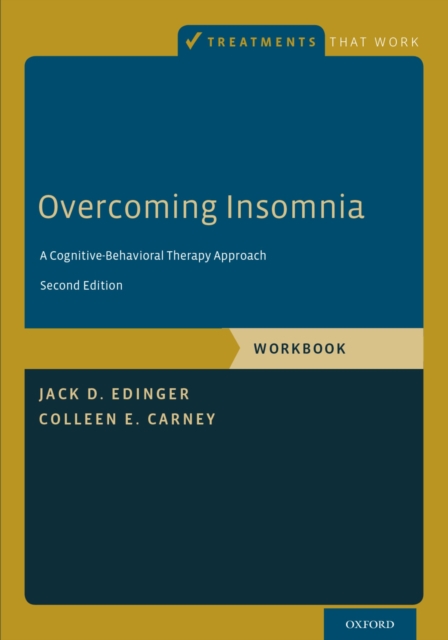
Overcoming Insomnia
It is estimated that one in ten U.S. adults suffers from chronic insomnia. If left untreated, chronic insomnia reduces quality of life and increases risk for psychiatric and medical disease, especially depression and anxiety. The Overcoming Insomnia treatment program uses evidence-based cognitive-behavioral therapy (CBT) methods to correct poor sleep habits. CBT has been proven in multiple studies to improve sleep by reducing time spent in bed before sleep onset, reducing time spent awake after first sleep onset, and increasing the quality and efficiency of sleep. This second edition has been thoroughly updated by the program developers, Jack D. Edinger and Colleen E. Carney. Patients use the Workbook in conjunction with the treatment they receive from their therapist. Patients will receive information about healthy sleep and the reasons for improving sleep habits, and the therapist will develop a program to address that patient's specific sleep problems. Use of a sleep diary, assessment forms, and other homework (all provided in the Workbook) allows patient and therapist to work together to develop an effective sleep regimen tailored specifically for each patient.
eBook
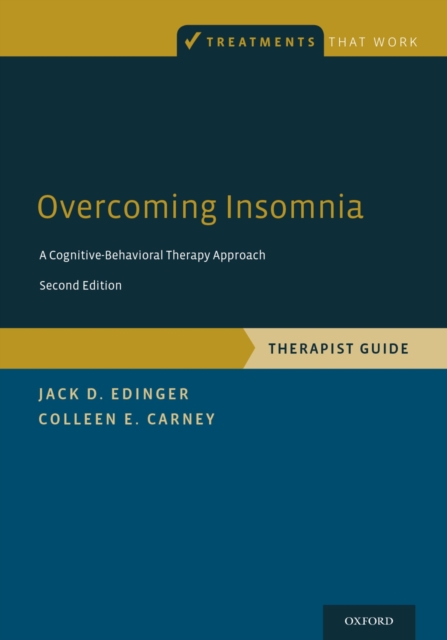
Overcoming Insomnia
It is estimated that one in ten U.S. adults suffers from chronic insomnia. If left untreated, chronic insomnia reduces quality of life and increases risk for psychiatric and medical disease, especially depression and anxiety. The Overcoming Insomnia treatment program uses evidence-based cognitive-behavioral therapy (CBT) methods to correct poor sleep habits. CBT has been proven in multiple studies to improve sleep by reducing time spent in bed before sleep onset, reducing time spent awake after first sleep onset, and increasing the quality and efficiency of sleep. Developed by Jack D. Edinger and Colleen E. Carney, this second edition has been thoroughly updated according to the DSM-5, which now conceptualizes insomnia as a sleep-wake disorder, rather than a sleep disorder only. The DSM-5 has also eliminated the differentiation between primary and secondary insomnias, so this program provides an expanded discussion of daytime related issues as well as delivery issues specific to those with comorbid mental and medical problems. Patients are first given information about healthy sleep and the reasons for improving sleep habits, then a behavioral program is developed to address that patient's specific sleep problems. Use of a sleep diary, assessment forms, and other homework (all provided in the corresponding patient Workbook) allows client and therapist to work together to develop an effective sleep regimen tailored specifically for each client, and several sessions are dedicated to increasing compliance and problem-solving.
eBook