
Catalogue Search | MBRL


Are you sure you want to remove the book from the shelf?

{{itemTitle}}
421
result(s) for
"Slovakia History."
Sort by:


Vanished History
Bohemia and Moravia, today part of the Czech Republic, was the first territory with a majority of non-German speakers occupied by Hitler's Third Reich on the eve of the World War II. Tens of thousands of Jewish inhabitants in the so called Protectorate of Bohemia and Moravia soon felt the tragic consequences of Nazi racial politics. Not all Czechs, however,remained passive bystanders during the genocide. After the destruction of Czechoslovakia in 1938-39, Slovakia became a formally independent but fully subordinate satellite of Germany. Despite the fact it was not occupied until 1944, Slovakia paid Germany to deport its own Jewish citizens to extermination camps.
About 270,000 out of the 360,000 Czech and Slovak casualties of World War II were victims of the Holocaust. Despite these statistics, the Holocaust vanished almost entirely from post-war Czechoslovak, and later Czech and Slovak, historical cultures. The communist dictatorship carried the main responsibility for this disappearance, yet the situation has not changed much since the fall of the communist regime. The main questions of this study are how and why the Holocaust was excluded from the Czech and Slovak history.
eBook

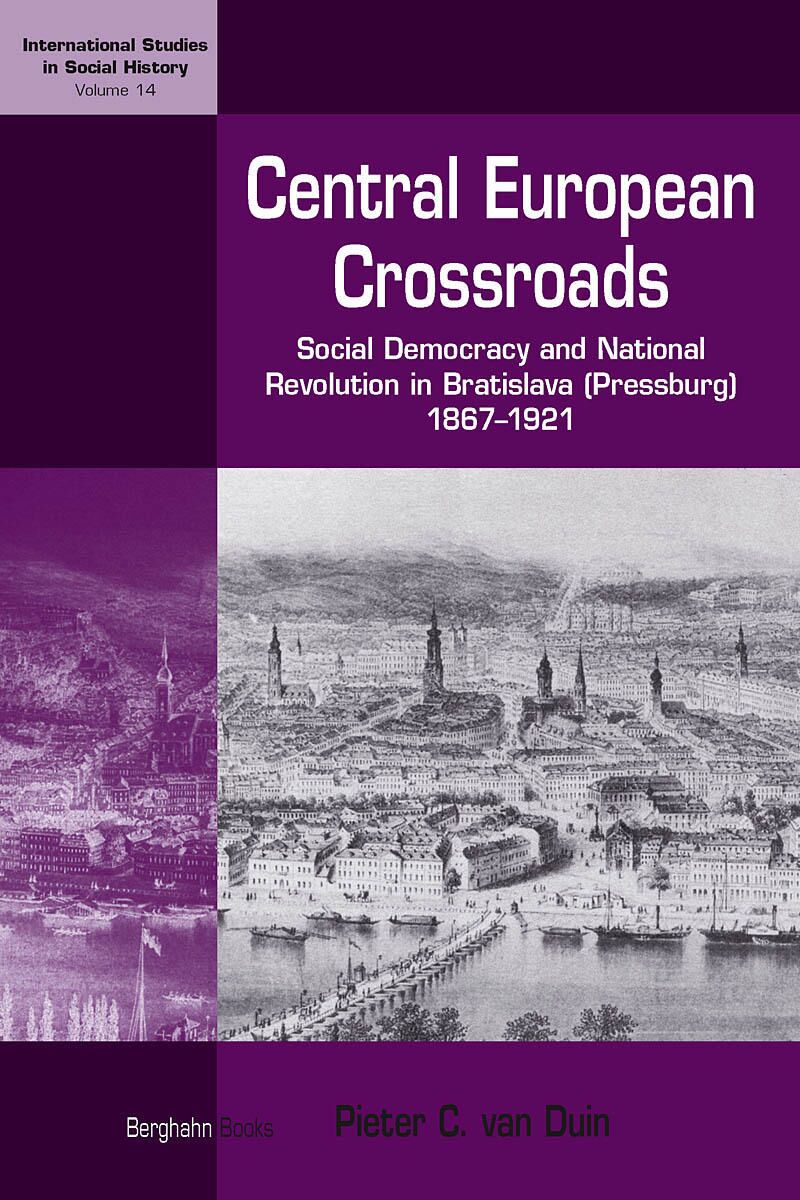
Central European Crossroads
During the four decades of the communist regime in Czechoslovakia a vast literature on working-class movements has been produced but it has hardly any value for today’s scholarship. This remarkable study reopens the field. Based on Czech, Slovak, German and other sources, it focuses on the history of the multi-ethnic social democratic labor movement in Slovakia’s capital Bratislava during the period 1867-1921, and on the process of national revolution during the years 1918–19 in particular. The study places the historic change of the former Pressburg into the modern Bratislava in the broader context of the development of multinational pre-1918 Hungary, the evolution of social, ethnic, and political relations in multi-ethnic Pressburg (a ‘tri-national’ city of Germans, Magyars, and Slovaks), and the development of the multinational labor movement in Hungary and the Habsburg Empire as a whole.
eBook

Vladimâir Dedeécek : interpretations of his architecture : the work of a post war Slovak architect
The work of Vladimâir Dedecek (born 1929) is considered as a prime example of an independent socialist version of the Modern style. His main commissions were prestigious buildings designed and built between the 1960s and 1980s. The most important of these are still being used as originally intended. The monograph consists of three parts -- it explains the method of research and the concept of the book; it analyzes and interprets four buildings as examples: the Boarding School in Modra (1972-1978), the Slovak National Archive (1972-1983), the Supreme Court (1977-1990), and the Slovak National Gallery (1967-1979) and informs about another thirteen key buildings forming the basis of possible interpretations and is followed by the list of works, the bibliography, and the biographical details.
Book

The Slovak Question
The so-called Slovak question asked what place Slovaks held-or
should have held-in the former state of Czechoslovakia. Formed in
1918 at the end of World War I from the remains of the Hungarian
Empire, and reformed after ceasing to exist during World War II,
the country would eventually split into the Czech Republic and
Slovakia after the \"Velvet Divorce\" in 1993. In the meantime, the
minority Slovaks often clashed with the majority Czechs over their
role in the nation. The Slovak Question examines this
debate from a transatlantic perspective. Explored through the
relationship between Slovaks, Americans of Slovak heritage, and
United States and Czechoslovakian policymakers, it shows how Slovak
national activism in America helped the Slovaks establish a sense
of independent identity and national political assertion after
World War I. It also shows how Slovak American leaders influenced
US policy by conceptualizing the United States and Slovakia as
natural allies due to their connections through immigration. This
process played a critical role in undermining attempts to establish
a united Czechoslovakian identity and instead caused a divide
between the two groups, which was exploited by Nazi Germany and
then by other actors during the Cold War, and proved ultimately to
be insurmountable.
eBook


Mapping Jewish Loyalties in Interwar Slovakia
In the aftermath of World War I, the largely Hungarian-speaking Jews in Slovakia faced the challenge of reorienting their political loyalties from defeated Hungary to newly established Czechoslovakia. Rebekah Klein-Pejšová examines the challenges Slovak Jews faced as government officials, demographers, and police investigators continuously tested their loyalty. Focusing on \"Jewish nationality\" as a category of national identity, Klein-Pejšová shows how Jews recast themselves as loyal citizens of Czechoslovakia. Mapping Jewish Loyalties in Interwar Slovakia traces how the interwar state saw and understood minority loyalty and underscores how loyalty preceded identity in the redrawn map of east central Europe.
eBook
