
Catalogue Search | MBRL


Are you sure you want to remove the book from the shelf?

{{itemTitle}}
26,447
result(s) for
"Soap opera"
Sort by:
Entertainment-Education and Social Change
Entertainment-Education and Social Change introduces readers to entertainment-education (E-E) literature from multiple perspectives. This distinctive collection covers the history of entertainment-education, its applications in the United States and throughout the world, the multiple communication theories that bear on E-E, and a range of research methods for studying the effects of E-E interventions. The editors include commentary and insights from prominent E-E theoreticians, practitioners, activists, and researchers, representing a wide range of nationalities and theoretical orientations.
Examples of effective E-E designs and applications, as well as an agenda for future E-E initiatives and campaigns, make this work a useful volume for scholars, educators, and practitioners in entertainment media studies, behavior change communications, public health, psychology, social work, and other arenas concerned with strategies for social change. It will be an invaluable resource book for members of governmental and non-profit agencies, public health and development professionals, and social activists.
Contents: Preface. Part I: History and Theory. A. Singhal, E.M. Rogers, The Status of Entertainment-Education Worldwide. D. Poindexter, A History of Entertainment-Education, 1958-2000. P.T. Poitrow, E. de Fossard, Entertainment-Education as a Public Health Intervention. M. Sabido, The Origins of Entertainment-Education. A. Bandura, Social Cognitive Theory for Personal and Social Change by Enabling Media. W.J. Brown, B.P. Fraser, Celebrity Identification in Entertainment-Education. S. Sood, T. Menard, K. Witte, The Theory Behind Entertainment-Education. Part II: Research and Implementation. S. Usdin, A. Singhal, T. Shongwe, S. Goldstein, A. Shabalala, No Short Cuts in Entertainment-Education: Designing Soul City Step-by-Step. W.N. Ryerson, N. Teffera, Organizing a Comprehensive National Plan for Entertainment-Education in Ethiopia. B.S. Greenberg, C.T. Salmon, D. Patel, V. Beck, G. Cole, Evolution of an E-E Research Agenda. V. Beck, Working With Daytime and Prime-Time Television Shows in the United States to Promote Health. M. Bouman, Entertainment-Education Television Drama in the Netherlands. M.J. Cody, S. Fernandes, H. Wilkin, Entertainment-Education Programs of the BBC and BBC World Service Trust. A.C. La Pastina, D.S. Patel, M. Schiavo, Social Merchandizing in Brazilian Telenovelas. E.M. Rogers, Delivering Entertainment-Education Health Messages Through the Internet to Hard-to-Reach U.S. Audiences in the Southwest. Part III: Entertainment-Education Interventions and Their Outcomes. R.A. Abdulla, Entertainment-Education in the Middle East: Lessons From the Egyptian Oral Rehydration Campaign. Y. Yaser, The Turkish Family Health and Planning Foundation's Entertainment-Education Campaign. N. McKee, M. Aghi, R. Carnegie, N. Shahzadi, Cartoons and Comic Books for Changing Social Norms: Meena, the South Asian Girl. A. Singhal, D. Sharma, M.J. Papa, K. Witte, Air Cover and Ground Mobilization: Integrating Entertainment-Education Broadcasts With Community Listening and Service Delivery in India. A. Singhal, Entertainment-Education Through Participatory Theater: Freirean Strategies for Empowering the Oppressed. T. Tufte, Soap Operas and Sense-Making: Mediations and Audience Ethnography. J.D. Storey, T.L. Jacobson, Entertainment-Education and Participation: Applying Habermas to a Population Program in Nepal. Epilogue.
eBook
Argentinian Telenovelas
This work explores the way in which telenovelas (TV serial dramas) give voice to contemporary and historical Argentinian social and political issues. Telenovelas have multiple layers of socio-cultural message -- local as well as global -- and are invariably laden with appealing drama and emotion, and sometimes comedy. The discussion focuses on how telenovelas reflect society's perception of, and adjustment toward, issues of globalisation. They are a means of portraying how individuals and families rationalize and incorporate rapid social and economic changes. The book explores how telenovelas might offer a subversive interpretation of reality; or provide a channel of dialogue with the government's political aims. The author challenges the assumption that they are merely a reflection of historical, political and social circumstance. One of the many telenovela examples addressed in this book is whether the serial Padre Coraje constructs a parallel between the current Kirchner government and that of Juan Peron, fifty years earlier. The serial explores the two leaders' relationship with the Church and implicitly presents President Kirchner as Peron's successor. Explaining telenovelas as cultural texts (they are not soap operas) provides the primary basis for this study, backed by Argentinian newspaper articles and secondary sources on Latin American history, culture and economy, as well as TV and cinema studies. The result is a more profound and nuanced interpretation than hitherto of Argentinian telenovelas. Analysis enables identification of the links between the serials' storylines and contemporary political and social events. These popular culture texts bring new meaning to the Argentinian historical narrative, and for TV viewers puts the processes and effects of economic and social globalisation on a local multi-cultural level perspective.
eBook

Farmers’ proclivity to use soap opera for sourcing agricultural information in Southwest Nigeria
Given the soap opera’s potential to engender behaviour learning and meet the information needs of farmers, this paper sought to establish farmers’ propensity to use soap opera for sourcing agricultural information in Southwest Nigeria. A multi-stage sampling procedure was used to draw representative samples (150 farmers) in this study. Using interview schedule, data were elicited on farmers’ personal characteristics, awareness about the use of soap opera, perceived benefits of soap opera and proclivity to use it for sourcing agricultural information. Data were analysed using descriptive (frequencies, percentages, means) and inferential (Chi-square and PPMC) statistics at
= 0.05. Farmers’ age, years of schooling and household size were 52.1 ± 11.4 years, 10.5 ± 4.6 years and 5.9 ± 2.4 persons, respectively. Majority of the farmers (86.0%) had heard about soap opera and 76.0% heard of different soaps in the last couple of years and more than half (53.3%) had heard of different soaps from both radio and television. However, 90.7% did not know any kind of soap opera that was used to promote agriculture. More than half of the farmers (56.7%) had high inclination for sourcing agricultural information using soap opera. There was a significant correlation between farmers’ perceived benefits (r = 0.36;
= 0.00) and proclivity to use soap opera for sourcing agricultural information. Farmers’ positive proclivity to use soap implies that soap opera strategy has potentials to benefit farmers as a source of agricultural information; therefore, soap opera should be considered as veritable avenue for agricultural information dissemination in Southwest Nigeria.
Journal Article

A New Form of Black Genre Communication
This article demonstrates how the soap opera Personal Problems reveals a crucial yet overlooked moment of Black media production in the late 1970s and early 1980s. Tracing the evolution of the show from radio drama to television program, I illuminate how video technology, generic innovation, and collaborative networks provided the foundation for new representations of Black life. While scholarly accounts typically focus on Hollywood and the LA Rebellion, I argue that the crew’s location shooting animated a critique of New York City’s media-focused urban redevelopment policies while challenging the broader inequities of creative industries. The trajectory of Personal Problems serves as a model for rethinking Black film history.
Journal Article
Brazilian telenovelas and the myth of racial democracy
Brazilian Telenovelas and the Myth of Racial Democracy, by Samantha Nogueira Joyce, examines what happens when a telenovela directly addresses matters of race and racism in contemporary Brazil. This investigation provides a traditional textual analysis of Duas Caras (2007-2008), a watershed telenovela for two main reasons: It was the first of its kind to present audiences with an Afro-Brazilian as the main hero, openly addressing race matters through plot and dialogue. Additionally, for the first time in the history of Brazilian television, the author of Duas Caras kept a web blog where he discussed the public's reactions to the storylines, media discussions pertaining to the characters and plot, and directly engaged with fans and critics of the program. Joyce combines her investigation of Duas Caras with a study of related media in order to demonstrate how the program introduced novel ideas about race and also offered a forum where varying perspectives on race, class, and racial relations in Brazil could be discussed. Brazilian Telenovelas is not a reception study in the traditional sense, it is not a story of entertainment-education in the strict sense, and it is not solely a textual analysis. Instead, Joyce's text is a study of the social milieu that the telenovela (and especially Duas Caras) navigates, one that is a component of a contemporary progressive social movement in Brazil, and one that views the text as being located in social interactions. As such, this book reveals how telenovelas contribute to social change in a way that has not been fully explored in previous scholarship.
eBook
The A to Z of American radio soap operas
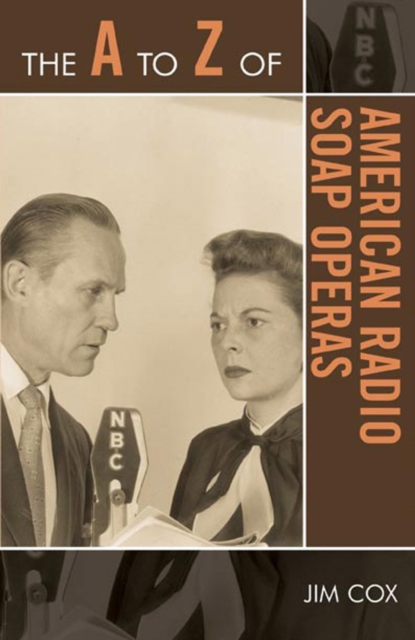
The period from 1925 to 1960 was the heyday of the American Radio Soap Opera. In addition to being part of popular culture, the soap opera had important commercial aspects as well that were not only related to their production, but also to the desperate need to sell products or perish. Both sides of this story are traced in this comprehensive compendium. The dictionary section, made up of more than 500 cross-referenced entries, provides brief vignettes of the more popular and also less well-known \"soaps,\" among them Back Stage Wife, Our Gal Sunday, Pepper Young's Family and The Guiding Light. Other entries evoke those who brought these programs to life: the actors, announcers, scriptwriters, networks, and even the sponsors. Nor are the basic themes, the stock characters and the gimmick, forgotten. The book's introduction defines the soap opera, examines the span of the radio serial, reviews its origins and its demise, and focuses on the character types that made up its denizens. The chronology outlines the period and the bibliography offers further reading. Together, these elements make a comprehensive reference work that researchers will find invaluable long into the future.
eBook

The great radio soap operas
This reference work contains exhaustive histories of 31 of network radio's most durable soap operas on the air between 1930 and 1960.The soap operas covered are Aunt Jenny's Real Life Stories, Backstage Wife, Big Sister, The Brighter Day, David Harum, Front Page Farrell, The Guiding Light, Hilltop House, Just Plain Bill, Life Can Be Beautiful.
eBook
Television Serials as Career Stepping Stones: An Empirical Analysis of Employment Paths of Professional Actors
Guided by cultural labor economics, the paper analyzes the career paths of former actors from popular television soap operas, and addresses in particular, if and under which conditions such serial engagements may function as a stepping stone for a subsequent professional acting career. A novel database of 396 German artists with detailed and long-term biographical information is used for the quantitative empirical analyses. The results indicate that soaps, contrary to popular opinion, function as a stepping stone, especially for younger actors. However, soap engagements should be rather short but long enough to allow artists to play multiple roles in other shows or films besides being in the cast of a soap. While formal acting education does not influence soap actors’ future filmographies, there is evidence that it helps artists to find jobs in arts-related occupations such as voice acting. Finally, publicity and media presence foster a later acting career. Practical implications for artists and their managers are outlined, along with a discussion on the meaning of serials for the creation and commercialization of stars.
Journal Article

Addictive Behaviour among Women Viewers of Indian Soap Opera
Media is an integral part of society and it plays vital role for inculcating information. In the course of accomplishing its duties and functions, media, especially television influence on society relatively depending on the audience it reaches. Soaps have a predominant female audience. Some soaps do include men viewers but some social researchers pointed, women are considering most peculiar viewers. They are emotionally attached and value particular soaps in their personal and domestic life. Today people are leading a fast life. People should have some kind of recreation in their get relation of their physical and psychological balances of life. So, different people have different activities to spend their leisure. Based on the present study, most of the women are getting involved with the soap opera and were emotionally attached and curiously waiting for next episodes as it is effecting social, family and occupational life. So the present study tried to come out with fact of effects of soap operas’ on women’s behaviour in the aspects of socio- cultural aspects, economic aspects, psychological aspects, physiological aspects and functional aspects.
Journal Article

Making sense of 'whiteman kontri' using transnational soap operas
This article situates transnational soap operas as a popular site through which some Bamenda market women in Cameroon learn and imagine other forms of transnational modernity which contrasts with local lived patterns. The ways in which some of the Bamenda market women imagine 'whiteman kontri' instigates a desire to travel, arguably acting as screen adverts for the countries imagined, turning some of the women into screen tourists, and reveals some of the participants' desire for migrancy. The argument within this article is that transnational texts provide a sense of modernity to its viewers, particularly to the Bamenda market women who use transnational soap operas to emulate modern practices and engineer local change. The process of dreaming about spaces never visited through the consumption of film texts and the women's attempts to change local practices is referred to here as symbolic distancing. In this instance, symbolic distancing involves viewers' creative and imaginative processes, which enable them to fearlessly relocate from their immediate locality to a distant realm without the constraints of immigration rules and regulations, allowing them the freedom of thoughts, which they use to map a paradise of the places they witness in soap operas. Qualitative research methods were employed to collect data on the different meanings some Bamenda market women make out of their consumption of transnational soap operas.
Journal Article