
Catalogue Search | MBRL


Are you sure you want to remove the book from the shelf?

{{itemTitle}}
458,096
result(s) for
"Social Sciences - methods"
Sort by:


Applying the Rasch Model
Recognised as the most influential publication in the field, ARM facilitates deep understanding of the Rasch model and its practical applications. The authors review the crucial properties of the model and demonstrate its use with examples across the human sciences. Readers will be able to understand and critically evaluate Rasch measurement research, perform their own Rasch analyses and interpret their results. The glossary and illustrations support that understanding, and the accessible approach means that it is ideal for readers without a mathematical background.
Intended as a text for graduate courses in measurement, item response theory, (advanced) research methods or quantitative analysis taught in psychology, education, human development, business and other social and health sciences. Professionals in these areas will also appreciate the book’s accessible introduction.
Highlights of the new edition include:
More learning tools to strengthen readers’ understanding including chapter introductions, boldfaced key terms, chapter summaries, activities and suggested readings.
Greater emphasis on the use of R packages; readers can download the R code from the Routledge website.
Explores the distinction between numerical values, quantity and units, to understand the measurement and the role of the Rasch logit scale (Chapter 4).
A new four-option data set from the IASQ (Instrumental Attitude toward Self-assessment Questionnaire) for the Rating Scale Model (RSM) analysis exemplar (Chapter 6).
Clarifies the relationship between Rasch measurement, path analysis and SEM, with a host of new examples of Rasch measurement applied across health sciences, education and psychology (Chapter 10).
eBook


Structural Equation Modeling with Mplus
[This book] reviews the basic concepts and applications of SEM using Mplus Version 6. ... The first two chapters introduce the fundamental concepts of SEM and important basics of the Mplus program. The remaining chapters focus on SEM applications and include a variety of SEM models presented within the context of three sections: Single-group analyses, Multiple-group analyses, and other important topics, the latter of which includes the multitrait-multimethod, latent growth curve, and multilevel models. (DIPF/Orig.).
eBook


Researching Life Stories
Researching Life Stories critically and pragmatically reflects upon the use of life stories in social and educational research. Using four life stories as examples, the authors apply four different, practical approaches to demonstrate effective research and analysis. As well as examining in detail the four life stories around which the book is written, areas covered include: * Method and methodology in life story research * Analysis * Reflections on analyses * Craft and ethics in researching life * Policy, practice and theory in life story research. Throughout the book the authors demystify the issues surrounding life story research and demonstrate the significance of this approach to understanding individual and social worlds. This unique approach to life story research will be a valuable resource for all social science and education researchers at undergraduate and postgraduate level.
Dan Goodley, Peter Clough and Michelle Moore are all based at the Inclusive Education and Equality Research Centre at the University of Sheffield's School of Education. Rebecca Lawthorn is Senior Lecturer in Psychology at Manchester Metropolitan University.
eBook

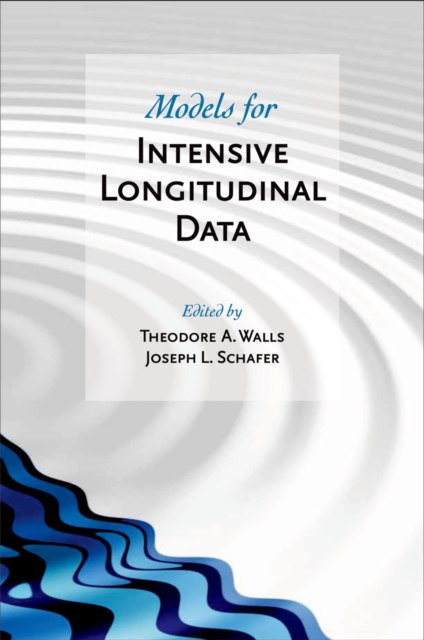
Models for intensive longitudinal data
Rapid technological advances in devices used for data collection have led to the emergence of a new class of longitudinal data: intensive longitudinal data (ILD). Behavioral scientific studies now frequently utilize handheld computers, beepers, web interfaces, and other technological tools for collecting many more data points over time than previously possible. Other protocols, such as those used in fMRI and monitoring of public safety, also produce ILD, hence the statistical models in this volume are applicable to a range of data. The volume features state-of-the-art statistical modeling strategies developed by leading statisticians and methodologists working on ILD in conjunction with behavioral scientists. Chapters present applications from across the behavioral and health sciences, including coverage of substantive topics such as stress, smoking cessation, alcohol use, traffic patterns, educational performance and intimacy. Models for Intensive Longitudinal Data (MILD) is designed for those who want to learn about advanced statistical models for intensive longitudinal data and for those with an interest in selecting and applying a given model. The chapters highlight issues of general concern in modeling these kinds of data, such as a focus on regulatory systems, issues of curve registration, variable frequency and spacing of measurements, complex multivariate patterns of change, and multiple independent series. The extraordinary breadth of coverage makes this an indispensable reference for principal investigators designing new studies that will introduce ILD, applied statisticians working on related models, and methodologists, graduate students, and applied analysts working in a range of fields. (DIPF/Orig.).
eBook

The comparative method
Charles C. Ragin's The Comparative Method proposes a synthetic strategy, based on an application of Boolean algebra, that combines the strengths of both qualitative and quantitative sociology. Elegantly accessible and germane to the work of all the social sciences, and now updated with a new introduction, this book will continue to garner interest, debate, and praise.
eBook