
Catalogue Search | MBRL


Are you sure you want to remove the book from the shelf?

{{itemTitle}}
1,059
result(s) for
"Social justice Fiction."
Sort by:

Woke baby
\"For all the littlest progressives, waking up to seize a new day of justice and activism. Woke babies are up early. Woke babies raise their fists in the air. Woke babies cry out for justice. Woke babies grow up to change the world. This lyrical and empowering book is both a celebration of what it means to be a baby and what it means to be woke. With bright playful art, Woke Baby is an anthem of hope in a world where the only limit to a skyscrapper is more blue.\"--Publisher's description.
Book
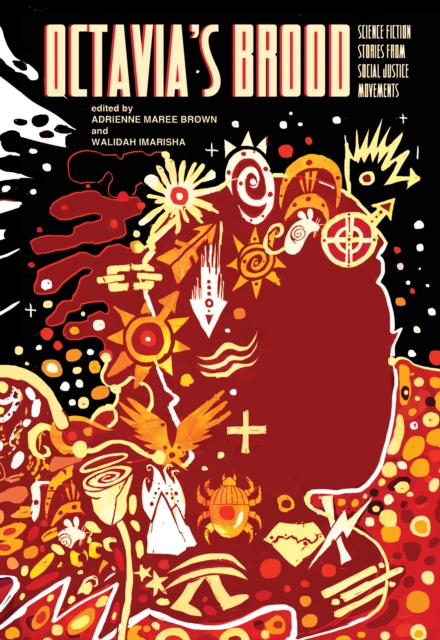
Octavia's brood : science fiction stories from social justice movements
Whenever we envision a world without war, without prisons, without capitalism, we are producing speculative fiction. Organizers and activists envision, and try to create, such worlds all the time. Walidah Imarisha and adrienne maree brown have brought twenty of them together in the first anthology of short stories to explore the connections between radical speculative fiction and movements for social change. The visionary tales of Octavia's Brood span genres—sci-fi, fantasy, horror, magical realism—but all are united by an attempt to inject a healthy dose of imagination and innovation into our political practice and to try on new ways of understanding ourselves, the world around us, and all the selves and worlds that could be. The collection is rounded off with essays by Tananarive Due and Mumia Abu-Jamal, and a preface by Sheree Renée Thomas.
PRAISE FOR OCTAVIA'S BROOD:
\"Those concerned with justice and liberation must always persuade the mass of people that a better world is possible. Our job begins with speculative fictions that fire society's imagination and its desire for change. In adrienne maree brown and Walidah Imarisha's visionary conception, and by its activist-artists' often stunning acts of creative inception, Octavia's Brood makes for great thinking and damn good reading. The rest will be up to us.\" —Jeff Chang, author of Who We Be: The Colorization of America
\"Conventional exclamatory phrases don't come close to capturing the essence of what we have here in Octavia's Brood. One part sacred text, one part social movement manual, one part diary of our future selves telling us, 'It's going to be okay, keep working, keep loving.' Our radical imaginations are under siege and this text is the rescue mission. It is the new cornerstone of every class I teach on inequality, justice, and social change...This is the text we've been waiting for.\" —Ruha Benjamin, professor of African American Studies at Princeton University and author of People's Science: Bodies and Rights on the Stem Cell Frontier
\"Octavia once told me that two things worried her about the future of humanity: The tendency to think hierarchically, and the tendency to place ourselves higher on the hierarchy than others. I think she would be humbled beyond words that the fine, thoughtful writers in this volume have honored her with their hearts and minds. And that in calling for us to consider that hierarchical structure, they are not walking in her shadow, nor standing on her shoulders, but marching at her side.\" —Steven Barnes, author of Lion's Blood
\"Never has one book so thoroughly realized the dream of its namesake. Octavia's Brood is the progeny of two lovers of Octavia Butler and their belief in her dream that science fiction is for everybody... Butler could not wish for better evidence of her touch changing our literary and living landscapes. Play with these children, read these works, and find the children in you waiting to take root under the stars!\" —Moya Bailey and Ayana Jamieson, Octavia E. Butler Legacy
\"Like [Octavia] Butler's fiction, this collection is cartography, a map to freedom.\" —dream hampton, filmmaker and Visiting Artist at Stanford University's Institute for Diversity in the Arts
Walidah Imarisha is a writer, organizer, educator, and spoken word artist. She is the author of the poetry collectionScars/Stars and facilitates writing workshops at schools, community centers, youth detention facilities, and women's prisons.
adrienne maree brown is a 2013 Kresge Literary Arts Fellow writing science fiction in Detroit, Michigan. She received a 2013 Detroit Knight Arts Challenge Award to run a series of Octavia Butler–based writing workshops.
eBook

Love the Earth
Encourages the reader to join in an imaginary journey aboard a magical plane, the White Feather Flier, to help clean the plastic out of the ocean, build a school for girls, and create a sanctuary for gray whales.
Book

Conclusion to this Special Issue: An Autoethnographic Peek into my Catalog
In the conclusion to this special issue, Patricia Leavy considers the different facets of her life and career that led her to social fiction and creative, artistic scholarship. She also shares some of the things she has learned by writing fiction.
Journal Article

Zombie seed and the butterfly blues : a case of social justice
\"Professor Delta Quinn teams with investigative reporter Caleb Barthes to unravel the mystery of the zombie seed, the genetically-modified follow-up to the \"terminator seed.\" This fact-based fiction is an academic novel that relies on fast-paced action as well as theoretical insights. Using the cultural icon of the zombie to address work alienation and contemporary apathy is perfect for the purposes of having the reader examine corporate greed in a global world, The cast of characters brings this global aspect to life. In the backdrop of the novel, a history of the zombie unfolds - a history of violence that Haiti and African diaspora have suffered. Yet, it is Delta's research into narratives of partner abuse that lead her to grapple with her own tragic past and take brave steps toward ending the abuse of others. This social justice book is based on award-winning research in rhetorical ethnography and is being assigned for courses in rhetoric, ethnography, narrative, organizational communication, and diversity, but would fit with others (e.g., ethics, interpersonal, public relations, journalism, sociology, philosophy) where examining the individual's role in the life-world is not only promoted but expected. If the novel doesn't do it, the facts found at the end of the book should \"wake up\" any remaining zombies\"--Page 4 of cover.
Book
Celebrating Dr. Patricia Leavy’s Body of Work: An Introduction to this Special Issue
In this article Laurel Richardson and Melissa Anyiwo detail Patricia Leavy’s contributions to qualitative inquiry. After providing background information, they provide a thematic look at Leavy’s contribution in the areas of innovation and trailblazing, paradigm shifts, border crossing, creativity and artistry, and social justice and humanitarianism. They conclude with remarks about Leavy’s enduring legacy in the field of qualitative research.
Journal Article


The Bubble Metropolis: Manhattan Island Crises in Contemporary Science Fiction
As “the island at the center of the world,” Manhattan has inspired countless writers and has served as a spatial archetype in science fiction’s world-building. From the interdisciplinary perspective of literature and economics, this article discusses the crisis imagination of the “bubble metropolis” in five contemporary Manhattan-related science fiction novels including Cities in Flight (1970), The Blister (1975), Terminal World (2010), Zone One (2011), and New York 2140 (2017). The spatial variety of Manhattan Island in these science fiction novels is closely combined with its economic condition. The characters, plots, and spatial imagery of these novels gather to reflect the different stages of the operation of a bubble economy, illustrating a historical cycle of capitalism that can never be escaped. Manhattan Island has long been the symbol of the world’s rush for wealth. The fear of economic recession, environmental degradation, and class conflict have formed the special geographical features of the island in the future. The crisis imagination of the “bubble metropolis” also seeks to stimulate critical thinking on economic ethics, urban design, and high technology, calling for social justice and public welfare.
Journal Article

Champion : a graphic novel
\"A high school student whose promising basketball career is in jeopardy discovers the triumphs and hardships of Kareem Abdul-Jabbar's life as a social justice advocate\"-- Provided by publisher.
BOOK

Corporate Responses to Community Grievance: Voluntarism and Pathologies of Practice
Grievance landscapes form in rapidly industrialising contexts where social and environmental impacts are inevitable. This paper focuses on the complex operational and organisational settings in which grievances arise and the industrial pathologies that form around resource development projects. The arguments draw on classic and contemporary literature on “grievance”, “right” and “entitlement”, and the authors’ own sustained engagement with global mining companies and local communities. Our contention is that the grievance landscape is far more critical to understanding environmental, human rights, and mining interactions than the managerial systems that companies construct to signal compliance with voluntary international norms. These managerial systems, or operational-level grievance mechanisms, map the procedural contours of how a local grievance would travel once it is made visible to the company. In practice, however, it is fiction, illegibility and invisibility that dominate. Across the pathologies, the common denominator is the corporate propensity to avoid recognising the legitimacy of a local grievance and the source of its cause.
Journal Article