
Catalogue Search | MBRL


Are you sure you want to remove the book from the shelf?

{{itemTitle}}
4
result(s) for
"Social movements Morocco 21st century"
Sort by:
La société contre l'état : mouvements sociaux et stratégie de la rue au Maroc
L'analyse des mouvements sociaux permet d'examiner le processus du changement social et la nature de la relation qui lie l'Etat au citoyen. Après l'explosion des différentes émeutes au Maroc (1981, 1984 et 1990), la conquête pacifique de l'espace public urbain devient subitement un enjeu politique de taille. Depuis, la politique ne se déroule plus seulement dans les sphères conventionnelles. Elle se fait également dans la rue. Face à l'augmentation des mouvements sociaux protestataires, le pouvoir politique hésite, tolère, autorise, dialogue, mais interdit également avec violence des marches et des sit-in non autorisés. En 2005, les actions collectives des différents mouvements sociaux dans l'espace public (sit-in, manifestation, marche, etc.) se sont traduites en 700 protestations, soit une moyenne de deux sit-in par jour. Ce chiffre passe de 5.000 actions en 2008 à 6.438 en 2009 pour atteindre 8.600 en 2010 et plus de 18.000 actuellement, soit 50 protestations collectives par jour. Sous le gouvernement mené par le PJD, le nombre de protestations a été multiplié par 26 par rapport à l'année 2005. -- Publisher description.
Book
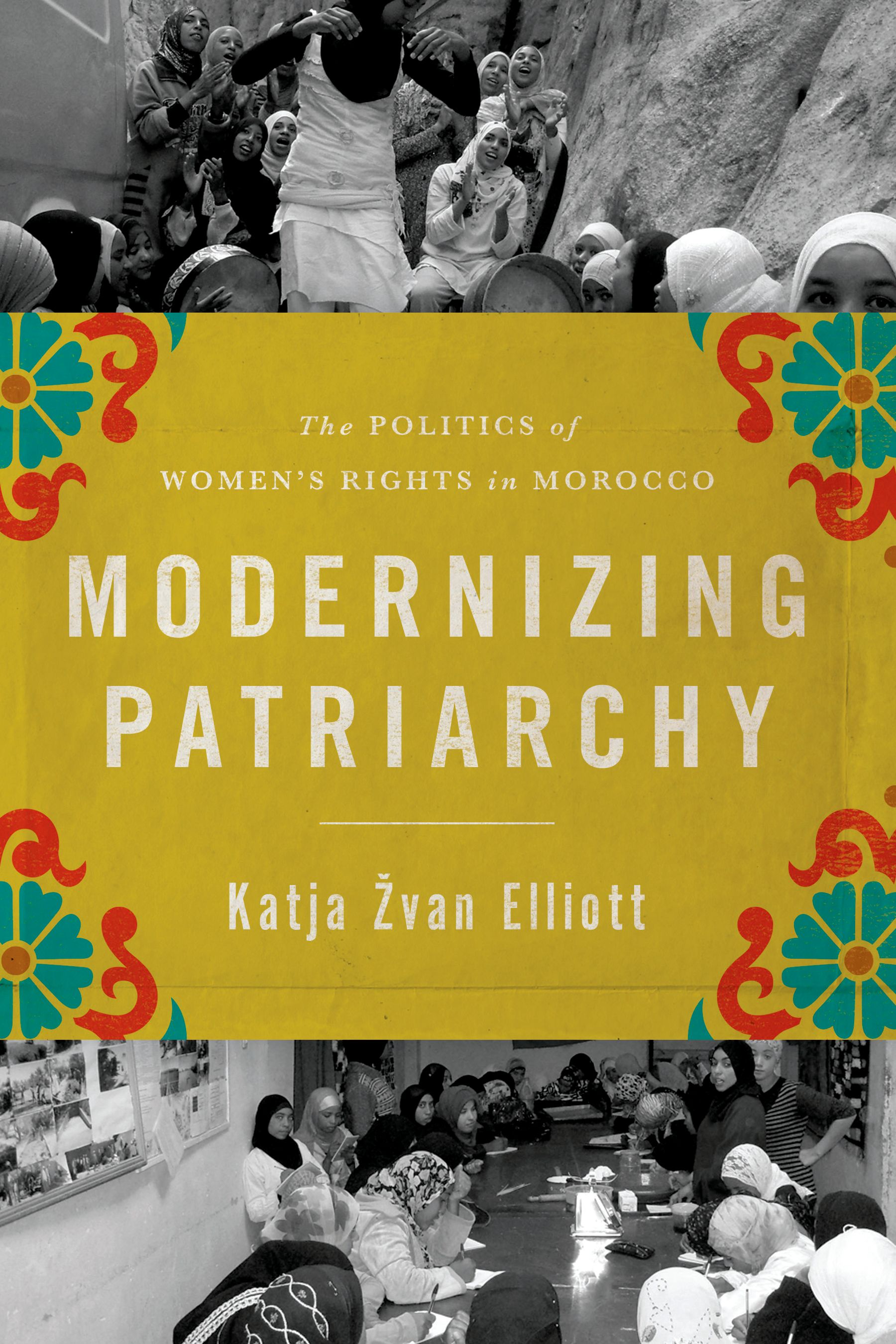
Modernizing Patriarchy
Morocco is hailed by academics, international NGO workers, and the media as a trailblazer in women’s rights and legal reforms. The country is considered a model for other countries in the Middle East and North African region, but has Morocco made as much progress as experts and government officials claim? In Modernizing Patriarchy, Katja Žvan Elliott examines why women’s rights advances are lauded in Morocco in theory but are often not recognized in reality, despite the efforts of both Islamist and secular feminists. In Morocco, female literacy rates remain among the lowest in the region; many women are victims of gender-based violence despite legal reforms; and girls as young as twelve are still engaged to adult men, despite numerous reforms. Based on extensive ethnographic research and fieldwork in Oued al-Ouliya, Modernizing Patriarchy offers a window into the life of Moroccan Muslim women who, though often young and educated, find it difficult to lead a dignified life in a country where they are expected to have only one destiny: that of wife and mother. Žvan Elliott exposes their struggles with modernity and the legal reforms that are supposedly ameliorating their lives. In a balanced approach, she also presents male voices and their reasons for criticizing the prevailing women’s rights discourse. Compelling and insightful, Modernizing Patriarchy exposes the rarely talked about reality of Morocco’s approach toward reform.
eBook
Errances critiques
La différence entre un livre programmé patiemment dès le départ, et un autre, comme celui-ci, construit à rebours, est que le premier exige de toi une forme dʹintrospection sur ce que tu as envie de dire, sur le coup, alors que le second tʹoblige à de la rétrospection. Quʹai-je pu écrire ou juste griffonner, qui mérite dʹêtre revu, réuni, faisant effet dʹunité, quoique construit à partir de bouts épars? Réponse: ces huit textes dialoguant, se croisant et parfois se complétant, autour du triptyque: art, liberté et politique. -- Publisher description.
Book

Civil Society and Democratization in the Arab World
The transition paradigm has traditionally viewed civil society activism as an essential condition for the establishment of democracy. The democracy promotion strategies of Western policy-makers have, therefore, been based on strengthening civil society in authoritarian settings in order to support the development of social capital -to challenge undemocratic regimes.
This book questions the validity of the link between an active associational life and democratization. It examines civil society in the Arab world in order to illustrate how authoritarian constraints structure civil society dynamics in the region in ways that hinder transition to democracy. Building on innovative theoretical work and drawing on empirical data from extensive fieldwork in the region, this study demonstrates how the activism of civil society in five different Arab countries strengthens rather than weakens authoritarian practices and rule. Through an analysis of the specific legal and political constraints on associational life, and the impact of these on relations between different civic groups, and between associations and state authorities, the book demonstrates that the claim that civil society plays a positive role in processes of democratic transformation is highly questionable.
Offering a broad and alternative vision of the state of civil society in the region, this book will be an important contribution to studies on Middle Eastern politics, democratization and civil society activism.
Francesco Cavatorta is Senior Lecturer in International Relations and Middle East Politics at the School of Law and Government, Dublin City University. His research interests lie in processes of democratisation in the Arab world, the political role of Islamist movements and civil society activism. He has published his research in a number of journals and has previously authored a book on failed transition in Algeria.
Vincent Durac is a Lecturer in Middle East Politics and Politics of Development in the School of Politics and International Relations, University College Dublin. He is interested in political reform, the role of civil society and the impact of external actors on the Middle East He is also a visiting lecturer in Middle East Politics at Bethlehem University in Palestine.
Introduction 1. Civil Society in the Arab world 2. Associational Life under Authoritarian Constraints 3. Algeria 4. Morocco 5. Jordan 6. Yemen 7. Lebanon 8. The Dynamics of Civic Activism in the Arab World
\"Cavatorta and Durac have produced an interesting study that re-examines the assumed connection between an active civil society and democratization... their argument is worthy of consideration by scholars and students of Middle East and North African politics, Islamist socio-political movements, and comparative politics.\" - Christopher Anzalone, Institute of Islamic Studies, McGill University; Journal of Islamic Studies, vol 23, no 1, January 2012
eBook