
Catalogue Search | MBRL


Are you sure you want to remove the book from the shelf?

{{itemTitle}}
23
result(s) for
"Social prediction Humor."
Sort by:

The future and why we should avoid it : killer robots, the apocalypse and other topics of mild concern
\"The future holds many unknowns: advances in medical technology, increased airport security and critical new inventions like sentient, polygraph-enabled, wireless toasters. Luckily, Maclean's columnist Scott Feschuk has written a survival guide--part how-to manual, part product guide, part apocalypse analysis and part sardonic observation--to help us navigate these troubled times. Or at least make us laugh while we try. The Future and Why We Should Avoid It envisions the daunting, depressing era we have to look forward to with the best of Feschuk's musings on aging, death, technology, inventions, health and leisure. Combining quizzes, voiceovers and speeches, and employing snark, innuendo, toilet humor and shameless mockery--because how else do you cope with the fact that one day you will die?--Feschuk contemplates the fate of humanity and the planet in the upcoming years, poking fun, provoking thought and dredging up silver linings in even the darkest forecasts\"--From publisher.
Book

Autism as a disorder of prediction
A rich collection of empirical findings accumulated over the past three decades attests to the diversity of traits that constitute the autism phenotypes. It is unclear whether subsets of these traits share any underlying causality. This lack of a cohesive conceptualization of the disorder has complicated the search for broadly effective therapies, diagnostic markers, and neural/genetic correlates. In this paper, we describe how theoretical considerations and a review of empirical data lead to the hypothesis that some salient aspects of the autism phenotype may be manifestations of an underlying impairment in predictive abilities. With compromised prediction skills, an individual with autism inhabits a seemingly “magical” world wherein events occur unexpectedly and without cause. Immersion in such a capricious environment can prove overwhelming and compromise one’s ability to effectively interact with it. If validated, this hypothesis has the potential of providing unifying insights into multiple aspects of autism, with attendant benefits for improving diagnosis and therapy.
Significance Autism is characterized by diverse behavioral traits. Guided by theoretical considerations and empirical data, this paper develops the hypothesis that many of autism's salient traits may be manifestations of an underlying impairment in predictive abilities. This impairment renders an otherwise orderly world to be experienced as a capriciously “magical” one. The hypothesis elucidates the information-processing roots of autism and, thereby, can aid the identification of neural structures likely to be differentially affected. Behavioral and neural measures of prediction might serve as early assays of predictive abilities in infants, and serve as useful tools in intervention design and in monitoring their effectiveness. The hypothesis also points to avenues for further research to determine molecular and circuit-level causal underpinnings of predictive impairments.
Journal Article

Dank or not? Analyzing and predicting the popularity of memes on Reddit
Internet memes have become an increasingly pervasive form of contemporary social communication that attracted a lot of research interest recently. In this paper, we analyze the data of 129,326 memes collected from Reddit in the middle of March, 2020, when the most serious coronavirus restrictions were being introduced around the world. This article not only provides a looking glass into the thoughts of Internet users during the COVID-19 pandemic but we also perform a content-based predictive analysis of what makes a meme go viral. Using machine learning methods, we also study what incremental predictive power image related attributes have over textual attributes on meme popularity. We find that the success of a meme can be predicted based on its content alone moderately well, our best performing machine learning model predicts viral memes with AUC=0.68. We also find that both image related and textual attributes have significant incremental predictive power over each other.
Journal Article

Eliciting Engagement in the High School Classroom: A Mixed-Methods Examination of Teaching Practices
This case study analyzes how and why student engagement differs across 581 classes in one diverse high school. Factor analyses of surveys with 1,132 students suggest three types of engaging teaching practices—connective instruction, academic rigor, and lively teaching. Multilevel regression analyses reveal that connective instruction predicts engagement more than seven times as strongly as academic rigor or lively teaching. Embedded case studies of five classes use interviews and observations to examine how various classes combine connective instruction, academic rigor, and lively teaching and how these practices individually and collectively engage students. Across these analyses, this study introduces a typology for thinking systematically about teaching for engagement.
Journal Article

“Wonderful! We’ve just missed the bus.” – Parental use of irony and children’s irony comprehension
Irony is one of the linguistic means in which intended and expressed meaning diverge. It serves social-communicative functions, requires the understanding of the speaker's mental state and its comprehension takes place at an advanced stage of language acquisition. In the present study, we investigated 8-year old's irony comprehension and social skills and asked their parents about their preferred use of irony towards their children. We then compared children with the highest scores in irony comprehension test with those with lower scores. The full sample included 46 families from Poland. Results show positive associations between children's levels of irony comprehension and levels of mothers irony use. No such relations were found for fathers. No differences were found in ToM scores between proficient and non-proficient irony comprehenders. Our findings provide a base for future studies to study the use of irony in child-parent talk in more diverse culturally and linguistically diverse populations.
Journal Article

From E-Democracy to C-Democracy: Analyzing Transnational Political Discourse During South Korea’s 2024 Presidential Impeachment on Polymarket
This study examines the emergence of cryptocurrency-enabled democracy (c-democracy) through an analysis of blockchain-based prediction markets during South Korea’s 2024 presidential impeachment crisis. Using a mixed-methods approach, namely network analysis, discourse analysis, and statistical validation, we identify transnational communities engaging in Korean politics beyond citizenship boundaries. Findings reveal a discourse–betting disconnect, where expressive, playful discourse coexists with serious financial stakes, reflecting hybrid motivations for participation. We also observe playful activism and transnational community formation that transcend geographical limits. These results highlight c-democracy as a novel form of political engagement that extends, but also complicates, traditional e-democracy frameworks.
Journal Article

A Pompous Snack: On the Unreasonable Complexity of the World's Third-Worst Jokes
Although studies of humour are as old as the Western academic tradition, most theories are too vague to allow for modelling and prediction of humour judgments. Previous work in modelling humour judgments has succeeded by focusing on the world's worst jokes: the slight humour of single nonwords (Westbury, Shaoul, Moroschan, & Ramscar, 2016) and single words (Westbury & Hollis, 2019). Here that work is extended to the world's third-worst jokes, adjective-noun pairs such as dancing dildo, flabby goldfish, and pompous snack. Participants used best-worst scaling to rate the humour of random word pairs. Those judgments were modelled using both linear regression and genetic programming, which is not constrained by assumptions of linearity. The linear regression models were as successful as the nonlinear models at predicting humour judgments, accounting for 27% of the variance in a 540-item validation set. Predictors associated only with the noun and with the relationship between the adjective and noun accounted for much more variance (over 14% each) than predictors associated only with the adjective (6.3%). Greater cosine distance of the adjective word2vec vector from the vectors of the shared neighbors of the noun and adjective is associated with higher humour ratings, whereas the opposite relationship is true for the noun. This captures a form of incongruity not seen in single items, by which neighbours of the adjective become unexpectedly relevant only when the noun brings them into focus.
Bien que les études sur l'humour remontent à aussi loin que la tradition universitaire occidentale, la plupart des théories sont trop vagues pour permettre de modéliser et de prédire les jugements relatifs à l'humour. Les travaux antérieurs visant à modéliser les jugements relatifs à l'humour ont connu du succès en centrant leur attention sur les pires blagues au monde : l'humour (discret) des non-mots (Westbury, Shaoul, Moroschan et Ramscar, 2016) et des mots uniques (Westbury et Hollis, 2019). Ici, ces travaux sont étoffés pour inclure les troisièmes pires blagues au monde, soit les paires nom-adjectif, par exemple : dildo dansant, poisson rouge flasque, grignotine hypocrite. Les participants devaient utiliser une échelle allant de la meilleure blague à la pire blague pour évaluer la qualité humoristique de paires de mots aléatoires. Ces jugements étaient ensuite modélisés en utilisant les méthodes de la régression linéaire et de la programmation génétique, laquelle n'est pas limitée par les hypothèses de la linéarité. Les modèles de régression linéaire réussissaient aussi bien que les modèles non linéaires pour prédire les jugements relatifs à l'humour, et représentaient 27 % de l'écart dans un ensemble de validation de 540 éléments. Les indicateurs associés seulement au nom et à la relation entre le nom et son adjectif expliquaient une bien plus grande portion de l'écart (plus de 14 % pour chacun de ces indicateurs) que les indicateurs associés seulement à l'adjectif. Une plus grande distance cosinusoïdale du vecteur adjectif word2vec par rapport aux vecteurs des voisins partagés du nom et de l'adjectif est associée à des évaluations plus favorables de la qualité humoristique, tandis que la relation opposée est vraie pour le nom. Cela englobe une forme d'incongruité que l'on ne constate pas pour les éléments simples, selon laquelle les voisins des adjectifs deviennent soudainement pertinents, mais seulement lorsque le nom les fait ressortir.
Public Significance Statement
Humour is a complex phenomenon. The scientific study of humour has mainly depended on simple experiments that manipulate a single element to assess its importance in the experience of humour. In this study we take a different approach, by building and testing statistical models that use many elements to predict human humour judgments of adjective-noun word pairs such as \"stupid sausage.\"
Journal Article

“That's really clever!” Ironic hyperbole understanding in children
Hyperbole supports irony comprehension in adults by heightening the contrast between what is said and the actual situation. Because young children do not perceive the communication situation as a whole, but rather give precedence to either the utterance or the context, we predicted that hyperbole would reduce irony comprehension in six-year-olds (n = 40) by overemphasizing what was said. By contrast, ten-year-olds (n = 40) would benefit from hyperbole in the way that adults do, as they would perceive the utterance and context as a whole, highlighted by the speaker's ironic intent. Short animated cartoons featuring ironic criticisms were shown to participants. We assessed comprehension of the speaker's belief and speaker's intent. Results supported our predictions. The development of mentalization during school years and its impact on the development of irony comprehension is discussed.
Journal Article

The Effectiveness of Humor in Persuasion: The Case of Business Ethics Training
In this study, persuasion theory was used to develop the following predictions about use of humor in persuasive messages for business ethics training: (a) cartoon drawings will enhance persuasion by creating liking for the source, (b) ironic wisecracks will enhance persuasion by serving as a distraction from counterarguments, and (c) self-effacing humor will enhance persuasion by improving source credibility. Canadian business students (N = 148) participated in 1 of 4 versions of 'The Ethics Challenge,\" a training exercise used by the Lockheed Martin Corporation. Three versions were modified by adding or removing cartoon drawings (of cartoon characters Dilbert and Dogbert) and humorous responses (Dogbert's wisecracks). Removing the cartoon drawings had little effect on persuasiveness. Removing ironic wisecracks had more effect, and interfering with the self-effacing combination of cartoons and wisecracks had the strongest effect. The results suggest that researchers should ground their predictions in existing theory and that practitioners should differentiate among humor types.
Journal Article
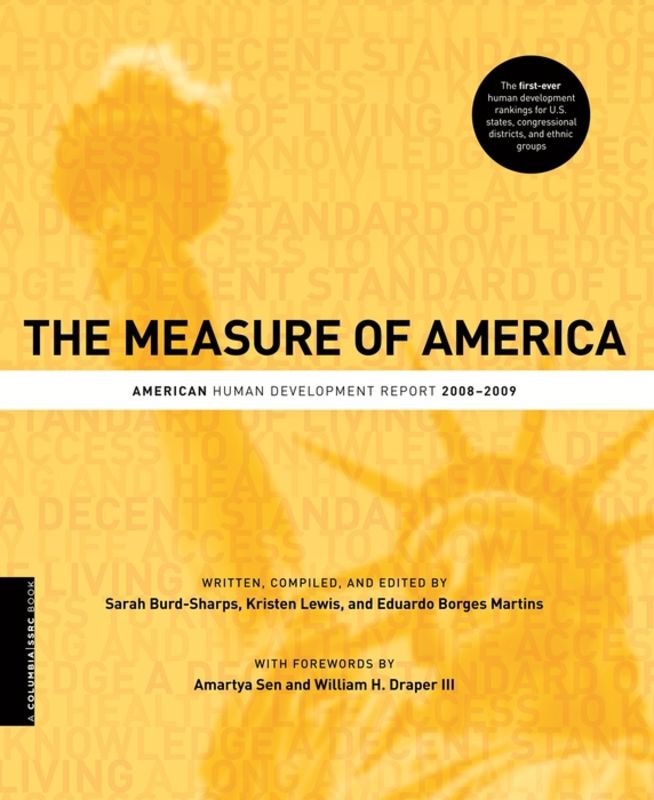
The Measure of America
The Measure of Americais the first-ever human development report for a wealthy, developed nation. It introduces the American Human Development Index, which provides a single measure of well-being for all Americans, disaggregated by state and congressional district, as well as by gender, race, and ethnicity. The Index rankings of the 50 states and 436 congressional districts reveal huge disparities in the health, education, and living standards of different groups. Clear, precise, objective, and authoritative, this report will become the basis for all serious discussions concerning the realization of a fair, just, and globally competitive American society.
eBook