
Catalogue Search | MBRL


Are you sure you want to remove the book from the shelf?

{{itemTitle}}
86
result(s) for
"Social structure Rome."
Sort by:

Migration, mobility and place in ancient Italy
\"Migration, Mobility and Place' in Ancient Italy challenges prevailing conceptions of a natural tie to the land and a demographically settled world. It argues that much human mobility in the last millennium BC was ongoing and cyclical. In particular, outside the military context \"the foreigner in our midst\" was not regarded as a problem. Boundaries of status rather than of geopolitics were those difficult to cross. The book discusses the stories of individuals and migrant groups, traders, refugees, expulsions, the founding and demolition of sites, and the political processes that could both encourage and discourage the transfer of people from one place to another. In so doing it highlights moments of change in the concepts of mobility and the definitions of those on the move. By providing the long view from history, it exposes how fleeting are the conventions that take shape here and now\"-- Summary.
Book
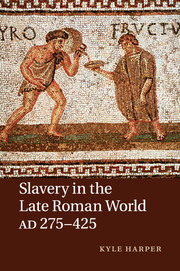
Slavery in the Late Roman World, AD 275–425
Capitalizing on the rich historical record of late antiquity, and employing sophisticated methodologies from social and economic history, this book reinterprets the end of Roman slavery. Kyle Harper challenges traditional interpretations of a transition from antiquity to the Middle Ages, arguing instead that a deep divide runs through 'late antiquity', separating the Roman slave system from its early medieval successors. In the process, he covers the economic, social and institutional dimensions of ancient slavery and presents the most comprehensive analytical treatment of a pre-modern slave system now available. By scouring the late antique record, he has uncovered a wealth of new material, providing fresh insights into the ancient slave system, including slavery's role in agriculture and textile production, its relation to sexual exploitation, and the dynamics of social honor. By demonstrating the vitality of slavery into the later Roman empire, the author shows that Christianity triumphed amidst a genuine slave society.
eBook


Aspects of ancient institutions and geography : studies in honor of Richard J.A. Talbert
In Aspects of Ancient Institutions and Geography colleagues and students honor Richard J.A. Talbert for his numerous contributions and influence on the fields of ancient history, political and social science, as well as cartography and geography. This collection of original and useful examinations is focused around the core theme of Talbert's work - how ancient individuals and groups organized their world, through their institutions and geography.The first half of the book considers institutional history in chapters on such diverse topics as the Roman Senate, Roman provincial politics and administration, healing springs, gladiators, and soldiers. Chapters on the geography of Thucydides and Alexander III, imperial geography, tracking letters and using sundials round out the second half of the book.
eBook
Attica, Central Greece, Macedonia, Thrace
Private associations organized around a common cult, profession, ethnic identity, neighbourhood or family were common throughout the Greco-Roman antiquity, offering opportunities for sociability, cultic activities, mutual support and a context in which to display and recognize virtuous achievement. This volume collects a representative selection of inscriptions from associations in Attica, Central Greece, Macedonia, Thrace, published with English translations, brief explanatory notes, commentaries and full indices. This volume is essential for several areas of study: ancient patterns of social organization; the organization of diasporic communities in the ancient Mediterranean; models for the structure of early Christian groups; and forms of sociability, status-displays, and the vocabularies of virtue.
eBook

North Coast of the Black Sea, Asia Minor
Private associations organized around a common cult, profession, ethnic identity, neighbourhood or family were common throughout the Greco-Roman antiquity, offering opportunities for sociability, cultic activities, mutual support and a context in which to display and recognize virtuous achievement. This second volume collects a representative selection of inscriptions from associations based on the North Coast of the Black Sea and in Asia Minor, published with English translations, brief explanatory notes, commentaries and full indices. This volume is essential for several areas of study: ancient patterns of social organization; the organization of diasporic communities in the ancient Mediterranean; models for the structure of early Christian groups; and forms of sociability, status-displays, and the vocabularies of virtue.
eBook

The Aurelian Wall and the Refashioning of Imperial Rome, AD 271–855
This book explores the relationship between the city of Rome and the Aurelian Wall during the six centuries following its construction in the 270s AD, a period when the city changed and contracted almost beyond recognition, as it evolved from imperial capital into the spiritual center of Western Christendom. The Wall became the single most prominent feature in the urban landscape, a dominating presence which came bodily to incarnate the political, legal, administrative, and religious boundaries of urbs Roma, even as it reshaped both the physical contours of the city as a whole and the mental geographies of 'Rome' that prevailed at home and throughout the known world. With the passage of time, the circuit took on a life of its own as the embodiment of Rome's past greatness, a cultural and architectural legacy that dwarfed the quotidian realities of the post-imperial city as much as it shaped them.
eBook

The Column of Marcus Aurelius
One of the most important monuments of Imperial Rome and at the same time one of the most poorly understood, the Column of Marcus Aurelius has long stood in the shadow of the Column of Trajan. InThe Column of Marcus Aurelius, Martin Beckmann makes a thorough study of the form, content, and meaning of this infrequently studied monument. Beckmann employs a new approach to the column, one that focuses on the process of its creation and construction, to uncover the cultural significance of the column to the Romans of the late second century A.D. Using clues from ancient sources and from the monument itself, this book traces the creative process step by step from the first decision to build the monument through the processes of planning and construction to the final carving of the column's relief decoration. The conclusions challenge many of the widely held assumptions about the value of the column's 700-foot-long frieze as a historical source. By reconstructing the creative process of the column's sculpture, Beckmann opens up numerous new paths of analysis not only to the Column of Marcus Aurelius but also to Roman imperial art and architecture in general.
eBook

Renovatio urbis
Examining the urban and architectural developments in Rome during the Pontificate of Julius II (1503-13) this book focuses on the political, religious and artistic motives behind the changes. Each chapter focuses on a particular project, from the Palazzo dei Tribunali to the Stanza della Segnatura, and examines their topographical and symbolic contexts in relationship to the broader vision of Julian Rome.
This original work explores not just historical sources relating to buildings but also humanist/antiquarian texts, papal sermons/eulogies, inscriptions, frescoes and contemporary maps. An important contribution to current scholarship of early sixteenth century Rome, its urban design and architecture.
eBook