
Catalogue Search | MBRL


Are you sure you want to remove the book from the shelf?

{{itemTitle}}
6,982
result(s) for
"Social values Economic aspects."
Sort by:

The price of our values : the economic limits of moral life
\"The economic case for self-interest at the outer limits of being morally good. Modern life is an exercise in discomfort. In the face of endless injustice, how much selfishness is permissible? How do we square suffering elsewhere with our hope to thrive at home? How does one strive for the greater good while guarding one's personal interests? The Price of Our Values argues that the answers to these questions are economic: by weighing our sense of the personal costs associated with the outer limits of our moral beliefs. These tradeoffs-the want to be good, the personal costs of being good, and the points at which people abandon goodness due to its costs-are somewhat unsettling. But as economists Augustin Landier and David Thesmar show, they are highly predictable, even justified. Our values guide us, but we are also forced to consider economic costs to settle decisions. The Price of Our Values is an economic reckoning with the universal unease of contemporary moral life. Wielding insights from the philosophical founders of the field, Landier and Thesmar provide frameworks for thinking about the place of values-justice, freedom, beauty- in the decisions of modern life. They do so in terms that seek to be consistent with both our good intentions and their limits\"-- Provided by publisher.
BOOK

Values and Revaluations
Why are some things valuable while others are not? How much effort does it take to produce valuable objects? How can one explain the different appraisal of certain things in different temporal horizons and in different cultures? Cultural processes on how value is attached to things, and how value is re-established, are still little understood.
The case studies in this volume, originating from anthropology and archaeology, provide innovative and differentiated answers to these questions. However, for all contributions there are some common basic assumptions. One of these concerns the understanding that it is rarely the value of the material itself that matters for high valuation, but rather the appreciation of the (assumed or constructed) origin of certain objects or their connection with certain social structures. A second of these shared insights addresses the ubiquity of phenomena of 'value in things'. There is no society without valued objects. As a rule, valuation is something negotiated or even disputed. Value arises through social action, whereby it is always necessary to ask anew which actors are interested in the value of certain objects (or in their appreciation). This also works the other way round: Who are those actors who question corresponding objective values and why?
eBook


Science and public reason
This essay collection explores how democratic governments construct public reason -- that is, the forms of evidence and argument used in making state decisions accountable to citizens. The term public reason as used here is not simply a matter of constructing principled arguments that respect the norms of democratic deliberation. My objective is to investigate what societies do in practice when they claim to be reasoning in the public interest. Reason, from this perspective, comprises the institutional practices, discourses, techniques and instruments through which governments claim legitimacy in an era of potentially unbounded risks -- physical, political, and moral. Those legitimation efforts, in turn, depend on citizens' acceptance of the forms of reasoning that governments offer. Included here therefore is an inquiry into the conditions that lead citizens of democratic societies to accept policy justification as being reasonable. These modes of public knowing, or 'civic epistemologies,' are integral to the constitution of political culture as described in this book. Methodologically, the book is grounded in the field of science and technology studies (STS). It uses in-depth qualitative studies of legal and political practices to shed light on the cultural construction of public reason and the reasoning political subject. It employs comparative analysis to illuminate the diverse ways in which science and expertise are factored into democratic decisionmaking; and it illustrates how STS scholarship can use comparison without falling into rigidly structural analysis. The collection as a whole contributes to democratic theory, legal studies, comparative politics, and ethnographies of modernity, as well as STS. (Text excerpt, IAB-Doku).
eBook

In the Absence of the Gift : New Forms of Value and Personhood in a Papua New Guinea Community
\"By adopting ideas like 'development,' members of a Papua New Guinean community find themselves continuously negotiating what can be expected of a relative or a community member. Nearly half the people born on the remote Mbuke Islands become teachers, businessmen, or bureaucrats in urban centers, while those who stay at home ask migrant relatives 'What about me?' This detailed ethnography sheds light on remittance motivations and documents how terms like 'community' can be useful in places otherwise permeated by kinship. As the state withdraws, Mbuke people explore what social ends might be reached through involvement with the cash economy\"--Provided by publisher.
Book

The moral economy : why good incentives are no substitute for good citizens
Should the idea of economic man-the amoral and self-interested Homo economicus-determine how we expect people to respond to monetary rewards, punishments, and other incentives? Samuel Bowles answers with a resounding \"no.\" Policies that follow from this paradigm, he shows, may \"crowd out\" ethical and generous motives and thus backfire. But incentives per se are not really the culprit. Bowles shows that crowding out occurs when the message conveyed by fines and rewards is that self-interest is expected, that the employer thinks the workforce is lazy, or that the citizen cannot otherwise be trusted to contribute to the public good. Using historical and recent case studies as well as behavioral experiments, Bowles shows how well-designed incentives can crowd in the civic motives on which good governance depends
eBook

Selling the Serengeti
Situating safari tourism within the discourses and practices of development, Selling the Serengeti examines the relationship between the Maasai people of northern Tanzania and the extraordinary influence of foreign-owned ecotourism and big-game hunting companies. It contrasts two major approaches to community conservation—international NGO and state-sponsored conservation efforts on the one hand and the neoliberal private investment in tourism on the other—and investigates their profound effect on the Maasai's culture and livelihood. It further explores how these changing social and economic forces remake the terms through which state institutions and local people engage with foreign investors, communities, and their own territories. And finally it highlights how the new tourism arrangements change the shape and meaning of the nation-state and the village and in the process remake cultural belonging and citizenship. Benjamin Gardner's experiences in Tanzania began during a study-abroad trip in 1991. His stay led to a relationship with the nation and the Maasai people in Loliondo lasting almost twenty years; it also marked the beginning of his analysis of and ethnographic research into social movements, market-led conservation, and neoliberal development around the Serengeti.
eBook

The Education Myth
The Education Myth questions the idea that education represents the best, if not the only, way for Americans to access economic opportunity. As Jon Shelton shows, linking education to economic well-being was not politically inevitable. In the eighteenth and nineteenth centuries, for instance, public education was championed as a way to help citizens learn how to participate in a democracy. By the 1930s, public education, along with union rights and social security, formed an important component of a broad-based fight for social democracy. Shelton demonstrates that beginning in the 1960s, the political power of the education myth choked off powerful social democratic alternatives like A. Philip Randolph and Bayard Rustin's Freedom Budget. The nation's political center was bereft of any realistic ideas to guarantee economic security and social dignity for the majority of Americans, particularly those without college degrees. Embraced first by Democrats like Lyndon Johnson, Jimmy Carter, and Bill Clinton, Republicans like George W. Bush also pushed the education myth. The result, over the past four decades, has been the emergence of a deeply inequitable economy and a drastically divided political system.
eBook

Morality, competition, and the firm : the market failures approach to business ethics
In this collection of essays, the author provides a compelling new framework for thinking about the moral obligations that private actors in a market economy have toward each other and to society. In a sharp break with traditional approaches to business ethics, the author argues that the basic principles of corporate social responsibility are already implicit in the institutional norms that structure both marketplace competition and the modern business corporation. In four new and nine previously published essays, the author articulates the foundations of a “market failures” approach to business ethics. Rather than bringing moral concerns to bear upon economic activity as a set of foreign or externally imposed constraints, this approach seeks to articulate a robust conception of business ethics derived solely from the basic normative justification for capitalism. The result is a unified theory of business ethics, corporate law, economic regulation, and the welfare state, which offers a reconstruction of the central normative preoccupations in each area that is consistent across all four domains. Beyond the core theory, the author offers new insights on a wide range of topics in economics and philosophy, from agency theory and risk management to social cooperation and the transaction cost theory of the firm.
eBook
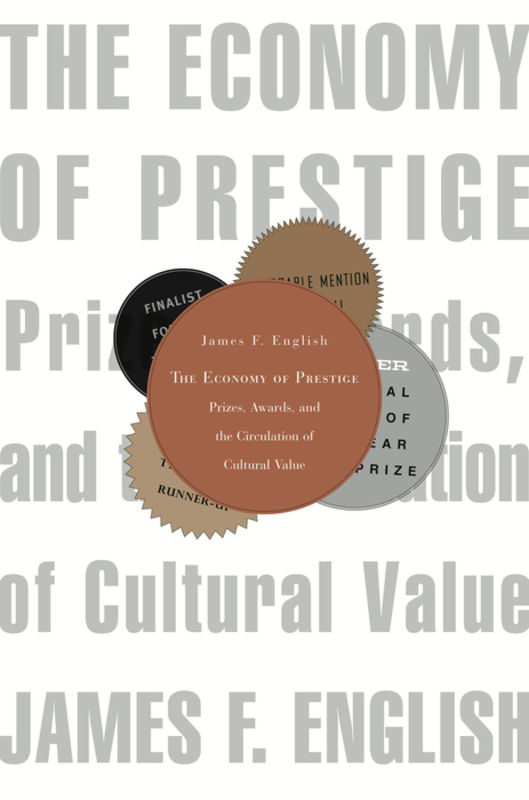
The economy of prestige : prizes, awards, and the circulation of cultural value
This is a book about one of the great untold stories of modern cultural life: the remarkable ascendancy of prizes in literature and the arts. Such prizes and the competitions they crown are almost as old as the arts themselves, but their number and power--and their consequences for society and culture at large--have expanded to an unprecedented degree in our day. In a wide-ranging overview of this phenomenon, James F. English documents the dramatic rise of the awards industry and its complex role within what he describes as an economy of cultural prestige. Observing that cultural prizes in their modern form originate at the turn of the twentieth century with the institutional convergence of art and competitive spectator sports, English argues that they have in recent decades undergone an important shift--a more genuine and far-reaching globalization than what has occurred in the economy of material goods. Focusing on the cultural prize in its contemporary form, his book addresses itself broadly to the economic dimensions of culture, to the rules or logic of exchange in the market for what has come to be called \"cultural capital.\" In the wild proliferation of prizes, English finds a key to transformations in the cultural field as a whole. And in the specific workings of prizes, their elaborate mechanics of nomination and election, presentation and acceptance, sponsorship, publicity, and scandal, he uncovers evidence of the new arrangements and relationships that have refigured that field.
eBook