
Catalogue Search | MBRL


Are you sure you want to remove the book from the shelf?

{{itemTitle}}
876
result(s) for
"Social work with transgender people."
Sort by:


Supporting Transgender Autistic Youth and Adults
Providing advice on how professionals working with autistic trans youth and adults can tailor their practice to best serve their clients and how parents can support their trans autistic children, this book increases awareness of the large overlap between trans identities and autism.By including chapters on gender diversity basics, neuroqueer trauma and how to support neuroqueer individuals, this book sets out strategies for creating more effective support that takes into account the unique experiences of trans people on the spectrum. Written by a therapist who identifies as neuroqueer, this book is the perfect companion for professionals who want to increase their knowledge of the experiences and needs of their trans autistic clients.
eBook


Lesbian, Gay, Bisexual and Trans Health Inequalities
This ground-breaking book examines inequalities experienced by LGBT people and considers the role of social work in addressing them.
The book is organised in three parts: the first provides a policy context in four countries, the second examines social work practice in tackling health inequalities, and part three considers research and pedagogic developments. The book’s distinctive approach includes international contributions, practice vignettes and key theoretical perspectives in health inequalities, including social determinants of health, minority stress, ecological approaches and human rights.
Lesbian, gay, bisexual and trans health inequalities is relevant to social work educators, practitioners and students, alongside an interdisciplinary audience interested in LGBT health inequalities.
eBook
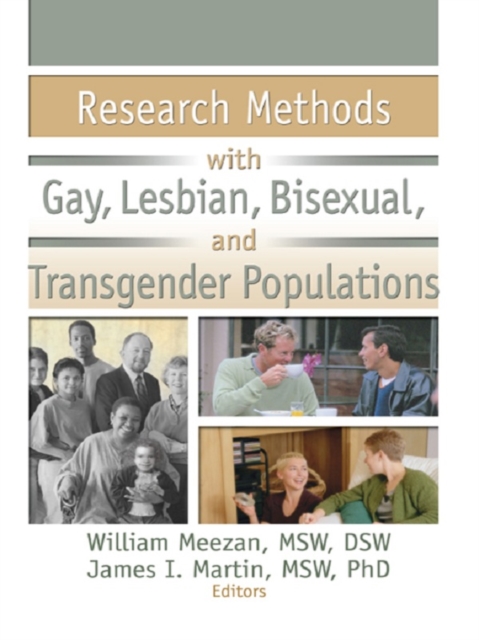
Research Methods with Gay, Lesbian, Bisexual, and Transgender Populations
Take an in-depth look at what worksand what doesn'tin research with GLBT populations!
This essential book examines the usefulness of current frameworks for research with GLBT populations and highlights the necessity for greater complexity in the conceptualization and design of research with these populations. It will help you understand the need for more inclusive and representative samples and the need to protect the privacy of GLBT research participants-and ways to accomplish these goals. In addition, Research Methods with Gay, Lesbian, Bisexual, and Transgender Populations considers the advantages and limitations of having an inside perspective when conducting research with these populations. It also explores the myriad ways in which this research can be used to better understand issues facing GLBT communities.
Specifically, Research Methods with Gay, Lesbian, Bisexual, and Transgender Populations discusses:
eight strategies that outsiders can use to overcome barriers to doing their work
the challenges of finding and studying older members of gay and lesbian communities
the special challenges that studying gay drug users pose to the researcher
factors affecting research with urban Black and African-American GLBT populations
sampling issues, including ways to overcome the challenges of conducting research with sexual minority adolescents, issues related to dealing with institutional review boards, and lessons derived from empirical articles in the Journal of Gay & Lesbian Social Services
unique features of AIDS service organizations to consider when developing an evaluation strategy
ethical standards for research and evaluation with GLBT populations
and a great deal more!
From the Foreword, by Anthony R. D'Augelli:
In social science research, the effort to extract durable principles of social causality from the apparent randomness of everyday
eBook

Body Battlegrounds
Body Battlegrounds explores the rich and complex lives of
society's body outlaws-individuals from myriad social locations who
oppose hegemonic norms, customs, and conventions about the body.
Original research chapters (based on textual analysis, qualitative
interviews, and participant observation) along with personal
narratives provide a window into the everyday lives of people
rewriting the norms of embodiment in sites like schools, sporting
events, and doctors' offices. Table of Contents
Introduction | Chris Bobel and Samantha Kwan Part I:
Going \"Natural\" • Body Hair Battlegrounds: The
Consequences, Reverberations, and Promises of Women Growing Their
Leg, Pubic, and Underarm Hair | Breanne Fahs • Radical
Doulas, Childbirth Activism, and the Politics of Embodiment |
Monica Basile • Caring for the Corpse: Embodied Transgression
and Transformation in Home Funeral Advocacy | Anne Esacove
Living Resistance: • Deconstructing Reconstructing: Challenging
Medical Advice Following Mastectomy | Joanna Rankin • My
Ten-Year Dreadlock Journey: Why I Love the \"Kink\" in My Hair . . .
Today | Cheryl Thompson • Living My Full Life: My
Rejecting Weight Loss as an Imperative for Recovery from Binge
Eating Disorder | Christina Fisanick • Pretty Brown:
Encounters with My Skin Color | Praveena Lakshmanan Part II:
Representing Resistance • Blood as Resistance:
Photography as Contemporary Menstrual Activism | Shayda Kafai
• Am I Pretty Enough for You Yet?: Resistance through Parody in
the Pretty or Ugly YouTube Trend | Katherine Phelps • The
Infidel in the Mirror: Mormon Women's Oppositional Embodiment
| Kelly Grove and Doug Schrock Living Resistance: • A Cystor's
Story: Polycystic Ovarian Syndrome and the Disruption of Normative
Femininity | Ledah McKellar • Old Bags Take a Stand: A
Face Off with Ageism in America | Faith Baum and Lori Petchers
• Making Up with My Body: Applying Cosmetics to Resist
Disembodiment | Haley Gentile • I Am a Person Now: Autism,
Indistinguishability, and (Non)optimal Outcome | Alyssa
Hillary Part III: Creating Community, Disrupting
Assumptions • Yelling and Pushing on the Bus: The
Complexity of Black Girls' Resistance | Stephanie D. Sears and
Maxine Leeds Craig • Big Gay Men's Performative Protest Against
Body Shaming: The Case of Girth and Mirth | Jason Whitesel
• \"What's Love Got to Do with It?\": The Embodied Activism of
Domestic Violence Survivors on Welfare | Sheila M. Katz Living
Resistance: • \"Your Signing Is So Beautiful!\": The Radical
Invisibility of ASL Interpreters in Public | Rachel Kolb •
Two Shakes | Rev. Adam Lawrence Dyer • \"Showing Our
Muslim\": Embracing the Hijab in the Era of Paradox | Sara
Rehman • \"Doing Out\": A Black Dandy Defies Gender Norms in the
Bronx | Mark Broomfield • Everybody: Making Fat Radio for
All of Us | Cat Pausé Part IV: Transforming Institutions
and Ideologies • Embodying Nonexistence: Encountering
Mono- and Cisnormativities in Everyday Life | J. E. Sumerau
• Freeing the Nipple: Encoding the Heterosexual Male Gaze into
Law | J. Shoshanna Ehrlich • Give Us a Twirl: Male Baton
Twirlers' Embodied Resistance in a Feminized Terrain | Trenton
M. Haltom • \"That Gentle Somebody\": Rethinking Black Female
Same-Sex Practices and Heteronormativity in Contemporary South
Africa | Taylor Riley Living Resistance:
eBook

Sex in Transition
Honorable Mention, 2013 Ruth Benedict Book Prize presented
by the Association for Queer Anthropology Honorable Mention, 2014
Distinguished Book Award presented by the Section on Sexualities of
the American Sociological Association Winner of the 2013 Sylvia
Rivera Award in Transgender Studies presented by the Center for Gay
and Lesbian Studies Sex in Transition explores
the lives of those who undermine the man/woman binary, exposing the
gendered contradictions of apartheid and the transition to
democracy in South Africa. In this context, gender liminality-a way
to describe spaces between common conceptions of \"man\" and
\"woman\"-is expressed by South Africans who identify as transgender,
transsexual, transvestite, intersex, lesbian, gay, and/or eschew
these categories altogether. This book is the first academic
exploration of challenges to the man/woman binary on the African
continent and brings together gender, queer, and postcolonial
studies to question the stability of sex. It examines issues
including why transsexuals' sex transitions were encouraged under
apartheid and illegal during the political transition to democracy
and how butch lesbians and drag queens in urban townships reshape
race and gender. Sex in Transition challenges the dominance of
theoretical frameworks based in the global North, drawing on
fifteen years of research in South Africa to define the parameters
of a new transnational transgender and sexuality studies.
eBook

Transgenderism and intersexuality in childhood and adolescence : making choices
Transgenderism and Intersexuality in Childhood and Adolescence: Making Choices presents an overview of the research, clinical insights, and ethical dilemmas relevant to clinicians who treat intersex youth and their families. Exploring gender development from a cross-cultural perspective, esteemed scholar Peggy T. Cohen-Kettenis and experienced practitioner Friedemann Pfäfflin focus on assessment, diagnosis, and treatment issues. To bridge research and practical application, they include numerous case studies, definitions of relevant terminology, and salient chapter summaries.
eBook
The making of a man
In the autumn of 2012, Maxim Februari—known until then as writer and philosopher Marjolijn Februari—announced his intention to live as a man. The news was greeted with a diversity of reactions, from curiosity to unease. These responses made it absolutely clear to Februari that most of us don't know how to think about transsexuality. The Making of a Man explores this lacuna through a deeply personal meditation on a profoundly universal aspect of our identities. Februari contemplates the many questions that sexual transitions entail: the clinical effects of testosterone, the alteration of sexual organs, and its effects on sexual intimacy; how transsexuality figures in the law; and how it challenges the way we talk about sex and gender, such as the seemingly minor—but crucially important—difference between the terms \"transsexual\" and \"transgender.\" He analyzes our impressions of effeminate men and butch women, separating apparent acceptance from actual prejudice, and critically examines the curious requirement in many countries that one must demonstrate a psychological disturbance—a \"gender identity disorder\"—in order to be granted sex change therapies. From there he explores the seemingly endless minutiae changing genders or sex effect, from the little box with an M or an F on passports to the shockingly sudden way testosterone can adjust physical features. With his characteristically clear voice combined with intimate—sometimes moving, sometimes funny—ruminations, Februari wakes readers up to all the ways, big and small, our world is structured by sex and gender.
eBook

Transsexualism : illusion and reality
\"Transsexualism is a stimulating, proactive and important book. Colette Chiland does not back away from difficult issues. She forces all of us to look at our assumptions about transsexualism and to re-examine what gender and sex really mean\" - Christine Ware, author of Where Id Was: Challenging Normalization in Psychoanalysis\"In a nutshell, the book offers a much-needed alternative view of transsexuality from a psychiatric and European point of view… Chiland's interesting and well presented book is a valued reminder of how different the same topic can appear in an alternative perspective\" - Transgender TapestryColette Chiland exhibits a masterful and encyclopedic knowledge of transsexualism, drawing together the insights of depth psychology, psychoanalysis, history, anthropology and sociology for rethinking transsexualism in terms of identity, subjectivity and the wider socio-historical world. This book is written with considerable precision on complex, technical issues, whilst at the same time keeping the broader question of the relationship between transsexualism and society firmly in mind.
eBook