
Catalogue Search | MBRL


Are you sure you want to remove the book from the shelf?

{{itemTitle}}
2,069
result(s) for
"Social workers Biography."
Sort by:


Character is destiny
In her autobiography, the remarkable feminist and social worker Alice Salomon recounts her transition in the 1890s from privileged idleness to energetic engagement in solving social problems. Salomon took the lead in establishing the profession of social work, and built a career as a social reformer, activist, and educator. A prolific author, Salomon also played a key role in the transatlantic dialogue between German and American feminists in the early twentieth century. Her narrative concludes with the account of her expulsion from Germany by the Nazis in 1937.
Salomon's formative influence on the field of social work makes her story crucial for the history of the discipline. This work will also appeal to anyone with an interest in the history of the feminist and socialist movements or the political and social history of twentieth-century Germany. The volume also includes several of Salomon's essays on social work and women's issues, along with photographs of Salomon, her students, and her colleagues.
Andrew Lees is Professor and Chair of the History Department at Rutgers University, Camden.
eBook

Jane Addams : spirit in action
Jane Addams (1860-1935) was one of the leading figures of the Progressive era. This \"pragmatic visionary,\" as Knight calls her, is best known as the creator of Hull House, a model settlement house offering training, shelter, and culture for Chicago's poor. Addams also involved herself in a long list of Progressive campaigns. Her rhetorical skills as both speaker and writer made her internationally recognized as a supporter of civil rights, woman suffrage, and labor reform.
Book

Citizen
Jane Addams was the first American woman to receive the Nobel Peace Prize. Now Citizen, Louise W. Knight's masterful biography, reveals Addams's early development as a political activist and social philosopher. In this book we observe a powerful mind grappling with the radical ideas of her age, most notably the ever-changing meanings of democracy. Citizen covers the first half of Addams's life, from 1860 to 1899. Knight recounts how Addams, a child of a wealthy family in rural northern Illinois, longed for a life of larger purpose. She broadened her horizons through education, reading, and travel, and, after receiving an inheritance upon her father's death, moved to Chicago in 1889 to co-found Hull House, the city's first settlement house. Citizen shows vividly what the settlement house actually was—a neighborhood center for education and social gatherings—and describes how Addams learned of the abject working conditions in American factories, the unchecked power wielded by employers, the impact of corrupt local politics on city services, and the intolerable limits placed on women by their lack of voting rights. These experiences, Knight makes clear, transformed Addams. Always a believer in democracy as an abstraction, Addams came to understand that this national ideal was also a life philosophy and a mandate for civic activism by all.
eBook

Jane Addams : social worker and Nobel Peace Prize winner
Describes the life of the woman whose devotion to social work led to her establishing Hull House in Chicago and who was awarded the Nobel Peace Prize in 1931.
Book
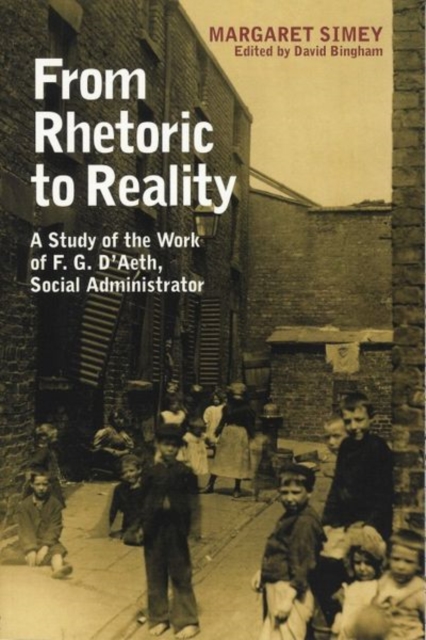
From Rhetoric to Reality
This book is an account of how a disillusioned minister, Frederick D’Aeth came to Liverpool and ended up making a unique contribution to the social welfare of the city. It is both a personal and a political story of this previously uncelebrated man, whose interests and gifts contributed greatly to the transformation of social welfare in the early part of the 20th century. Margaret Simey charts how in 1905 D’Aeth came to this city, becoming the first paid lecturer in newly formed social science department in Liverpool University and later in 1909, became the Director of Reports for the newly formed Liverpool Council for Voluntary Aid. This was also one of the first of such coordinating councils, emerging from the Report on the Royal Commission on Poor Laws, with D’Aeth responding to this challenge with vigour and a wealth of ideas. Although it is part biography, the book is also an important journey into past and present debates over social welfare. D’Aeth represents a particularly interesting figure, as his work clearly bridged the period of transition between victorian philanthropism, and the growing influence of the welfare state. The author reveals the talent D’Aeth developed in the as yet undefined field of Social Administration and his particular verve for co-ordination. Such a focus was crucial with a tide of diverse and fairly uncoordinated charitable organisations. Margaret Simey concludes that D’Aeth largely succeeded in harnessing these diverse groups in Liverpool and from further afield and, in doing so, demonstrated the structural value of truly independent voluntary sector effort within society and the potential of the active ‘citizenship’, as a essential balance to government provision.
eBook


The Life and Thought of Louis Lowy
Louis Lowy (1920–1991), an international social worker and gerontologist, rarely spoke publicly about the Holocaust. During the last months of his life, however, he recorded an oral narrative that explores his activities during the Holocaust as the formative experiences of his career. Whether caring for youth in concentration camps, leading an escape from a death march, or forming the self-government of a Jewish displaced persons center, Lowy was guided by principles that would later inform his professional identity as a social worker, including the values of human worth and self-determination, the interdependence of generations, and the need for social participation and lifelong learning. Drawing on Lowy’s oral narrative and accounts from three other Holocaust survivors who witnessed his work in the Terezín ghetto and the Deggendorf Displaced Persons Center, Gardella offers a rich portrait of Lowy’s personal and professional legacy. In chronicling his life, Gardella also uncovers a larger story about Jewish history and the meaning of the Holocaust in the development of the social work profession.
eBook


A heart at leisure from itself : Caroline Macdonald of Japan
This book throws light on Japanese-Canadian relations in the first few decades of this century.
eBook