
Catalogue Search | MBRL


Are you sure you want to remove the book from the shelf?

{{itemTitle}}
4,320
result(s) for
"Socialism Europe."
Sort by:


Racial Science in Hitler's New Europe, 1938-1945
InRacial Science in Hitler's New Europe, 1938-1945, international scholars examine the theories of race that informed the legal, political, and social policies aimed against ethnic minorities in Nazi-dominated Europe. The essays explicate how racial science, preexisting racist sentiments, and pseudoscientific theories of race that were preeminent in interwar Europe ultimately facilitated Nazi racial designs for a \"New Europe.\"
The volume examines racial theories in a number of European nation-states in order to understand racial thinking at large, the origins of the Holocaust, and the history of ethnic discrimination in each of those countries. The essays, by uncovering neglected layers of complexity, diversity, and nuance, demonstrate how local discourse on race paralleled Nazi racial theory but had unique nationalist intellectual traditions of racial thought.
Written by rising scholars who are new to English-language audiences, this work examines the scientific foundations that central, eastern, northern, and southern European countries laid for ethnic discrimination, the attempted annihilation of Jews, and the elimination of other so-called inferior peoples.
eBook

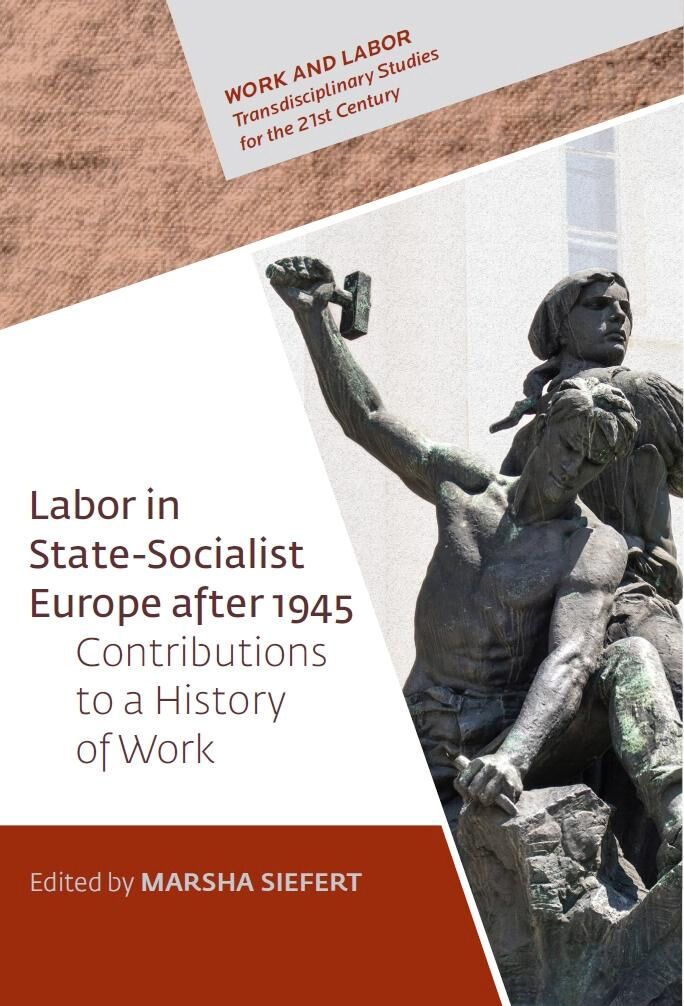
Labor in State-Socialist Europe, 1945–1989
Labor regimes under communism in East-Central Europe were complex, shifting, and ambiguous. This collection of sixteen essays offers new conceptual and empirical ways to understand their history from the end of World War II to 1989, and to think about how their experiences relate to debates about labor history, both European and global.
The authors reconsider the history of state socialism by re-examining the policies and problems of communist regimes and recovering the voices of the workers who built them. The contributors look at work and workers in Albania, Bulgaria, Czechoslovakia, the German Democratic Republic, Hungary, Poland, Romania, and Yugoslavia. They explore the often contentious relationship between politics and labor policy, dealing with diverse topics including workers' safety and risks; labor rights and protests; working women's politics and professions; migrant workers and social welfare; attempts to control workers' behavior and stem unemployment; and cases of incomplete, compromised, or even abandoned processes of proletarianization. Workers are presented as active agents in resisting and supporting changes in labor policies, in choosing allegiances, and in defining the very nature of work.
eBook


Socialist escapes
During much of the Cold War, physical escape from countries in the East Bloc was a near impossible act. There remained, however, possibilities for other socialist escapes, particularly time away from party ideology and the mundane routines of everyday life. The essays in this volume examine sites of socialist escapes, such as beaches, camp sites, nightclubs, concerts, castles, cars, and soccer matches. The chapters explore the effectiveness of state efforts to engineer society through leisure, entertainment, and related forms of cultural programming and consumption, as it was in leisure and tourism that the party's intentions encountered Eigen-Sinn, the pursuit of individual interests. This volume leads to a deeper understanding of state- society relations in the East Bloc, where the state did not simply \"dictate from above\" and inhabitants had some opportunities to shape solidarities, identities, and meaning.
eBook


The Socialist Car
Across the Soviet Bloc, from the 1960s until the collapse of communism, the automobile exemplified the tension between the ideological imperatives of political authorities and the aspirations of ordinary citizens. For the latter, the automobile was the ticket to personal freedom and a piece of the imagined consumer paradise of the West. For the authorities, the personal car was a private, mobile space that challenged the most basic assumptions of the collectivity. The \"socialist car\"-and the car culture that built up around it-was the result of an always unstable compromise between official ideology, available resources, and the desires of an increasingly restless citizenry. InThe Socialist Car, eleven scholars from Europe and North America explore in vivid detail the interface between the motorcar and the state socialist countries of Eastern Europe, including the USSR.
In addition to the metal, glass, upholstery, and plastic from which the Ladas, Dacias, Trabants, and other still extant but aging models were fabricated, the socialist car embodied East Europeans' longings and compromises, hopes and disappointments. The socialist car represented both aspirations of overcoming the technological gap between the capitalist first and socialist second worlds and dreams of enhancing personal mobility and status. Certain features of automobility-shortages and privileges, waiting lists and lack of readily available credit, the inadequacy of streets and highways-prevailed across the Soviet Bloc. In this collective history, the authors put aside both ridicule and nostalgia in the interest of trying to understand the socialist car in its own context.
Contributors: Elke Beyer, Swiss Institute of Technology; Valentina Fava, Helsinki Collegium for Advanced Studies and University of Helsinki; Luminita Gatejel, European University Institute, Florence; Mariusz Jastrzab, Kozminski University; Corinna Kuhr-Korolev, University of Bochum; Brigitte Le Normand, Indiana University Southeast; Esther Meier, University of the Federal Armed Forces, Hamburg; Kurt Möser, Karlsruhe Institute of Technology; György Péteri, Norwegian University of Science and Technology, Trondheim; Eli Rubin, Western Michigan University; Lewis H. Siegelbaum, Michigan State University
eBook

One Hundred Years of Socialism : The West European Left in the Twentieth Century
This new edition of Donald Sassoon's magisterial history of the Left in the twentieth century includes a substantial new introduction by the author. With unique authority and unparalleled scholarship, Sassoon traces the fortunes of the political parties of the left in Western Europe across 14 countries, covering the fortunes of socialism from the rise of the Bolsheviks through two World Wars to the revival of feminism and the arrival of \"green\" politics. -- Provided by publisher.
Book

Between yesterday and tomorrow
An intellectual and cultural history of mid-twentieth century plans for European integration, this book calls into question the usual pre- and post-war periodizations that have structured approaches to twentieth-century European history. It focuses not simply on the ideas of leading politicians but analyses debates about Europe in \"civil society\" and the party-political sphere in Germany, asking if, and how, a \"permissive consensus\" was formed around the issue of integration. Taking Germany as its case study, the book offers context to the post-war debates, analysing the continuities that existed between interwar and post-war plans for European integration. It draws attention to the abiding scepticism of democracy displayed by many advocates of integration, indeed suggesting that groups across the ideological spectrum converged around support for European integration as a way of constraining the practice of democracy within nation-states.
eBook