
Catalogue Search | MBRL


Are you sure you want to remove the book from the shelf?

{{itemTitle}}
1,243
result(s) for
"Socio-Legal Studies"
Sort by:
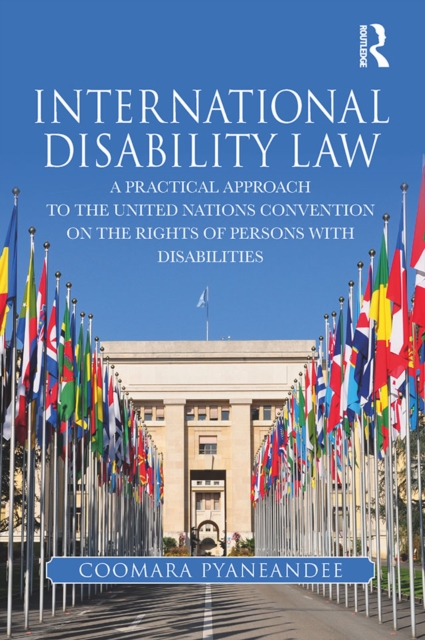
International Disability Law
This book provides a concise guide to international disability law. It analyses the case law of the CRPD Committee and other international human rights treaty bodies, and provides commentaries on more than 50 leading cases. The author elaborates on the obligations of States Parties under the CRPD and other international treaties, while also spelling out the rights of persons with disabilities, and the different mechanisms that exist at both domestic and international levels for ensuring that those rights are respected, protected and promoted. The author also delineates the traditional differentiation between civil and political rights on the one hand, and economic, social and cultural rights on the other. He demonstrates, through analysis of the evolving case law, how the gap between these two sets of rights is gradually closing. The result is a powerful tool for political decision-makers, academics, legal practitioners, law students, persons with disabilities and their representative organisations, human rights activists and general readers.
eBook

The Court of Justice in the Archives Project: An Initial Reflection
This Article offers an initial reflection on the output of the \"Court of Justice in the Archives\" project represented by the case studies included in this Special Section. The value of this collective endeavour is not a matter of find-ing the (legal or historical) truth hidden in some unpublished part of the dossier that would allow us to settle on the real \"origins\" of EU law. The project contributes to deepening our understanding of landmark cases decades later, during which time their meaning and scope have been simplified and codified as \"EU law answers to EU law questions\" at the cost of losing their many legal, sociological and economic layers. As the Articles bring back defeated and the marginalized arguments, and exemplify how things could have gone otherwise, the reader is led to a thought-experiment that can prove extremely useful in reopening the legal and political imagination of EU law, emancipating it from a sense of necessity and exposing more explicitly the normative choices made by the Court. And as alternative legal pasts of Europe emerge, it may become easier to conceive of alternative futures for EU legal integration.
Journal Article

Violence, Imagination, and Resistance
For some time, scholars have devoted considerable attention to the law as a force of repression, one that replicates and enforces structural inequalities through violence and legally sanctioned modes of punishment. But it is the means by which the law functions as a tool of governmentality that occupies the contributors to this volume. Through the exploration of how to deconstruct law’s power, how to expose the violence the law produces, and finally how to identify modes of resistance that have transformative potential, these essays contribute to the ongoing interrogation of settler colonialism, racism, and structural violence in Canada.
eBook

The Routledge International Handbook of Perpetrator Studies
The Routledge International Handbook of Perpetrator Studies provides the first comprehensive overview of this emerging interdisciplinary field in the humanities and social sciences. Featuring contributions by scholars from a wide variety of fields and disciplines, the Handbook charts the growth and development, foundations, key debates, core concerns, and frontiers of Perpetrator Studies. Focusing on genocide, terrorism, and other forms of political mass violence, this Handbook addresses questions of guilt and responsibility, definition, terminology, typology, motivations, group dynamics, memory, trauma, representation, and pedagogy. Offering a thematic and conceptual approach that facilitates a comparative analysis across historical, geographic, and disciplinary lines, the Handbook allows different disciplinary perspectives to confront one another. In so doing, this foundational volume presents contemporary perspectives on longstanding debates whilst providing new contributions to the field. Written with an interdisciplinary readership in mind, the chapters provide an overview of existing work on a specific topic or issue, delineate current developments within the respective discipline or field, and make suggestions for further research. As such, the book will appeal to scholars across a range of disciplines, including history, sociology, anthropology, criminology, law, philosophy, memory studies, psychology, political science, literary studies, film studies, cultural studies, art history, and education.
eBook

Rhetoric, Aboriginal Australians and the Northern territory intervention: A socio-legal investigation into prelegislative argumentation
Presented within this article is a systematic discourse analysis of the arguments used by the then Australian Prime Minister and also the Minister for Indigenous Affairs in explaining and justifying the extensive and contentious intervention by the federal government into remote Northern Territory Aboriginal communities. The methods used within this article extend the socio-legal toolbox, providing a contextually appropriate, interdisciplinary methodology that analyses the speech act's rhetorical properties. Although many academics use sound-bites of pre-legislative speech in order to support their claims, this analysis is concerned with investigating the contents of the speech acts in order to understand how the Prime Minister's and Minister for Indigenous Affairs' argumentations sought to achieve consensus to facilitate the enactment of legislation. Those seeking to understand legislative endeavours, policy makers and speech actors will find that paying structured attention to the rhetorical properties of speech acts yields opportunities to strengthen their insight. The analysis here indicates three features in the argumentation: the duality in the Prime Minister's and Minister's use of the Northern Territory Government's Little Children are Sacred report; the failure to sufficiently detail the linkages between the Intervention and the measures combatting child sexual abuse; and the omission of recognition of Aboriginal agency and consultation.
Journal Article

Domestic fortress
Domestic Fortress offers a critical analysis of the contemporary home and its close relationship to fear and security. It considers the important connection between the private home, political life and the economy that we term tessellated neoliberalism. The book considers the nucleus of the domestic home as part of a much larger archipelago frontline of homes and gated communities that appear as a new home front set against diverse sources of social anxiety. These range from questions of invasion (such as burglary or identity theft) to those of security (the home as a financial resource in retirement and as a place of refuge in an unpredictable world). A culture of fear has been responded to through increasingly emphatic retreats by homeowners into fortified dwellings, palatial houses, concealed bunker pads and gated developments. Many feature elaborate security measures; alarms, CCTV systems, motion-sensing lights and impregnable panic rooms. Domestic Fortress locates the anxieties driving these responses to the corporate and political manufacturing of fear, the triumph of neoliberal models of homeownership and related modes of social individualisation and risk that permeate society today. Domestic Fortress draws on perspectives and research from criminology, urban studies and sociology to offer a sense of the private home as a site of wavering anxiety and security, exclusion and warmth, alongside dreams of retreat and autonomy that mesh closely with the defining principles of neoliberal governance.Even as the home is acknowledged to play a vital role in sheltering us from the elements so it has now come to be a locus around which many anxieties are shut-out. The home allows us to lock out the daily hardships of life, but is also a site from which we witness a wide range of troubling phenomena: the insecurities of the workplace, plans for our future welfare, internationalized terror, geo-political warfare, ecological catastrophes, feelings of loss and uncertainty around identity, to say nothing of the daily risks of flood, fire and other disasters.The home now plays a complex dual role that slips between offering us protection from these worries while also offering the nightmare of its own possible invasion, erosion or destruction. On top of these concerns entire industries have been built that sell a war against strangers, dirt and disaster. This of course includes the insurance industry itself, but also the use of technologies that both protect the home and make it effectively more impregnable to casual social contact as well as the proliferation of products devoted to domestic cleanliness. Domestic Fortress considers the fantasies and realities of dangers to the contemporary home and its inhabitants and details the wide range of actions taken in the pursuit of total safety.
eBook

Time will tell
Calculating the potential risk of future terrorist violence is at the core of counter-terrorism practices. Particularly in court cases, this potential risk serves as legitimization for the preemptive criminalization of suspicious (financial) behaviour. This article argues that the preemptive temporality seen in such court cases is a practice of ‘sorting time’ and producing distinct legal definitions around future violence. Building on postcolonial and feminist scholarship on temporality, the article examines preemptive temporality as the material, embodied and multiple engagements with time that are enacted in terrorism court cases. Through the use of empirical data obtained from court observations, court judgements and interviews with legal practitioners, accounts of empirical temporalities are traced to illuminate other forms of violence that until now have been overshadowed by the dominant (and relatively unchallenged) perception of future terrorist threats that is enacted in the courtroom. In this way, the article makes two important contributions. First, it advances the theoretical debate on preemptive security through an examination of how legal and security practices co-produce temporality by defining future terrorist violence. Second, it contributes empirically by showing how temporality is constructed in multiple ways, paying specific attention to temporalities resisting dominating perceptions of future terrorist violence.
Journal Article

Conspiracy! Or, when bad things happen to good litigants in person
This paper considers the relationship between litigants in person (LiPs) and conspiracy theories and seeks to answer two questions: how, and why, do some LiPs come to be conspiracy theorists? The majority of LiPs, of course, do not become conspiracy-minded. There is also no evidence that LiPs are more likely than anyone else in legal proceedings to be conspiracists, only, perhaps, that it is more obvious when they are. But there continue to be individuals who have conspiracist explanations for difficulties or failures they experience throughout legal proceedings. And while it is widely held that some LiPs hold eccentric beliefs about the law, there has been little attempt to understand how and why LiPs may come to acquire or articulate these beliefs. This is presumably because it has not been considered important to interrogate the views of people already often assumed to be ‘difficult’ or eccentric. This paper contends, however, that trying to understand how and why these conspiracist beliefs are acquired matters very much. This is because conspiracy theories can give us a critical insight into how negative experiences of litigation can result in a loss of faith or trust in legal institutions.
Journal Article

South Korean civil movement organisations
This highly engaging book invites the reader to learn about how South Korean activists, intellectuals and various reformers approach the role of civil society in a post-colonial, post-Cold War, post-dictatorship, and post-IMF neoliberal democracy. In particular, it provides a detailed description of civil movement organisations in Seoul leading up to, during and after the Roh Moo Hyun era (2003–8). The book engages the entangled hopes, crises and pragmatic transitions that animated this era in South Korean politics and connects it with larger debates in anthropology, sociology, law and politics from around the world. Ultimately, the book contributes to growing areas of research, advocacy and general interest in pragmatism, ethnography, hope and crisis.
eBook

The impact of coastal grabbing on community conservation – a global reconnaissance
\"Coastal grab\" refers to the contested appropriation of coastal (shore and inshore) space and resources by outside interests. This paper explores the phenomenon of coastal grabbing and the effects of such appropriation on community-based conservation of local resources and environment. The approach combines social-ecological systems analysis with socio-legal property rights studies. Evidence of coastal grab is provided from four country settings (Canada, Brazil, India and South Africa), distinguishing the identity of the 'grabbers' (industry, government) and 'victims', the scale and intensity of the process, and the resultant 'booty'. The paper also considers the responses of the communities. While emphasizing the scale of coastal grab and its deleterious consequences for local communities and their conservation efforts, the paper also recognizes the strength of community responses, and the alliances/partnerships with academia and civil society, which assist in countering some of the negative effects.
Journal Article