
Catalogue Search | MBRL


Are you sure you want to remove the book from the shelf?

{{itemTitle}}
197
result(s) for
"Sociolinguistics -- Japan"
Sort by:


Fluid Orality in the Discourse of Japanese Popular Culture
This volume invites the reader into the world of pragmatic and discourse studies in Japanese popular culture. Through \"character-speak\", the book analyzes quoted speech in light (graphic) novels, the effeminate onee kotoba in talk shows, narrative character in keetai (mobile phone) novels, floating whispers in manga, and fictionalized dialects in television drama series. Explorations into conversational interaction, internal monologue, rhetorical figures, intertextuality, and the semiotic mediation between verbal and visual signs reveal how speakers manipulate language in performing playful \"characters\" and \"characteristics\". Most prominent in the discourse of Japanese popular culture is its \"fluid orality\". We find the essential oral nature in and across genres of Japanese popular culture, and observe seamless transitions among styles and speech variations. This fluidity is understood as a feature of polyphonic speech initiated not by the so-called ideal singular speaker, but by a multiple and often shifting interplay of one's speaking selves performing as various characters. Challenging traditional (Western) linguistic theories founded on the concept of the autonomous speaker, this study ventures into open and embracing pragmatic and discourse studies that inquire into the very nature of our speaking selves.
eBook

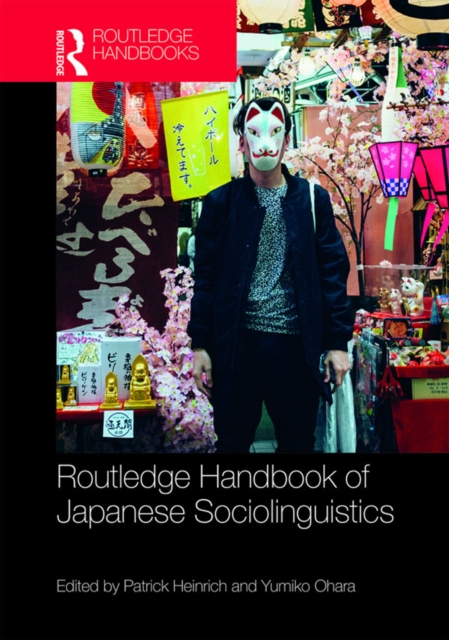
Routledge Handbook of Japanese Sociolinguistics
Presenting new approaches and results previously inaccessible in English, the Routledge Handbook of Japanese Sociolinguistics provides an insight into the languages and society of contemporary Japan from a fresh perspective.
While it was once believed that Japan was a linguistically homogenous country, research over the past two decades has shown Japan to be a multilingual and sociolinguistically diversifying country. Building on this approach, the contributors to this handbook take this further, combining Japanese and western approaches alike and producing research which is relevant to twenty-first century societies. Organised into five parts, the sections covered include:
The languages and language varieties of Japan.
The multilingual ecology.
Variation, style and interaction.
Language problems and language planning.
Research overviews.
With contributions from across the field of Japanese sociolinguistics, this handbook will prove very useful for students and scholars of Japanese studies, as well as sociolinguists more generally.
eBook
Bonding through context : language and interactional alignment in Japanese situated discourse
This book examines the linguistic and interactional mechanisms through which people bond or feel bonded with one another by analyzing situated discourse in Japanese contexts. The term \"bonding\" points to the sense of co-presence, belonging, and alignment with others as well as with the space of interaction. We analyze bonding as established, not only through the usage of language as a foregrounded code, but also through multi-layered contexts shared on the interactional, corporeal, and socio-cultural levels. The volume comprises twelve chapters examining the processes of bonding (and un-bonding) using situated discourse taken from rich ethnographic data including police suspect interrogations, Skype-mediated family conversations, theatrical rehearsals, storytelling, business email correspondence and advertisements. While the book focuses on processes of bonding in Japanese discourse, the concept of bonding can be applied universally in analyzing the co-creation of semiotic, pragmatic, and communal space in situated discourse.
eBook

Sociolinguistics in Japanese Contexts
No detailed description available for \"Sociolinguistics in Japanese Contexts\".
eBook


Symbolic values of foreign language use : from the Japanese case to a general sociolinguistic perspective
No detailed description available for \"Symbolic Values of Foreign Language Use\".
eBook

Reading Japan Cool
Japanese animation, video games, and manga have attracted fans around the world. The characters, the stories, and the sensibilities that come out of these cultural products are together called Japan Cool. This is not a sudden fad, but is rooted in manga—Japanese comics—which since the mid-1940s have developed in an exponential way. In spite of a gradual decline in readership, manga still commands over a third of the publishing output. The volume of manga works that is being produced and has been through history is enormous. There are manga publications that attract readers of all ages and genders. The diversity in content attracts readers well into adulthood. Surveys on reading practices have found that almost all Japanese people read manga or have done so at some point in their lives. The skills of reading manga are learned by readers themselves, but learned in the context of other readers and in tandem with school learning. Manga reading practices are sustained by the practices of other readers, and manga content therefore serves as a topic of conversation for both families and friends. Moreover, manga is one of the largest sources of content for media production in film, television, and video games. Manga literacy, the practices of the readers, the diversity of titles, and the sheer number of works provide the basis for the movement recognized as Japan Cool. Reading Japan Cool is directed at an audience of students of Japanese studies, discourse analysts, educators, parents, and manga readers.
eBook