
Catalogue Search | MBRL


Are you sure you want to remove the book from the shelf?

{{itemTitle}}
33,074
result(s) for
"Sociology - methods"
Sort by:

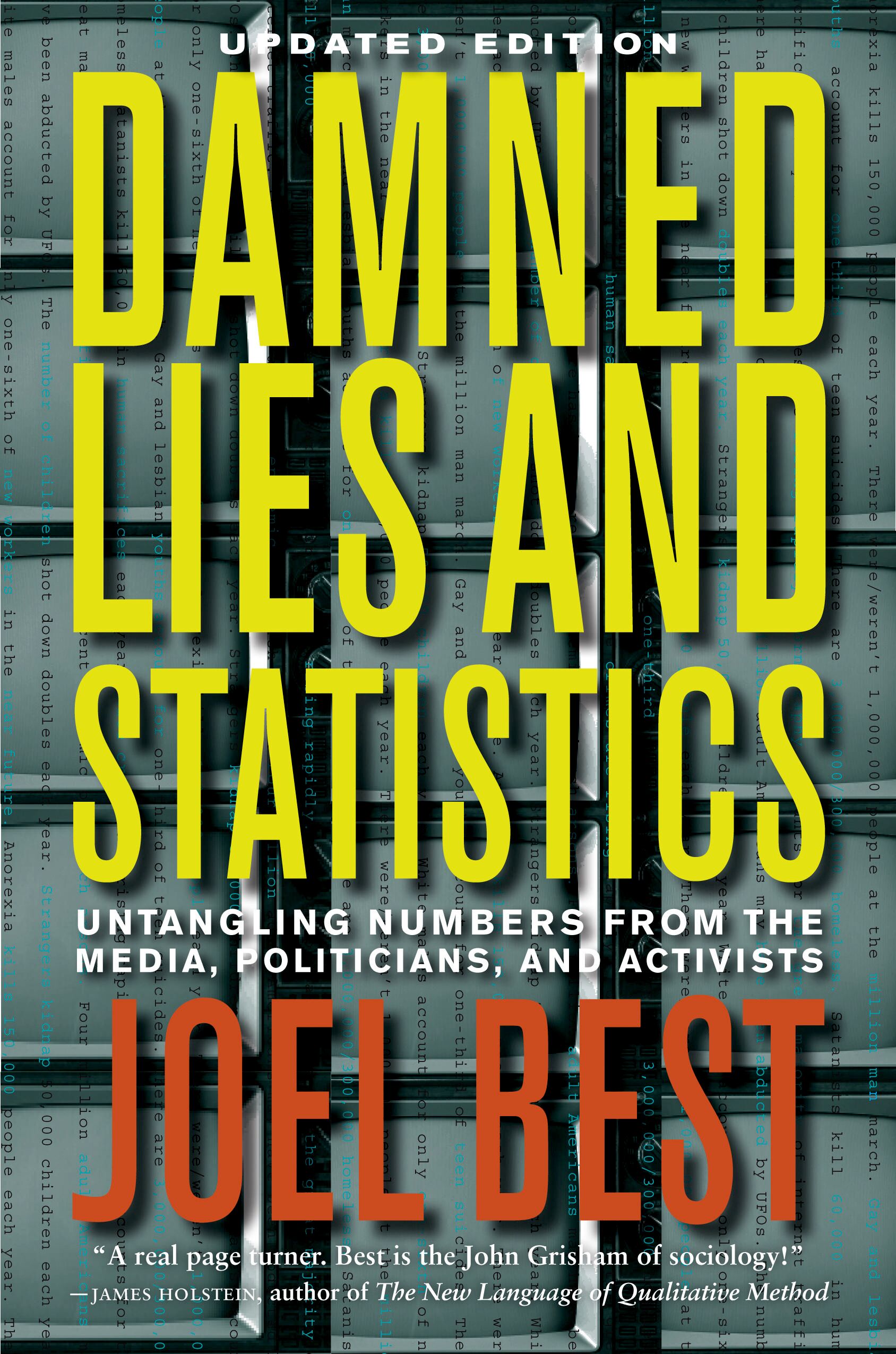
Damned lies and statistics
Here, by popular demand, is the updated edition to Joel Best's classic guide to understanding how numbers can confuse us. In his new afterword, Best uses examples from recent policy debates to reflect on the challenges to improving statistical literacy. Since its publication ten years ago, Damned Lies and Statistics has emerged as the go-to handbook for spotting bad statistics and learning to think critically about these influential numbers.
eBook

Damned lies and statistics : untangling numbers from the media, politicians, and activists
\"Here, by popular demand, is the updated edition to Joel Best's classic guide to understanding how numbers can confuse us. In his new afterword, Best uses examples from recent policy debates to reflect on the challenges to improving statistical literacy. Since its publication ten years ago, Damned Lies and Statistics has emerged as the go-to handbook for spotting bad statistics and learning to think critically about these influential numbers.\"--book jacket.
Book
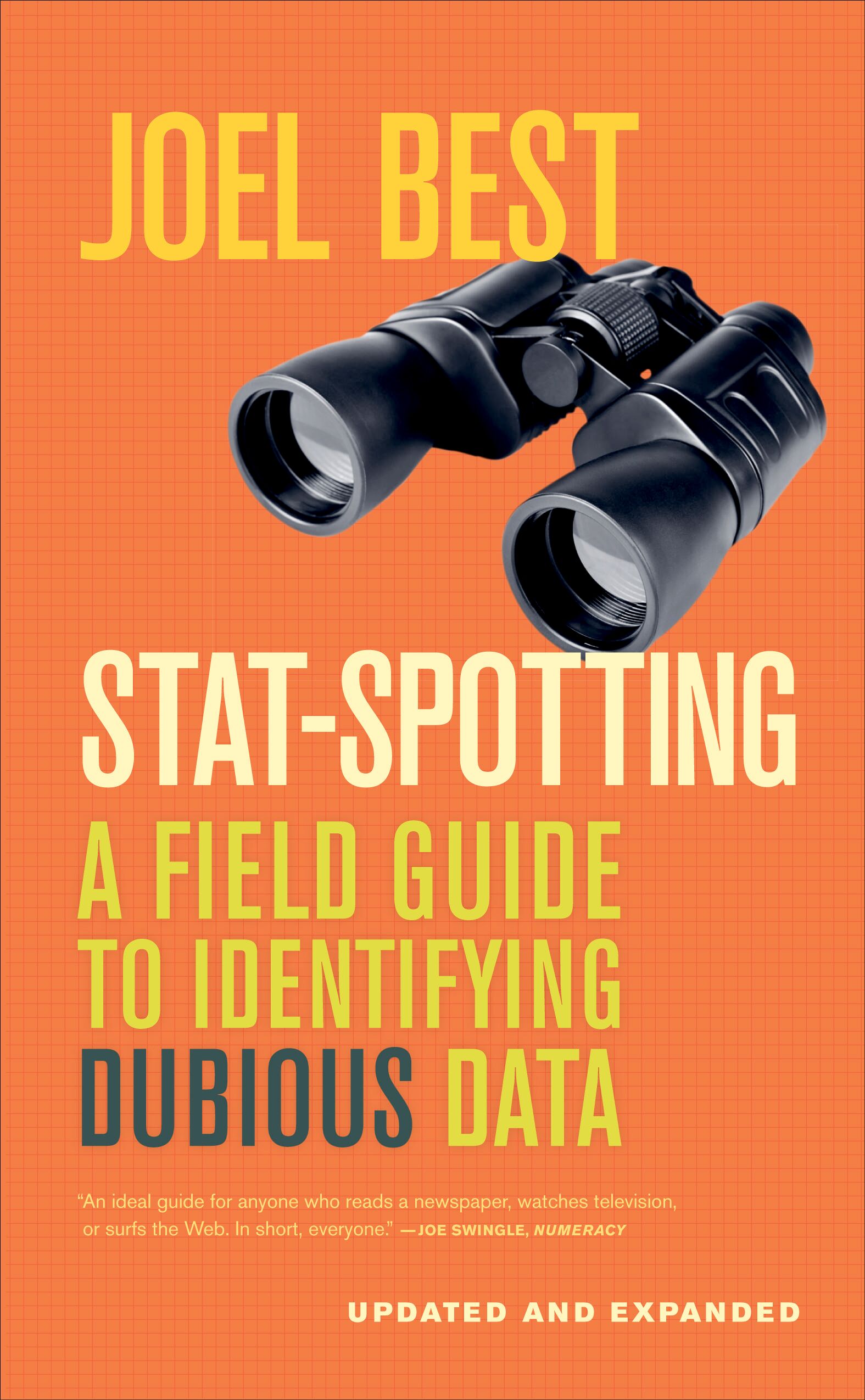
Stat-Spotting
Does a young person commit suicide every thirteen minutes in the United States? Are four million women really battered to death by their husbands or boyfriends each year? Is methamphetamine our number one drug problem today? Alarming statistics bombard our daily lives, appearing in the news, on the Web, seemingly everywhere. But all too often, even the most respected publications present numbers that are miscalculated, misinterpreted, hyped, or simply misleading.
This new edition contains revised benchmark statistics, updated resources, and a new section on the rhetorical uses of statistics, complete with new problems to be spotted and new examples illustrating those problems. Joel Best's best seller exposes questionable uses of statistics and guides the reader toward becoming a more critical, savvy consumer of news, information, and data.
Entertaining, informative, and concise, Stat-Spotting takes a commonsense approach to understanding data and doesn't require advanced math or statistics.
eBook


Evolutionary dynamics on any population structure
The authors derive a condition for how natural selection chooses between two competing strategies on any graph for weak selection, elucidating which population structures promote certain behaviours, such as cooperation.
Evolution, the great game
Evolution is a game that anyone can play. The traits that evolve in a population depend on how the players interact. Students are familiar with toy populations in which every member of the population can interact equally with any other, but as W. S. Gilbert wrote, “When everyone is somebody, then no one's anybody”. In the real world, the numbers and identities of the players can change, and realistic simulations of evolution have proven exceedingly hard to create. Recent models have worked only in special cases in which all individuals have the same number of neighbours. Benjamin Allen and colleagues have now devised a model that works for any number of neighbours, providing that natural selection is weak. They simulate how small changes in population structure can affect evolutionary outcomes, and that cooperation flourishes most in populations with strong ties between pairs of individuals.
Evolution occurs in populations of reproducing individuals. The structure of a population can affect which traits evolve
1
,
2
. Understanding evolutionary game dynamics in structured populations remains difficult. Mathematical results are known for special structures in which all individuals have the same number of neighbours
3
,
4
,
5
,
6
,
7
,
8
. The general case, in which the number of neighbours can vary, has remained open. For arbitrary selection intensity, the problem is in a computational complexity class that suggests there is no efficient algorithm
9
. Whether a simple solution for weak selection exists has remained unanswered. Here we provide a solution for weak selection that applies to any graph or network. Our method relies on calculating the coalescence times
10
,
11
of random walks
12
. We evaluate large numbers of diverse population structures for their propensity to favour cooperation. We study how small changes in population structure—graph surgery—affect evolutionary outcomes. We find that cooperation flourishes most in societies that are based on strong pairwise ties.
Journal Article


The Resurgence of Medical Education in Sociology: A Return to Our Roots and an Agenda for the Future
From 1940 to 1980, studies of medical education were foundational to sociology, but attention shifted away from medical training in the late 1980s. Recently, there has been a marked return to this once pivotal topic, reflecting new questions and stakes. This article traces this resurgence by reviewing recent substantive research trends and setting the agenda for future research. We summarize four current research foci that reflect and critically map onto earlier projects in this subfield while driving theoretical development elsewhere in the larger discipline: (1) professional socialization, (2) knowledge regimes, (3) stratification within the profession, and (4) sociology of the field of medical education. We then offer six potential future directions where more research is needed: (1) inequalities in medical education, (2) socialization across the life course and new institutional forms of gatekeeping, (3) provider well-being, (4) globalization, (5) medical education as knowledge-based work, and (6) effects of the COVID-19 pandemic.
Journal Article

Bodies of information : intersectional feminism and digital humanities
Bodies of Information assembles leading voices in the digital humanities, showcasing feminist contributions to a panoply of topics, including ubiquitous computing, game studies, new materialisms, hashtag activism, hacktivism, and campaigns against online misogyny. Taking intersectional feminism as the starting point for doing digital humanities, Bodies of Information is diverse in discipline, identity, location, and method. Helpfully organized around keywords of materiality, values, embodiment, affect, labor, and situatedness, this comprehensive volume is ideal for classrooms. And with its multiplicity of viewpoints and arguments, it's also an important addition to the evolving conversations around one of the fastest growing fields in the academy.
Book
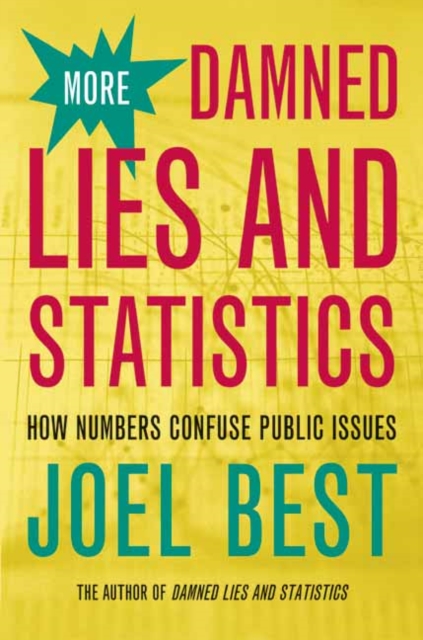
More damned lies and statistics
In this sequel to the acclaimed Damned Lies and Statistics, which the Boston Globe said \"deserves a place next to the dictionary on every school, media, and home-office desk,\" Joel Best continues his straightforward, lively, and humorous account of how statistics are produced, used, and misused by everyone from researchers to journalists. Underlining the importance of critical thinking in all matters numerical, Best illustrates his points with examples of good and bad statistics about such contemporary concerns as school shootings, fatal hospital errors, bullying, teen suicides, deaths at the World Trade Center, college ratings, the risks of divorce, racial profiling, and fatalities caused by falling coconuts. More Damned Lies and Statistics encourages all of us to think in a more sophisticated and skeptical manner about how statistics are used to promote causes, create fear, and advance particular points of view.
eBook