
Catalogue Search | MBRL


Are you sure you want to remove the book from the shelf?

{{itemTitle}}
12,525
result(s) for
"Solar cycle"
Sort by:


Geoeffectiveness of Interplanetary Alfvén Waves. I. Magnetopause Magnetic Reconnection and Directly Driven Substorms
In particular during the descending phase of the solar cycle, Alfvén waves in the high-speed solar wind streams are a major form of interplanetary disturbances. The fluctuating southward interplanetary magnetic field (IMF) of Alfvén waves has been suggested to induce geomagnetic activities through intermittent magnetic reconnection at the magnetopause. In this study, we provide in situ observational evidence for dayside magnetopause reconnection induced by such interplanetary Alfvén waves. Using multipoint conjunction observations, we show that the IMF B z from interplanetary Alfvén waves is transmitted through and amplified by the Earth’s bow shock. Associated with the intensified southward B z to the magnetopause, in situ signatures of magnetic reconnection are detected. Repetitively, interplanetary Alfvén waves transmit the intensified B z to the magnetosheath, leading to intervals of large magnetic shear angles across the magnetopause and magnetopause reconnection. Such intervals are promptly followed by hundreds of nanoTesla (nT) increases in the auroral electrojet indices (AE and AU) within 10–20 minutes. These observations are confirmed in multiple events in corotating interaction region-driven geomagnetic storms. To put the observations into context, we propose a phenomenological model of a strongly driven substorm. The substorm electrojet is linked to the enhanced magnetopause reconnection in the short timescale of re-establishing the ionosphere electric field and the two-cell convection. These results provide insights on the temporal patterns of solar wind magnetosphere–ionosphere coupling, especially during the descending phase of the solar cycle.
Journal Article
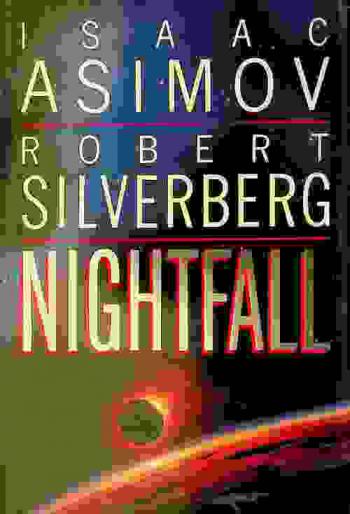
Nightfall
Isaac Asimov's short story, \"Nightfall\", tells of a planet orbiting in a system containing six suns, where a configuration leading to the fall of darkness occurs only once in two millennia. In collaboration with Silverberg, he has expanded the story into a novel which reveals a world on brink of chaos, torn between religious fanaticism and scientific denial and faced with the end of civilization.
Book

Physical Models for Solar Cycle Predictions
The dynamic activity of stars such as the Sun influences (exo)planetary space environments through modulation of stellar radiation, plasma wind, particle and magnetic fluxes. Energetic solar-stellar phenomena such as flares and coronal mass ejections act as transient perturbations giving rise to hazardous space weather. Magnetic fields – the primary driver of solar-stellar activity – are created via a magnetohydrodynamic dynamo mechanism within stellar convection zones. The dynamo mechanism in our host star – the Sun – is manifest in the cyclic appearance of magnetized sunspots on the solar surface. While sunspots have been directly observed for over four centuries, and theories of the origin of solar-stellar magnetism have been explored for over half a century, the inability to converge on the exact mechanism(s) governing cycle to cycle fluctuations and inconsistent predictions for the strength of future sunspot cycles have been challenging for models of the solar cycles. This review discusses observational constraints on the solar magnetic cycle with a focus on those relevant for cycle forecasting, elucidates recent physical insights which aid in understanding solar cycle variability, and presents advances in solar cycle predictions achieved via data-driven, physics-based models. The most successful prediction approaches support the Babcock-Leighton solar dynamo mechanism as the primary driver of solar cycle variability and reinforce the flux transport paradigm as a useful tool for modelling solar-stellar magnetism.
Journal Article

Solar Wind Helium Abundance Heralds Solar Cycle Onset
We study the solar wind helium-to-hydrogen abundance’s (
A
He
) relationship to solar cycle onset. Using OMNI/Lo data, we show that
A
He
increases prior to sunspot number (SSN) minima. We also identify a rapid depletion and recovery in
A
He
that occurs directly prior to cycle onset. This
A
He
shutoff happens at approximately the same time across solar wind speeds (
v
sw
) and the time between successive
A
He
shutoffs is typically on the order of the corresponding solar cycle length. In contrast to
A
He
’s
v
sw
-dependent phase lag with respect to SSN (Alterman and Kasper,
2019
),
A
He
shutofff’s concurrence across
v
sw
likely implies it is independent of solar wind acceleration and driven by a mechanism near or below the photosphere. Using brightpoint (BP) measurements to provide context, we infer that
A
He
shutoff is likely related to the overlap of adjacent solar cycles and the equatorial flux cancelation of the older, extended solar cycle during solar minima.
Journal Article
Origins of Very Low Helium Abundance Streams Detected in the Solar Wind Plasma
The abundance of helium (A He) in the solar wind exhibits variations typically in the range from 2% to 5% with respect to solar cycle activity and solar wind velocity. However, there are instances where the observed A He is exceptionally low (<1%). These low-A He occurrences are detected both near the Sun and at 1 au. The low-A He events are generally observed near the heliospheric current sheet. We analyzed 28 low-A He events observed by the Wind spacecraft and 4 by Parker Solar Probe to understand their origin. In this work, we make use of the ADAPT-WSA model to derive the sources of our events at the base of the solar corona. The modeling suggests that the low-A He events originated from the boundaries of coronal holes, primarily from large quiescent helmet streamers. We argue that the cusp above the core of the streamer can produce such very low helium abundance events. The streamer core serves as an ideal location for gravitational settling to occur as demonstrated by previous models, leading to the release of this plasma through reconnection near the cusp, resulting in low-A He events. Furthermore, observations from Ulysses provide direct evidence that these events originated from coronal streamers.
Journal Article
Solar Wind Driven from GONG Magnetograms in the Last Solar Cycle
In a previous study, Huang et al. used the Alfvén Wave Solar atmosphere Model, one of the widely used solar wind models in the community, driven by ADAPT-GONG magnetograms to simulate the solar wind in the last solar cycle and found that the optimal Poynting flux parameter can be estimated from either the open field area or the average unsigned radial component of the magnetic field in the open field regions. It was also found that the average energy deposition rate (Poynting flux) in the open field regions is approximately constant. In the current study, we expand the previous work by using GONG magnetograms to simulate the solar wind for the same Carrington rotations and determine if the results are similar to the ones obtained with ADAPT-GONG magnetograms. Our results indicate that similar correlations can be obtained from the GONG maps. Moreover, we report that ADAPT-GONG magnetograms can consistently provide better comparisons with 1 au solar wind observations than GONG magnetograms, based on the best simulations selected by the minimum of the average curve distance for the solar wind speed and density.
Journal Article

Modeling the Solar Wind during Different Phases of the Last Solar Cycle
We describe our first attempt to systematically simulate the solar wind during different phases of the last solar cycle with the Alfvén Wave Solar atmosphere Model (AWSoM) developed at the University of Michigan. Key to this study is the determination of the optimal values of one of the most important input parameters of the model, the Poynting flux parameter, which prescribes the energy flux passing through the chromospheric boundary of the model in the form of Alfvén wave turbulence. It is found that the optimal value of the Poynting flux parameter is correlated with the area of the open magnetic field regions with the Spearman’s correlation coefficient of 0.96 and anticorrelated with the average unsigned radial component of the magnetic field with the Spearman’s correlation coefficient of −0.91. Moreover, the Poynting flux in the open field regions is approximately constant in the last solar cycle, which needs to be validated with observations and can shed light on how Alfvén wave turbulence accelerates the solar wind during different phases of the solar cycle. Our results can also be used to set the Poynting flux parameter for real-time solar wind simulations with AWSoM.
Journal Article
Periodic Variations in Visible Light Brightness as Tracers of Fine Coronal Structures
The quiescent or dynamic nature of fine-scale raylike features in the Sun corona, observed in visible light, is still an open question. Here, we show that most of the daily and hourly periodic variations in visible light brightness of the high corona (up to 15 R⊙) are aligned to the tip of streamers and are consistent with the periodicity of plasma release from simulations of tearing-induced magnetic reconnection at the heliospheric current sheet. The areas in which we detect periodicities can be used as tracers of nonquiescent fine coronal rays. This also allows their distinction from coronal rays more likely to be real quiescent features or associated with smaller and/or faster unresolved brightness variations. In the low- and middle-corona (down to 1.4 R⊙) similar brightness variations are observed along loop-like and cusp-like features marking boundaries of streamers, which then connect to radial features in the high corona. This suggests the presence of additional mechanisms in the low- and middle-corona periodically releasing density structures in the solar wind. The periodicity distributions show a solar cycle modulation with shorter periods (smaller structures) during solar maximum. Periodicities are observed within streamers during solar minimum but are visible at all latitudes, even extending radially from the poles, during solar maximum.
Journal Article
The Differences in the Origination and Properties of the Near-Earth Solar Wind between Solar Cycles 23 and 24
The dependence of the sources and properties of the near-Earth solar wind on solar cycle activity is an important issue in solar and space physics. We use the improved “two-step” mapping procedure that takes into account the initial acceleration processes to trace the near-Earth solar winds back to their source regions from 1999–2020, covering solar cycles (SCs) 23 and 24. Then, the solar wind is categorized into coronal hole (CH), active region (AR), and quiet Sun (QS) solar wind based on the source region type. We find that the proportions of CH and AR (QS) wind during SC 23 are higher (lower) than those during SC 24. During solar maximum and declining phases, the magnetic field strength, speed, helium abundance (A He), and charge states of all three types of solar wind during SC 23 are generally higher than those during SC 24. During solar minimum, these parameters of solar wind are generally lower during SC 23 than those during SC 24. There is a significant decrease in the charge states of all three types of solar wind during the solar minimum of SC 23. The present statistical results demonstrate that the sources and properties of the solar wind are both influenced by solar cycle amplitude. The temperatures of AR, QS, and CH regions exhibit significant differences at low altitudes, whereas they are almost uniform at high altitudes.
Journal Article