
Catalogue Search | MBRL


Are you sure you want to remove the book from the shelf?

{{itemTitle}}
48
result(s) for
"Soldiers Iraq Biography"
Sort by:

Connected Soldiers
2023 Gold Medal in Biography/Memoir from the Military Writers
Society of America John Spencer was a new second lieutenant in 2003
when he parachuted into Iraq leading a platoon of infantry soldiers
into battle. During that combat tour he learned how important unit
cohesion was to surviving a war, both physically and mentally. He
observed that this cohesion developed as the soldiers experienced
the horrors of combat as a group, spending their downtime together
and processing their shared experiences. When Spencer returned to
Iraq five years later to take command of a troubled company, he
found that his lessons on how to build unit cohesion were no longer
as applicable. Rather than bonding and processing trauma as a
group, soldiers now spent their downtime separately, on computers
communicating with family back home. Spencer came to see the
internet as a threat to unit cohesion, but when he returned home
and his wife was deployed, the internet connected him and his
children to his wife on a daily basis. In Connected
Soldiers Spencer delivers lessons learned about effective
methods for building teams in a way that overcomes the distractions
of home and the outside world, without reducing the benefits gained
from connections to family.
eBook

Ghosts of war : the true story of a 19-year-old GI
Ryan Smithson joined the Army Reserve when he was seventeen. Two year later, he was deployed to Iraq as an Army engineer. In this memoir, readers march along one GI's tour of duty. This is an account of the motivations and life of a contemporary soldier.
Book
Women at War
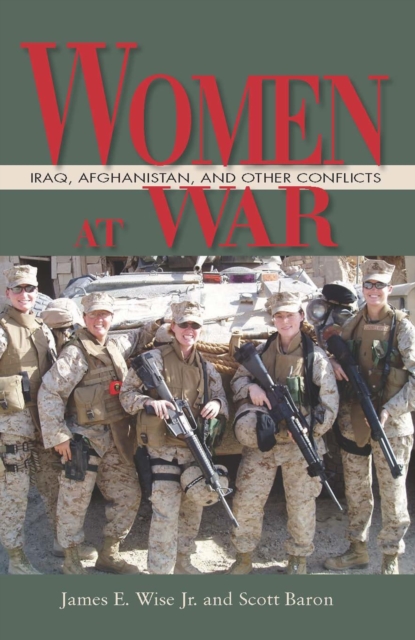
Today, women in all U.S. military services are involved in the war in Iraq and Afghanistan. They serve as pilots and crewmen of assault helicopters, bombers, fighters, and transport planes, and are frequently engaged in firefights with enemy insurgents while guarding convoys, traveling in hostile territory, or performing military police duties. Like their male counterparts, they carry out their missions with determination and great courage. The advent of the insurgency war, which has no rear or front lines, has made the debate regarding women in combat irrelevant. In such a war zone, anyone can be killed or injured at any moment. The stories of these courageous women are told by James E. Wise and Scott Baron, who use a format similar to the one employed with such success in the book \"Stars in Blue\". The profiles of some forty women and their photographs are included. To record their stories, the authors conducted numerous personal interviews, and in every case Wise and Baron were struck by the women's extraordinary display of dedication to their mission and to the soldiers and sailors with whom they served. Because the service of women in the military has been under reported to date, most of the women included in this book will be unknown to readers and reveal another dimension to the service of women in the desert and the vital role they play in the armed forces. While the book's focus is on today's women in combat, it also reaches back to Vietnam, Korea, and World War II to offer selected stories of inspiring women who served at the \"cusp of the spear\" as they fought and died for their country.
eBook

My life as a foreign country
\"In this ... memoir, award-winning poet Brian Turner retraces his war experience--pre-deployment to combat zone, homecoming to aftermath. Free of self-indulgence or self-glorification, his account combines recollection with the imagination's efforts to make reality comprehensible. Across time, he seeks parallels in the histories of others who have gone to war, especially his taciturn grandfather (World War II), father (Cold War), and uncle (Vietnam). Turner also offers something that is truly rare in a memoir of violent conflict--he sees through the eyes of the enemy, imagining his way into the experience of the 'other'\"--Provided by publisher.
Book

\Good Soldier\ on Trial
An expert witness in legal cases involving rules of engagement and the US military murder of prisoners, Prof. Mestrovic exposes profound contradictions and systemic flaws that confuse criminal brutality and heroism, making victims of soldiers like Sergeant Michael Leahy who won a purple heart but also was sentenced to life imprisonment in 2009.
eBook

Living with no excuses : the remarkable rebirth of an American soldier
Galloway discusses \"his upbringing in rural Alabama, his military experience, and the battle he faced to overcome losing two limbs during Operation Iraqi Freedom. From reliving the early days of life to his acceptance of his 'new normal' after losing his arm and leg in combat, Noah reveals his ambition to succeed against all odds, [including participating in the TV shows Dancing with the Stars and American Grit]\"--Amazon.com.
Book
How do I save my honor?
How Do I Save My Honor? is a powerful exploration of individual moral responsibility in a time of war. When people decide that the actions of their government have violated basic norms of ethics and justice, what are they to do? Are there degrees of moral responsibility that public officials, soldiers, and private citizens bear for unethical actions of their leaders and government? William F. Felice considers these central ethical questions through the compelling stories of individuals in the U.S. and British government and military who struggled to protect their moral integrity during the Iraq war and occupation. Some came to the difficult conclusion that resignation from their post was necessary to maintain their responsibility to the truth and to uphold their honor. Others decided to work from within to try to correct what they perceived as misguided policies. Examining the struggles of these contemporary men and women, as well as of historical figures facing similar dilemmas, William Felice weighs the profound difficulties of overcoming the intense pressures of misguided loyalty, patriotism, and groupthink that predominate during war.
eBook

Desert mementos : stories of Iraq and Nevada
\"Desert Mementos capture the similarities in the respective desert landscapes of both Iraq and Nevada. But it is not just a study in contrasting landscapes. Desert Mementos explores the similarities and differences in human needs from the perspectives of vastly different cultures and in vastly different environments.\"--Provided by publisher.
Book
