
Catalogue Search | MBRL


Are you sure you want to remove the book from the shelf?

{{itemTitle}}
11,523
result(s) for
"Sonata"
Sort by:

Beethoven's cello : five revolutionary sonatas and their world
\"In 1796 the young Beethoven presented his first two cello sonatas at the court of Frederick William II, an avid cellist and the reigning Prussian monarch. Released in print the next year, these revolutionary sonatas forever altered the cello repertoire by fundamentally redefining the relationship between the cello and the piano and promoting their parity. Beethoven continued to develop the potential of the duo partnership in his three other cello sonatas - the lyrical and heroic Op. 69 and the two experimental sonatas Op. 102, No. 1 and No. 2, transcendent compositions conceived on the threshold of the composer's late style. In Beethoven's Cello, Marc D. Moskovitz and R. Larry Todd examine these seminal cornerstones of the cello repertoire and place them within their historical and cultural context. Also considered in a series of interludes are Beethoven's three variation sets, his cello-centric 'Triple' Concerto, and arrangements for cello and piano of other works. Two other interludes address the cellos owned by Beethoven and the changing nature of his pianos. Featuring a preface by renowned cellist Steven Isserlis and concluding with translated reviews of the composer's cello music published during his lifetime, Beethoven's Cello is the ideal companion for cellists, pianists, musicologists and chamber-music devotees desiring a comprehensive understanding of this beloved repertoire.\"--Jacket flap.
BOOK

Ludwig Van Beethoven
A comprehensive and immersive survey of thirty-five Beethoven piano sonatasBeethoven's piano sonatas are among the iconic cornerstones of the classical music repertoire. Jan Marisse Huizing offers an in-depth study of the sonatas using available autographs, first editions, recordings, and nearly three hundred musical examples.Digging into the historical background and historical performance practice, the book provides illuminating detail on Beethoven's pianism as well as his characteristics of notation, form and content, \"types of touch,\" articulation, beaming, pedal indications, character, rubato, meter, metric constructions, tempo, and metronome marks.Packed with anecdotes, quotations, and considerable new information, the book will inspire all involved with these masterworks, playing a fortepiano or modern Grand, giving the sense of the composer sitting beside them as he translates his inspiration and ideas into his notation.
eBook

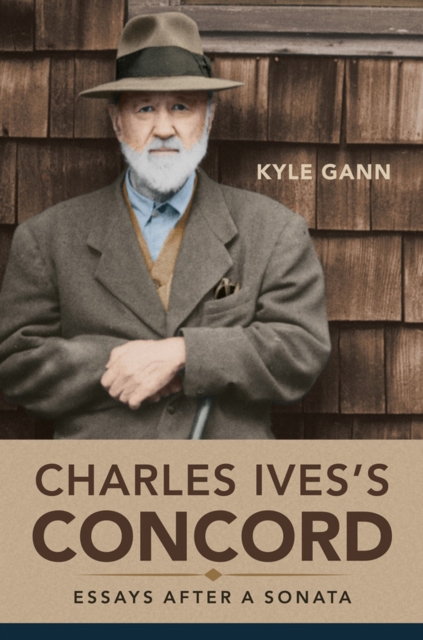
Charles Ives's Concord
In 1921, insurance executive Charles Ives sent out copies of a piano sonata to two hundred strangers. Laden with dissonant chords, complex rhythm, and a seemingly chaotic structure, the so-called Concord Sonata confounded the recipients, as did the accompanying book, Essays before a Sonata . Kyle Gann merges exhaustive research with his own experience as a composer to reveal the Concord Sonata and the essays in full. Diffracting the twinned works into their essential aspects, Gann lays out the historical context that produced Ives's masterpiece and illuminates the arguments Ives himself explored in the Essays . Gann also provides a movement-by-movement analysis of the work's harmonic structure and compositional technique; connects the sonata to Ives works that share parts of its material; and compares the 1921 version of the Concord with its 1947 revision to reveal important aspects of Ives's creative process. A tour de force of critical, theoretical, and historical thought, Charles Ives's Concord provides nothing less than the first comprehensive consideration of a work at the heart of twentieth century American music.
eBook

Elements of Sonata Theory
Elements of Sonata Theory is a comprehensive rethinking of the basic principles of sonata form in the decades around 1800. This foundational study outlines a new, up-to-date paradigm for understanding the compositional choices found in the instrumental works of Haydn, Mozart, Beethoven: sonatas, chamber music, symphonies, overtures, and concertos.
eBook

The Expositional Rondo
This paper argues that “problematic” or “inconvenient” sonata-rondo movements lacking clear recapitulations, such as Haydn’s “Clock” symphony finale, should be defined neither negatively (as a flawed or “lesser” sonata-rondo form) nor experientially (as a midstream conversion from Type 4 to rondo), but rather as descendants of the expositional rondo that originated in finales as early as the 1760s in pieces by Mozart, Joseph and Michael Haydn, J.C. Bach, and Joseph Bologne, the Chevalier St. Georges. Their first couplet-episode (AB) pair forms a sonata exposition (by Galant standards, using Burstein’s (2020) recently revived Kochian terms such as Grundabsätze and Quintabsätze, as well as the Modulating Prinner), and then proceeds to the standard couplet-episode (AC, AD, etc.) layout until complete; the expositional materials never return. As the generic norms of their sonata forms began to take shape in the 1770s, both Mozart and Haydn began to add a section late in the pieces, perhaps to compensate for the lack of the return of expositional materials, a section I label a “balancing” section.
Journal Article

Graph Neural Network and LSTM Integration for Enhanced Multi-Label Style Classification of Piano Sonatas
In the field of musicology, the automatic style classification of compositions such as piano sonatas presents significant challenges because of their intricate structural and temporal characteristics. Traditional approaches often fail to capture the nuanced relationships inherent in musical works. This paper addresses the limitations of traditional neural networks in piano sonata style classification and feature extraction by proposing a novel integration of graph convolutional neural networks (GCNs), graph attention networks (GATs), and Long Short-Term Memory (LSTM) networks to conduct the automatic multi-label classification of piano sonatas. Specifically, the method combines the graph convolution operations of GCNs, the attention mechanism of GATs, and the gating mechanism of LSTMs to perform the graph structure representation, feature extraction, allocation weighting, and coding of time-dependent features of music data layer by layer. The aim is to optimize the representation of the structural and temporal features of musical elements, as well as the dependence between discovery features, so as to improve classification performance. In addition, we utilize MIDI files of several piano sonatas to construct a dataset, spanning the 17th to the 19th centuries (i.e., the late Baroque, Classical, and Romantic periods). The experimental results demonstrate that the proposed method effectively improves the accuracy of style classification by 15% over baseline schemes.
Journal Article

Commentary on De Souza and Lokan (2019)
This contribution is a brief commentary on the paper \"Hypermetrical Irregularity in Sonata Form: A Corpus Study\" by Jonathan De Souza and David Lokan. The original paper explores the hypothesis that in a sonata form, the development is more hypermetrically stable than the exposition. The published data support the hypothesis. The commentary suggests other paths for discussion and further tweaks to the study that may better show how data support or contradict De Souza and Lokan's intuitions.
Journal Article
