
Catalogue Search | MBRL


Are you sure you want to remove the book from the shelf?

{{itemTitle}}
11,558
result(s) for
"Sonatas"
Sort by:

The Prague sonata : a novel
\"A literary quest novel that travels from Nazi-occupied Prague to turn-of-the-millennium New York as a young musicologist seeks to solve the mystery behind an eighteenth-century sonata manuscript\"--Amazon.com.
Book

Ludwig Van Beethoven
A comprehensive and immersive survey of thirty-five Beethoven piano sonatasBeethoven's piano sonatas are among the iconic cornerstones of the classical music repertoire. Jan Marisse Huizing offers an in-depth study of the sonatas using available autographs, first editions, recordings, and nearly three hundred musical examples.Digging into the historical background and historical performance practice, the book provides illuminating detail on Beethoven's pianism as well as his characteristics of notation, form and content, \"types of touch,\" articulation, beaming, pedal indications, character, rubato, meter, metric constructions, tempo, and metronome marks.Packed with anecdotes, quotations, and considerable new information, the book will inspire all involved with these masterworks, playing a fortepiano or modern Grand, giving the sense of the composer sitting beside them as he translates his inspiration and ideas into his notation.
eBook


SONATA KV 457 DE MOZART Y SONATA OP. 13 DE BEETHOVEN: SIMILITUDES ESTILÍSTICAS SORPRENDENTES
La sonata fue la forma musical preponderante del Clasicismo, ya como sinfonía, cuarteto o sonata de tipo instrumental. De esta manera, la forma sonata se convirtió en el principal vehículo de expresión de los compositores del período vienés -Haydn, Mozart y Beethoven- y, en realidad, no fueron pocas las intersecciones estilísticas entre ellos. En el caso de las sonatas KV457 (Mozart) y Op. 13 (Beethoven), ambas en Do menor, encontramos diversas analogías que nos permiten pensar en la famosa Sonata Patética de Beethoven como un velado homenaje al genio de Salzburgo.
Journal Article

Beethoven's 32 piano sonatas : a handbook for performers
\"The thirty-two piano sonatas of Ludwig van Beethoven comprise one of the most important parts of the piano literature, yet true mastery of these works can be elusive to even the most seasoned performer. With years of experience performing and teaching the literature and intimate knowledge of the works, their history and context, renowned pianist and pedagogue Stewart Gordon guides today's pianist performer through each of the thirty-two sonatas in stunning detail.\"--Page 4 of cover.
BOOK

Chasing Chopin : a musical journey across three centuries, four countries, and a half-dozen revolutions
\"The Frédéric Chopin Annik LaFarge presents here is not the melancholy, sickly, romantic figure so often portrayed. The artist she discovered is, instead, a purely independent spirit: an innovator who created a new musical language, an autodidact who became a spiritually generous, trailblazing teacher, a stalwart patriot during a time of revolution and exile. In Chasing Chopin she follows in his footsteps during the three years, 1837-1840, when he composed his iconic \"Funeral March\"-dum dum da dum-using its composition story to illuminate the key themes of his life: a deep attachment to his Polish homeland; his complex relationship with writer George Sand; their harrowing but consequential sojourn on Majorca; the rapidly developing technology of the piano, which enabled his unique tone and voice; social and political revolution in 1830s Paris; friendship with other artists, from the famous Eugène Delacroix to the lesser known, yet notorious in his time, Marquis de Custine. Each of these threads-musical, political, social, personal-is woven through the \"Funeral March\" in Chopin's Opus 35 sonata, a melody so famous it's known around the world even to people who know nothing about classical music. But it is not, as LaFarge discovered, the piece of music we think we know. As part of her research into Chopin's world, then and now, LaFarge visited piano makers, monuments, churches, and archives; she talked to scholars, jazz musicians, video game makers, software developers, music teachers, theater directors, and of course dozens of pianists. The result is extraordinary: an engrossing, page-turning work of musical discovery and an artful portrayal of a man whose work and life continue to inspire artists and cultural innovators in astonishing ways\"-- Provided by publisher.
BOOK
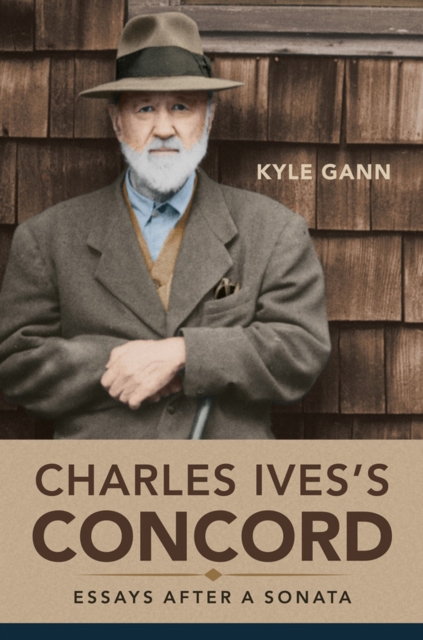
Charles Ives's Concord
In 1921, insurance executive Charles Ives sent out copies of a piano sonata to two hundred strangers. Laden with dissonant chords, complex rhythm, and a seemingly chaotic structure, the so-called Concord Sonata confounded the recipients, as did the accompanying book, Essays before a Sonata . Kyle Gann merges exhaustive research with his own experience as a composer to reveal the Concord Sonata and the essays in full. Diffracting the twinned works into their essential aspects, Gann lays out the historical context that produced Ives's masterpiece and illuminates the arguments Ives himself explored in the Essays . Gann also provides a movement-by-movement analysis of the work's harmonic structure and compositional technique; connects the sonata to Ives works that share parts of its material; and compares the 1921 version of the Concord with its 1947 revision to reveal important aspects of Ives's creative process. A tour de force of critical, theoretical, and historical thought, Charles Ives's Concord provides nothing less than the first comprehensive consideration of a work at the heart of twentieth century American music.
eBook
