
Catalogue Search | MBRL


Are you sure you want to remove the book from the shelf?

{{itemTitle}}
1,012
result(s) for
"Song texts."
Sort by:

The tide is rising so are we! : a climate movement anthem
\"Inspired by the climate movement anthem \"The Tide Is Rising,\" this story is full of hope and determination for rising up to meet the climate change challenges of our day\"-- Provided by publisher.
CHILDBOOK
Rachmaninoff's Complete Songs
Sergei Rachmaninoff-the last great Russian romantic and arguably the finest pianist of the late 19th and early 20th centuries-wrote 83 songs, which are performed and beloved throughout the world. Like German Lieder and French mélodies, the songs were composed for one singer, accompanied by a piano. In this complete collection, Richard D. Sylvester provides English translations of the songs, along with accurate transliterations of the original texts and detailed commentary. Since Rachmaninoff viewed these \"romances\" primarily as performances and painstakingly annotated the scores, this volume will be especially valuable for students, scholars, and practitioners of voice and piano.
eBook


Exploring widowhood experiences through selected Zimbabwean Shona songs
This article explores the post-death socio-cultural and economic vicissitudes that are encountered by widows in the context of losing the husband as a male counterpart. Focus is on the reflections from male-sung selected Shona songs as cultural texts, namely, Simon Chimbetu’s Shirikadzi (widow), Solo Makore’s Shirikadzi (widow), and Oliver Mutukudzi’s Neria. These song texts are utilized as the article’s primary sources and prism through which the typical lived and liveable realities of widowhood among the Shona people of Zimbabwe are interpreted. Obtaining in the lyrical renditions and maintained as the argument of the article is that losing the husband, in a nuclear Shona family setup, plunges the surviving female spouse into socio-economic turbulence and emotional turmoil. In this regard, responsible participation and complementarity among kin members become indispensable. With less effective social nets towards such vulnerable groups in contemporary society, the article further avers that this has far-reaching implications on the kinship system–precisely the elder son (mwanakomana) and/or the brother (hanzvadzi), among others. Thus, unlike previous widowhood studies, this article uniquely interrogates widowed women’s uncomfortable experiences as a society collective responsibility rather than an individual burden. The article uniquely engages music since it is deployed as a functional and valid tool for mass communication. The expressed poignant widowhood challenges are appreciated from the perspective of Africana womanism theory against the backdrop that the issues are conceptualised within the socio-cultural and economic frame of male-female relations.
Journal Article


Robert de Reims
Robert de Reims, also known as \"La Chievre de Rains,\" was among
the earliest trouvères-poet-composers who were contemporaries of
the troubadours but who wrote in the dialects of northern France.
This critical edition provides new translations into English and
modern French of all the songs and motets ascribed to him, along
with the original texts, the extant music, and a substantive
introduction.
Active sometime between 1190 and 1220, Robert was an influential
figure in the literary circles of Arras. Thirteen compositions set
to music are here attributed to him, including nine chansons and
four polyphonic motets that were broadly disseminated in the
thirteenth century and beyond. Robert's work is exceptional on a
number of fronts. He lavished particular care on the phonic harmony
of his words. Acoustic luxuriance and expertise in rhyming,
grounded in the play of echoes and variation (often extending into
the music), constitute the hallmark of his poetry. Moreover, he is
the earliest trouvère known to have composed a parodic sotte
chanson contre Amours (silly song against Love).
Located clearly at the nexus of monophonic song and polyphony,
Robert's corpus also poses the intriguing question of trouvère
participation in the development of the polyphonic repertory. The
case of Robert de Reims jostles and tempers the standard history of
the chanson and motet.
Accessible and instructive, this trilingual critical edition of
his complete works makes the oeuvre of this innovative and
consequential trouvère available in one volume for the first
time.
eBook

Music, Text and Translation
Expanding the notion of translation, this book specifically focuses on the transferences between music and text. The concept of 'translation' is often limited solely to language transfer. It is, however, a process occurring within and around most forms of artistic expression. Music, considered a language in its own right, often refers to text discourse and other art forms. In translation, this referential relationship must be translated too. How is music affected by text translation? How does music influence the translation of the text it sets? How is the sense of both the text and the music transferred in the translation process? Combining theory with practice, the book questions the process and role translation has to play in a musical context. It provides a range of case studies across interdisciplinary fields. It is the first collection on music in translation that is not restricted to one discipline, including explorations of opera libretti, surtitling, art song, musicals, poetry, painting, sculpture and biography, alongside looking at issues of accessibility.
eBook

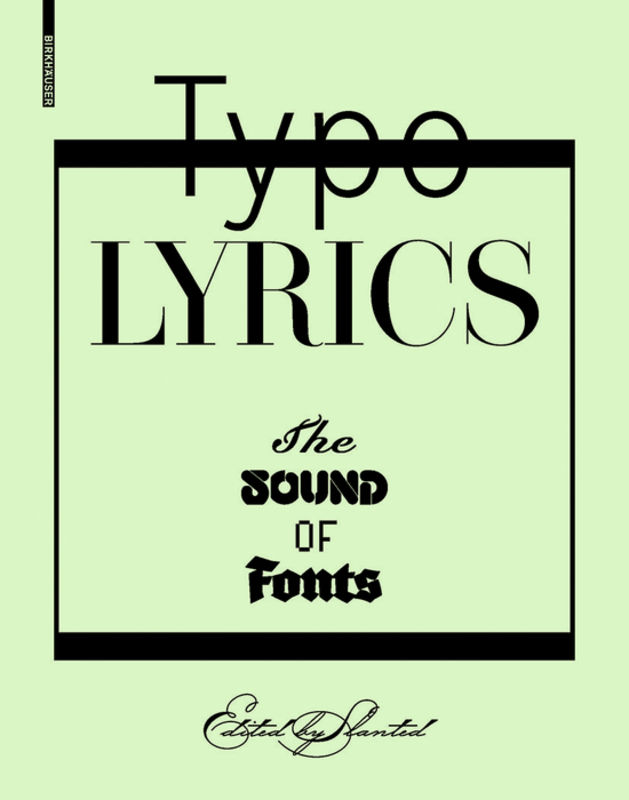
TypoLyrics
Graphic designers love music.This is attested not least by the tremendous enthusiasm that readers of the typography magazine Slanted bring to its \"Typo Lyrics\" column, in which designers interpret music in entirely new ways with the help of fonts.
eBook

Norms of Textual Scansion and Rhyme in Beatles AABA Forms
In AABA songs (sometimes called verse–bridge songs) written and performed by the Beatles, the song texts’ scansion and rhyme show significant contrasts between different sections, and these contrasts often have important formal and narrative functions. Combining rock Formenlehre with phonetic analysis, this article shows that A modules tend to have irregular scansion and frequent rhyme, while B modules tend to show regular scansion and less frequent rhyme. In the unusual cases where A modules have infrequent rhyme, the B modules tend to offer contrast by showing greater rhyme frequency. These contrasts represent an independent, recurring formal device in the Beatles’ catalogue that does not entirely comport with other well-defined formal processes, such as the looseverse/tight-chorus schema. The scansion and rhyme have various narrative and formal functions: They often suggest a contrast between an active and passive state in the song’s protagonist, and disruptions to regular patterns or conflict with grammatical boundaries can play a critical role in shaping phrases. B modules that thwart the norm can connote an especially high emotional arousal or suggest a process of intensification and conclusion, linking the form to an expanded statement–response–departure–conclusion form. The analyses demonstrate the central role that prosody often plays in popular song and show the importance of considering its relation to other musical patterns.
Journal Article