
Catalogue Search | MBRL


Are you sure you want to remove the book from the shelf?

{{itemTitle}}
8,869
result(s) for
"Sophocles."
Sort by:

Late Sophocles : the hero's evolution in Electra, Philoctetes, and Oedipus at Colonus
\"Only a few plays by Sophocles--one of the great tragic playwrights from Classical Athens--have survived, and each of them dramatizes events from the rich store of myths that framed literature and art. Sophocles' treatment evokes issues that were vividly contemporary for Athenian audiences of the Periclean age: How could the Athenians incorporate older, aristocratic ideas about human excellence into their new democratic society? Could citizens learn to be morally excellent, or were these qualities only inherited? What did it mean to be a creature who knows that he or she must die? Late Sophocles traces the evolution of the Sophoclean hero through the final three plays, Electra, Philoctetes, and Oedipus at Colonus. The book's main thesis, that Sophocles reimagined the nature of the tragic hero in his last three works, is developed inductively through readings of the plays. This balanced approach, in which a detailed argument about the plays is offered in a format accessible to nonspecialists, is unusual--perhaps unique--in contemporary Classical scholarship on Sophocles. This book will appeal to nonspecialist readers of serious literature as well as scholars of classical and other literatures. While including ample guidance for those not familiar with the plays, Late Sophocles goes beyond a generalized description of \"what happens\" in the plays to offer a clear, jargon-free argument for the enduring importance of Sophocles' plays. The argument's implications for longstanding interpretational issues will be of interest to specialists. All Greek is translated.\" -- Publisher's description
BOOK

Sophocles and the Language of Tragedy
This book offers a revolutionary take on Sophocles’ tragic language – and on how we talk about tragedy as a genre. The first section explores how Sophocles excitingly develops the resources of Greek tragedy: it looks at Sophocles’ manipulation of irony, his construction of dialogue, his deployment of the actors, the role of the chorus, and reveals the playwright’s distinctive brilliance. The second section explores how the critical understanding of tragedy as a genre developed in the nineteenth century: how did Victorian critics develop a distinctive way of talking about irony, the chorus, the development of the actor’s role? Goldhill reveals the deep debt of modern critics to their nineteenth-century forebears. Finally, the book explores the foundational question of literary criticism raised by these two sections: how historical, how historically self-conscious should a reading of Greek tragedy be? This book makes a
telling contribution to the discussion of tragedy, of literary criticism, and of how the past is understood.
eBook

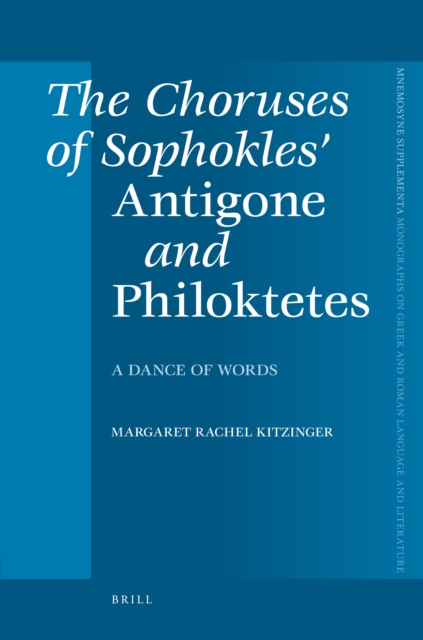
The Choruses of Sophokles' Antigone and Philoktetes
This volume argues for a fundamental difference in the modes of expression of actor and chorus in Sophoklean tragedy. The chorus views the action and the world of the play from the perspective of dancers and singers, while the actors' understanding is shaped by the responsibility they have to make things happen.
eBook


Brill's Companion to the Reception of Sophocles
Brill's Companion to the Reception of Sophocles offers a comprehensive account of the reception of Sophocles' plays over the centuries, across cultures and within a range of different fields, such as literature, intellectual history, visual arts, music, dance, stage and cinema.
eBook


City of suppliants : tragedy and the Athenian empire
With close readings of suppliant dramas by each of the major playwrights, this book explores how Greek tragedy used tales of foreign supplicants to promote, question, and negotiate the imperial ideology of Athens as a benevolent and moral ruling city.
eBook

Scholia vetera in Sophoclis Oedipum Coloneum
Scholars have been seeking to understand Sophocles' 'Oedipus at Colonus' for over two millennia. The roots of this long tradition of the play's interpretation lie in Hellenistic Alexandria, and are now represented mainly by a series of notes that have survived in the margins of medieval manuscripts. The book offers an introduction and an authoritative new critical text, which is accompanied by a detailed apparatus criticus.
BOOK

AJAX’S ‘GREAT TIME’ AND STOBAEUS’ TRAGIC QUOTATIONS: SOPHOCLES, AJAX 714
This article supports Livineius’ deletion of τϵ καὶ ϕλέγϵι in Soph. Aj. 714 πάνθ’ ὁ μέγας χρόνος μαραίνϵι by means of a comparative examination of tragic quotations in Stobaeus’ Anthology, where Aj. 714 is quoted without τϵ καὶ ϕλέγϵι (1.8.24).
Journal Article