
Catalogue Search | MBRL


Are you sure you want to remove the book from the shelf?

{{itemTitle}}
129
result(s) for
"South African literature (English) History and criticism."
Sort by:


South Africa and the dream of love to come : queer sexuality and the struggle for freedom
After apartheid, South Africa established a celebrated new political order that imagined the postcolonial nation as belonging equally to the descendents of indigenous people, colonizing settlers, transported slaves, indentured laborers, and immigrants. Its constitution, adopted in 1996, was the first in the world to include gays and lesbians as full citizens. Brenna M. Munro examines the stories that were told about sexuality, race, and nation throughout the struggle against apartheid in order to uncover how these narratives ultimately enabled gay people to become imaginable as fellow citizens. She also traces how the gay, lesbian, or bisexual person appeared as a stock character in the pageant of nationhood during the transition to democracy. In the process, she offers an alternative cultural history of South Africa. Munro asserts that the inclusion of gay people made South Africans feel \"modern\"-at least for a while. Being gay or being lesbian was reimagined in the 1990s as distinctly South African, but the \"newness\" that made these sexualities apt symbols for a transformed nation can also be understood as foreign and un-African. Indeed, a Western-style gay identity is often interpreted through the formula \"gay equals modernity equals capitalism.\" As South Africa's reentrance into the global economy has failed to bring prosperity to the majority of its citizens, homophobic violence has been on the rise. Employing a wide array of texts-including prison memoirs, poetry, plays, television shows, photography, political speeches, and the postapartheid writings of Nobel Laureates Nadine Gordimer and J. M. Coetzee-Munro reports on how contemporary queer activists and artists are declining to remain ambassadors for the \"rainbow nation\" and refusing to become scapegoats for the perceived failures of liberation and liberalism.
eBook


Apartheid and Beyond
This book contributes to the study of South African literature, offering readings of writers such as Coetzee, Gordimer, Fugard, Tlali, and Mda. Focusing on the relationship between place, subjectivity, and literary form, the study examines our understanding of apartheid as a geographical form of control, and of its imagined and actual transformation.
eBook

Like family : domestic workers in South African history and literature
More than a million black South African women are domestic workers. These nannies, housekeepers and chars occupy a central place in South African society. but it is an ambivalent position. Precariously situated between urban and rural areas, rich and poor, white and black, these women are at once intimately connected to and at a distant remove from the families they serve. \"Like family\" they may be, but they and their employers know they can never be real family. The author shows that slavery at the Cape shaped South African domestic worker relations, establishing social hierarchies and patterns of behavior and interaction that persist in the predicament of black female domestic workers today. The author examines the representation of domestic workers in a diversity of texts in English and Afrikaans. Authors include Andrâe Brink, JM Coetzee, Nadine Gordimer, Elsa Joubert, Antjie Krog, Sindiwe Magona, Es'kia Mphahlele, Sisonke Msimang, Zukiswa Wanner and Zoèe Wicomb. She uncovers wry and subversive insights into the \"madam/maid\" nexus, capturing paradoxes relating to shifting power relationships.
Book
South African Literary Cultural Nationalism--Abalobi BeSizwe EMzansi--1918-45
This book is an intellectual history that uses Am lcar Cabral's theory of the \"return to the source,\" to examine Sol Plaatje's Mhudi, B.W. Vilakazi's poetry, and A.C. Jordan's The Wrath of the Ancestors within the broader context of African cultural nationalisms in the early twentieth century African Atlantic World. It shows the development of the idea of African equality with Whites in the face of prevailing ideas of White supremacy during Union-era South Africa. These authors were part of the New African Movement, which was one of eight literary movements among Africans and peoples of African descent in the Americas between 1915 and 1945, including the Harlem Renaissance, N gritude, Claridade in Cape Verde, and similar movements in Cuba, Haiti, Brazil, and Belize. The text presents new models for interpreting Union-era African literature, and recasts understanding of the nature of interactions between Africans and Europeans, including Western Syphilization, Chiral Interdiscursivity, and the relationship between history and memory informed by a neurobiological analysis of memory.
eBook


Trauma, Memory, and Narrative in South Africa
Twenty years after the fall of apartheid, South Africa is still struggling with its traumatic past. In this interdisciplinary collection of interviews, prominent South African novelists, psychologists, and academics reflect on the issues of trauma, memory.
eBook

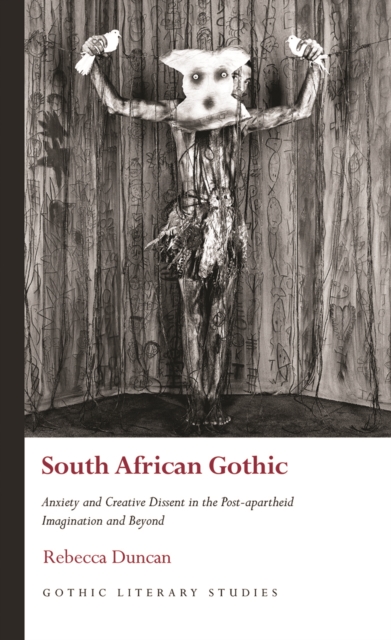
South African Gothic
The term 'Gothic' has rarely been brought to bear on contemporary South African fictions, appearing too fanciful for the often overtly political writing of apartheid and post-apartheid South Africa. As the first book-length exploration of Gothic impulses in South African literature, this volume accounts for the Gothic currents that run through South African imaginaries from the late-nineteenth century onwards. South African Gothic identifies an intensification in Gothic production that begins with the nascent decline of the apartheid state, and relates this to real anxieties that arise with the unfolding of social and political change. In the context of a South Africa unmaking and reshaping itself, Gothic emerges as a language for long-suppressed histories of violence, and for ongoing experiences at odds with utopian images of the new democracy. Its function is interrogative and ultimately creative: South African Gothic challenges narrow conceptions of the status quo to drive at alternative, less exclusionary visions.
eBook