
Catalogue Search | MBRL


Are you sure you want to remove the book from the shelf?

{{itemTitle}}
14
result(s) for
"South Asia History, Military 19th century."
Sort by:


War, Culture and Society in Early Modern South Asia, 1740-1849
This book argues that the role of the British East India Company in transforming warfare in South Asia has been overestimated. Although it agrees with conventional wisdom that, before the British, the nature of Indian society made it difficult for central authorities to establish themselves fully and develop a monopoly over armed force, the book argues that changes to warfare in South Asia were more gradual, and the result of more complicated socio-economic forces than has been hitherto acknowledged.
The book covers the period from 1740, when the British first became a major power broker in south India, to 1849, when the British eliminated the last substantial indigenous kingdom in the sub-continent. Placing South Asian military history in a global, comparative context, it examines military innovations; armies and how they conducted themselves; navies and naval warfare; major Indian military powers - such as the Mysore and Khalsa kingdoms, the Maratha confederacy - and the British, explaining why they succeeded.
eBook


Sailors, slaves, and immigrants : bondage in the Indian Ocean world, 1750-1914
Slaves, convicts, and unfree immigrants have traveled the oceans throughout human history, but the conventional Atlantic World historical paradigm has narrowed our understanding of modernity. This provocative study contrasts the Atlantic conflation of freedom and the sea with the complex relationships in the Indian Ocean in the long 19th century.
eBook

Coolies of Capitalism
Coolie labour was often proclaimed as a deliberate compromise straddling the regimes of the past (slave labour) and the future (free labour). In the late 1850s, the locals were replaced by labourers imported from outside the province who were designated coolies. Qualifying this framework of transition and introduction, this study makes a case for the production of coolie labour in the history of the colonial-capitalist plantations in Assam.
eBook

Vice in the Barracks
This book examines the colonial state's approach to venereal disease and 'vice'-driven health risks in the first half of the nineteenth century. Further, it shows that these decisions had wide-ranging and often surprising consequences not simply for the army itself, but for India and the empire more broadly.
eBook

The hybrid military establishment of the East India Company in South Asia: 1750–1849
During the seventeenth century, the East India Company (EIC) was a minor power in South Asia, repeatedly defeated in battle. However, this changed rapidly, beginning in the 1750s, as the EIC started projecting power from its coastal enclaves into the interior. One after other, the indigenous powers were defeated and destroyed. This article argues that the EIC’s military success was not merely the result of importing the military institutions that emerged in western Europe: there was no military revolution in early modern South Asia. Rather, the EIC blended imported British military institutions and techniques with South Asia’s indigenous military traditions, creating a hybrid military establishment in which South Asian manpower, animals, and economic resources were crucial. The article focuses on the construction of the EIC’s military establishment by concentrating on three spheres: military technology, manpower management, and logistics.
Journal Article

Farzana
Amongst the riches of nineteenth century India, as the British fought their way across Mughal territory, an orphaned streetgirl ends up at court with the ear of the Emperor. That girl was Farzana, and she would become a courtesan, a leader of armies, a treasured defender of the last Mughal emperor and the head of one of the most legendary courts in history. In this beautifully written book, the author's last, Julia Keay weaves a story which spans the Indian continent and the end of a golden era in Indian history, the story of a nobody who became a teenage seductress and died one of the richest and most prominent women of her age. Farzana rode into battle atop a stallion, though only 4 1/2 feet tall, and led an army which defended a sickly Mughal Empire. She dabbled in witchcraft while gaining favour with the Pope, and died a favourite of the British Raj. Farzana is an evocative and moving depiction of one of the most remarkable, and least-known, historical lives of the nineteenth century.
eBook

Administrator-scholars and the Writing of History in Early British India: A review article
The histories of Asian peoples penned by British East India Company officials during the early years of colonial rule—rightly—have long been considered to be doubtful source material within the historiography of South Asia. Their credibility was suspect well before the middle of the twentieth century, when Bernard Cohn's work began to present the British colonial state as one that relentlessly sought to categorize Indian society, and to use the distorted information thus gained to impose its government. However, the histories of these administrator-scholars still retain value—not as accurate studies of their subjects, perhaps, but as barometers of the times in which they were written and also in the unexpected ways in which some continue to resonate in the present. To illustrate that point, this paper will review three recent monographs which deal with the writings and historical legacies of some of the Company's most prominent early nineteenth-century administrator-scholars. These are: Jason Freitag's Serving Empire, Serving Nation: James Tod and the Rajputs of Rajasthan; Jack Harrington's Sir John Malcolm and the Creation of British India; and Rama Mantena's work centred around the antiquarian pursuits of Colin Mackenzie, The Origins of Modern Historiography in India: Antiquarianism and Philology, 1780–1880.1
Journal Article
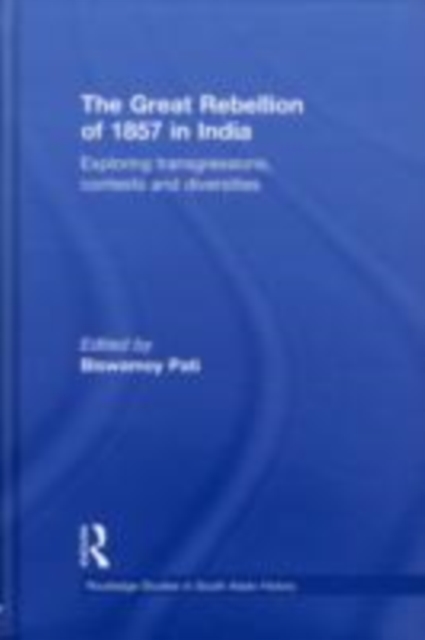
The Great Rebellion of 1857 in India
The Great Rebellion of 1857 in India was much more than a ‘sepoy mutiny’. It was a major event in South Asian and British colonial history that significantly challenged imperialism in India.
This fascinating collection explores hitherto ignored diversities of the Great Rebellion such as gender and colonial fiction, courtesans, white ‘marginals’, penal laws and colonial anxieties about the Mughals, even in exile. Also studied are popular struggles involving tribals and outcastes, and the way outcastes in the south of India locate the Rebellion. Interdisciplinary in focus and based on a range of untapped source materials and rare, printed tracts, this book questions conventional wisdom.
The comprehensive introduction traces the different historiographical approaches to the Great Rebellion, including the imperialist, nationalist, marxist and subaltern scholarship. While questioning typical assumptions associated with the Great Rebellion, it argues that the Rebellion neither began nor ended in 1857-58.
Clearly informed by the ‘Subaltern Studies’ scholarship, this book is post-subalternist as it moves far beyond narrow subalternist concerns. It will be of interest to students of Colonial and South Asian History, Social History, Cultural and Political Studies.
1. Introduction: The Great Rebellion, Biswamoy Pati 2. 1857 and the Adivasis of Chotanagpur, Shashank S. Sinha 3. Remembering Gonoo: The Profile of an Adivasi Rebel of 1857, Sanjukta Dasgupta 4. Beyond Colonial Mapping: Common People, Fuzzy Boundaries and the Rebellion of 1857, Biswamoy Pati 5. Forests on Fire: The 1857 Rebellion in Tribal Andhra, B. Rama Chandra Reddy 6. Contested sites: The Prison, Penal Laws and the 1857 Revolt, Madhurima Sen 7. Courtesans and the 1857 Revolt: The Role of Azeezun in Kanpur, Lata Singh 8. Discourses of ‘Gendered Loyalty’: Constructing Indian Women in ‘Mutiny’ Fiction of the Nineteenth century, Indrani Sen 9. The ‘Disposable’ Brethren: European Marginals in Eastern India during the Great Rebellion, Sarmsitha De 10. Sanitizing Indigenous Memory: 1857 and Mughal Exile, Amar Farooqui 11. Ideas, Memories and Meanings: Adi Dravida Interpretations of the Impact of the 1857 Rebellion, Raj Shekhar Basu
Biswamoy Pati is Associate Professor at the Department of History, University of Delhi, India. His latest publications include two co-edited books published by Routledge The Social History of Health and Medicine in Colonial India (with Mark Harrison, 2009) and India's Princely States (with Waltraud Ernst, 2007) and an edited volume entitled The 1857 Rebellion: Debates in Indian History and Society (2007).
\"The chapters add a fascinating depth and variety to any examination of this important period in colonial history... Pati has succeeded in producing an edition that achieves his purpose. Not only does it expand the geographic and chronological scale of the Rebellion, but the The Great Rebellion successfully contests colonial narratives that still seem to dominate today.\" - Robyn Curtis, University of canterbury; New Zealand Journal of Asian Studies 12, 2 (December 2010)
\"It is a pleasure to read because this book startles. It provokes more questions than it answers, which is important. Biswamoy Pati introduces, I believe, a whole new conceptual framework of looking at the Rebellion.\" - Milinda Bangerjee, Orientalistische Literaturzeitung (2012)
eBook