
Catalogue Search | MBRL


Are you sure you want to remove the book from the shelf?

{{itemTitle}}
67
result(s) for
"Sovereignty Cross-cultural studies."
Sort by:


Sovereignty after Empire
This is a unique, systematic comparison of empires and of their consequences for sovereignty in the Middle East and Central Asia. It brings theory on empire and sovereignty to bear on empirical variation across the two regions.
eBook


Revolutions in the Atlantic World, New Edition
A new look at a contentious period in the history of the Atlantic world
Within just a half century, the American, French, Haitian, and Spanish American revolutions transformed the Atlantic world. This book is the first to analyze these events through a comparative lens, revealing several central themes in the field of Atlantic history. From the murky position of the European empire between the Old and New Worlds to slavery and diaspora, Wim Klooster offers insights into the forces behind the many conflicts in the Atlantic world in the late eighteenth and early nineteenth centuries.
Digging deeply into the structural causes and oppressive environments in which these revolutions occurred, Klooster debunks the popular myth that the \"people\" rebelled against a small ruling elite, arguing instead that the revolutions were civil wars in which all classes fought on both sides. The book reveals the extent to which mechanisms of popular mobilization were visible in the revolutions. For example, although Blacks and Indians often played an important role in the success of the revolutions, they were never compensated once new regimes rose to power. Nor was democracy a goal or product of these revolutions, which usually spawned authoritarian polities.
The new edition covers the latest historiographical trends in the study of the Atlantic world, including new research regarding the role of privateers. Drawing on fresh research - such as primary documents and extant secondary literature - Klooster ultimately concludes that the Enlightenment was the ideological inspiration for the Age of Revolutions, although not its cause.
eBook


Traitors
The figure of the traitor plays an intriguing role in modern politics. Traitors are a source of transgression from within, creating their own kinds of aversion and suspicion. They destabilize the rigid moral binaries of victim and persecutor, friend and enemy. Recent history is stained by collaborators, informers, traitors, and the bloody purges and other acts of retribution against them. In the emergent nation-state of Bhutan, the specter of the \"antinational\" traitor helped to transform the traditional view of loyalty based on social relations. In Sri Lanka, the Tamil Tigers' fear of traitors is tangled with the Tamil civilians' fear of being betrayed to the Tigers as traitors. For Palestinians in the West Bank, simply earning a living can mean complicity with people acting in the name of the Israeli state. While most contemporary studies of violence and citizenship focus on the creation of the \"other,\" the cases inTraitors: Suspicion, Intimacy, and the Ethics of State-Buildingillustrate the equally strong political and social anxieties among those who seem to be most alike. Treason is often treated as a pathological distortion of political life. However, the essays inTraitorspropose that treachery is a constant, essential, and normal part of the processes through which social and political order is produced. In the political gray zones between personal and state loyalties, traitors and their prosecutors play roles that make and unmake regimes. In this volume, ten scholars examine political, ethnic, and personal trust and betrayals in modern times from Mozambique to the Taiwan Straits, from the former Eastern Bloc to the West Bank. This fascinating collection studies the tension between close personal relationships, the demands of nation-states, and the moral choices that result when these interests collide. In asking how traitors are defined in the context of local histories, contributors address larger comparative questions about the nature of postcolonial citizenship.
eBook

International Relations and the Problem of Difference
International Relations and the Problem of Difference has developed out of the sense that IR as a discipline does not assess the quality of cultural interactions that shape, and are shaped by, the changing structures and processes of the international system. In this work, the authors re-imagine IR as a uniquely placed site for the study of differences as organized explicitly around the exploration of the relation of wholes and parts and sameness and difference-and always the one in relation to the other.
eBook

Biyani Guwiyang Dharug Ngurrawa: healing fire on Dharug Country
ABSTRACT Caring and attending to Dharug Ngurra (Indigenous Dharug Country in Sydney, Australia) is a deep responsibility that is part of Dharug Lore/Law. Though deeply impacted by ongoing colonisation processes, one important responsibility is to guwiyang (fire), which has burnt for and with Dharug people for all time. Through careful attention to guwiyang, this paper builds on the powerful work of Indigenous scholars to share our Yanama Budyari Gumada collective’s understandings of relationality through our work together at a special place on Dharug Ngurra called Yarramundi. We draw on the lessons learned from making buran nalgarra (stringybark rope) to highlight the difficult, complex, and messy relationships that can lie at the heart of relational practice, particularly in colonised places. We discuss how we navigate these tensions by focusing on the importance of ‘yanama budyari gumada’ (walking in good spirit), taking small steps, and learning from others on Dharug Ngurra. Guwiyang reveals how relational responsibilities require constant care and attention to Ngurra, and we engage the everyday politics of relationality on Dharug Ngurra to make a powerful case for recognition of Dharug regenerative sovereignties and the active support of Dharug custodians living on Ngurra—on lands and waters stolen by the British Crown. We speak not of relationality as a research method that can be discarded or ‘turned’ towards, but of relationality as life, as responsibility, as Dharug Ngurra. We argue that understanding and deeply engaging Indigenous relationalities is fundamental for sustainability research, practices, and thinking.
Journal Article

Global versus intercultural citizenship education
Given the growing presence of citizens with cultural differences, it is no longer appropriate to base citizenship on the individual belonging of a nation-state. It has become necessary to develop a new concept of citizenship that considers the existing multiple identities of people. This idea has gradually permeated educational policies on citizenship of international institutions such as UNESCO, which has introduced the concept of global citizenship education (GCE). This article is intended to enrich readers’ reflection on GCE through the incorporation of an intercultural approach, to overcome nationalistic, Western-centric, and neoliberal conceptions, and to promote dialogue and interaction between different learners. Research on citizenship education and intercultural competence carried out by the Centre for Intercultural Studies, University of Verona, Italy, provides additional stimuli to foster reflection.
Journal Article
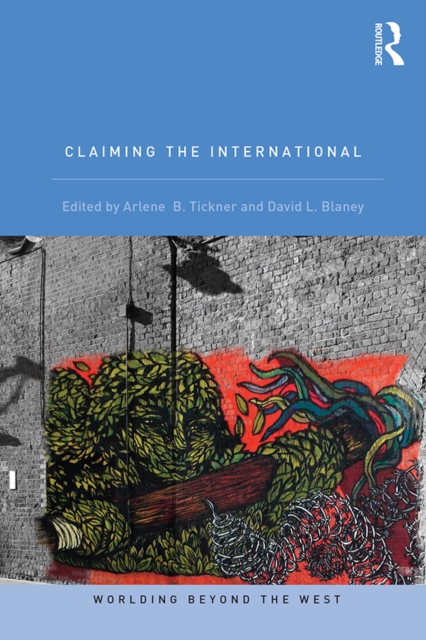
Claiming the International
This book explores the possibilities of alternative worldings beyond those authorized by the disciplinary norms and customs of International Relations. In response to the boundary-drawing practices of IR that privilege the historical experience and scholarly folkways of the \"West,\" the contributors examine the limits of even critical practice within the discipline; investigate alternative archives from India, the Caribbean, the steppes of Eurasia, the Andes, China, Japan and Southeast Asia that offer different understandings of proper rule, the relationality of identities and polities, notions of freedom and imaginations of layers of sovereignty; and demonstrate distinct modes of writing and inquiry. In doing so, the book also speaks about different possibilities for IR and for inquiry without it.
eBook