
Catalogue Search | MBRL


Are you sure you want to remove the book from the shelf?

{{itemTitle}}
80
result(s) for
"Soviet Union -- History -- 1985-1991"
Sort by:

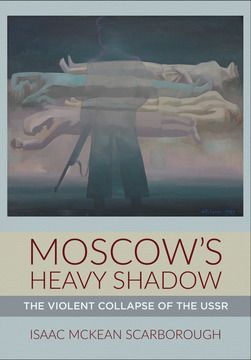
Moscow's Heavy Shadow
Moscow's Heavy Shadow tells
the story of the collapse of the USSR from the perspective of the
many millions of Soviet citizens who experienced it as a period of
abjection and violence. Mikhail Gorbachev and the leaders
of the USSR saw the years of reform preceding the collapse as
opportunities for rebuilding ( perestroika ), rejuvenation,
and openness ( glasnost ). For those in provincial cities
across the Soviet Union, however, these reforms led to rapid
change, economic collapse, and violence.
Focusing on Dushanbe, Tajikistan, Isaac McKean Scarborough
describes how this city experienced skyrocketing unemployment, a
depleted budget, and streets filled with angry young men unable to
support their families. Tajikistan was left without financial or
military resources, unable and unprepared to stand against the wave
of populist politicians of all stripes who took advantage of the
economic collapse and social discontent to try to gain power. By
May 1992, political conflict became violent and bloody and engulfed
the whole of Tajikistan in war. Moscow's Heavy Shadow
tells the story of how this war came to be, and how it was grounded
in the reform and collapse of the Soviet economy that came
before.
eBook

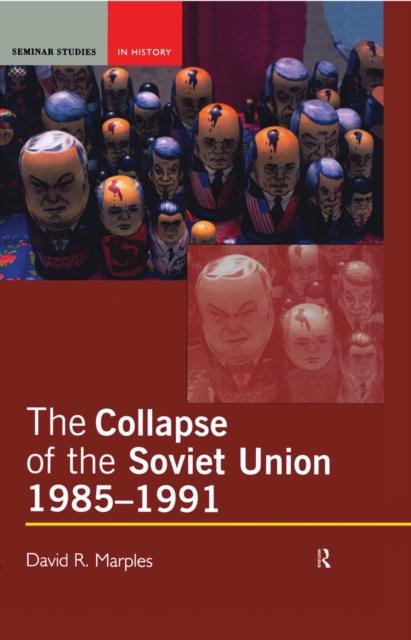
The Collapse of the Soviet Union, 1985-1991
The collapse of the Soviet experiment was one of the major turning points in twentieth century history. During the period of 'perestroika' the Soviet Union took the first steps to becoming a civil society and started to re-examine it's Stalinist past. This new text examines the Gorbachev years, asks why the Soviet Union collapsed in 1991, and offers a succinct and accessible interpretation of the remarkable events that led to the collapse.
eBook

The Soviet Union and Russia, 1939-2015 : a history in documents
\"Utilizing a wide range of primary sources including both texts and images, this book tells the story of Soviet and Russian history from multiple viewpoints, enabling students to develop interpretive skills. Each document is carefully chosen and contextualized to promote class discussion on a variety of critical topics\"--Provided by publisher.
Book

Russia and the Long Transition from Capitalism to Socialism
Out of early twentieth-century Russia came the world's first
significant effort to build a modern revolutionary society.
According to Marxist economist Samir Amin, the great upheaval that
once produced the Soviet Union has also produced a movement away
from capitalism - a long transition that continues even today. In
seven concise, provocative chapters, Amin deftly examines the
trajectory of Russian capitalism, the Bolshevik Revolution, the
collapse of the Soviet Union, the possible future of Russia - and,
by extension, the future of socialism itself.
Amin manages to combine an analysis of class struggle with
geopolitics - each crucial to understanding Russia's singular and
complex political history. He first looks at the development (or
lack thereof) of Russian capitalism. He sees Russia's geopolitical
isolation as the reason its capitalist empire developed so
differently from Western Europe, and the reason for Russia's
perceived \"backwardness.\" Yet Russia's unique capitalism proved to
be the rich soil in which the Bolsheviks were able to take power,
and Amin covers the rise and fall of the revolutionary Soviet
system. Finally, in a powerful chapter on Ukraine and the rise of
global fascism, Amin lays out the conditions necessary for Russia
to recreate itself, and perhaps again move down the long road to
socialism. Samir Amin's great achievement in this book is not only
to explain Russia's historical tragedies and triumphs, but also to
temper our hopes for a quick end to an increasingly insufferable
capitalism.
This book offers a cornucopia of food for thought, as well as an
enlightening means to transcend reductionist arguments about
\"revolution\" so common on the left. Samir Amin's book - and the
actions that could spring from it - are more necessary than ever,
if the world is to avoid the barbarism toward which capitalism is
hurling humanity.
eBook

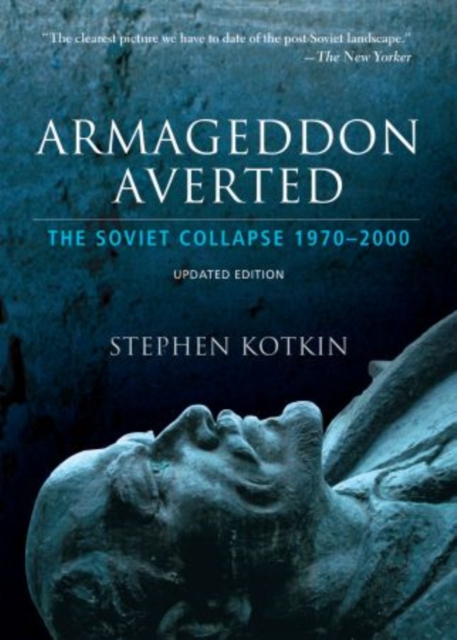
Armageddon averted : the Soviet collapse, 1970-2000
In this text, Stephen Kotkin shows that the Soviet collapse resulted not from military competition but, ironically, from the dynamism of Communist ideology, the long-held dream for \"socialism with a human face\".
eBook

Zhivago's children : the last Russian intelligentsia
This is an in-depth history of the cultural and intellectual evolution of the intelligentsia in Russia from Stalin's death in 1953 to the collapse of the Soviet Union in 1991.
BOOK

A Failed Empire
In this widely praised book, Vladislav Zubok argues that Western interpretations of the Cold War have erred by exaggerating either the Kremlin's pragmatism or its aggressiveness. Explaining the interests, aspirations, illusions, fears, and misperceptions of the Kremlin leaders and Soviet elites, Zubok offers a Soviet perspective on the greatest standoff of the twentieth century. Using recently declassified Politburo records, ciphered telegrams, diaries, and taped conversations, among other sources, Zubok offers the first work in English to cover the entire Cold War from the Soviet side. A Failed Empire provides a history quite different from those written by the Western victors. In a new preface for this edition, the author adds to our understanding of today's events in Russia, including who the new players are and how their policies will affect the state of the world in the twenty-first century.
eBook