
Catalogue Search | MBRL


Are you sure you want to remove the book from the shelf?

{{itemTitle}}
181
result(s) for
"Soviet Union Civilization"
Sort by:

Symbols and Legitimacy in Soviet Politics
Symbols and Legitimacy in Soviet Politics analyses the way in which Soviet symbolism and ritual changed from the regime's birth in 1917 to its fall in 1991. Graeme Gill focuses on the symbolism in party policy and leaders' speeches, artwork and political posters, and urban redevelopment, and on ritual in the political system. He shows how this symbolism and ritual were worked into a dominant metanarrative which underpinned Soviet political development. Gill also shows how, in each of these spheres, the images changed both over the life of the regime and during particular stages: the Leninist era metanarrative differed from that of the Stalin period, which differed from that of the Khrushchev and Brezhnev periods, which was, in turn, changed significantly under Gorbachev. In charting this development, the book lays bare the dynamics of the Soviet regime and a major reason for its fall.
eBook
Soviet society in the era of late socialism, 1964–1985
What did it mean to be a Soviet citizen in the 1970s and 1980s? How can we explain the liberalization that preceded the collapse of the USSR? This period in Soviet history is often depicted as stagnant with stultified institutions and the oppression of socialist citizens. However, the socialist state was not simply an oppressive institution that dictated how to live and what to think—it also responded to and was shaped by individuals’ needs. In Soviet Society in the Era of Late Socialism, 1964–85, Neringa Klumbyte and Gulnaz Sharafutdinova bring together scholarship examining the social and cultural life of the USSR and Eastern Europe from 1964 to 1985. This interdisciplinary and comparative study explores topics such as the Soviet middle class, individualism, sexuality, health, late-socialist ethics, and civic participation. Examining this often overlooked era provides the historical context for all post-socialist political, economic, and social developments.
eBook


The Archaeology of Anxiety
The \"Silver Age\" (c. 1890-1917) has been one of the most intensely studied topics in Russian literary studies, and for years scholars have been struggling with its precise definition. Firmly established in the Russian cultural psyche, it continues to influence both literature and mass media.The Archaeology of Anxietyis the first extended analysis of why the Silver Age occupies such prominence in Russian collective consciousness.
Galina Rylkova examines the Silver Age as a cultural construct-the byproduct of an anxiety that permeated society in reaction to the social, political, and cultural upheavals brought on by the Bolshevik Revolution, the fall of the Romanovs, the Civil War, and Stalin's Great Terror. Rylkova's astute analysis of writings by Anna Akhmatova, Vladimir Nabokov, Boris Pasternak and Victor Erofeev reveals how the construct of the Silver Age was perpetuated and ingrained.
Rylkova explores not only the Silver Age's importance to Russia's cultural identity but also the sustainability of this phenomenon. In so doing, she positions the Silver Age as an essential element to Russian cultural survival.
eBook

Empire of friends : Soviet power and socialist internationalism in Cold War Czechoslovakia
\"Argues that the USSR's power in Cold War Czechoslovakia was based on a wide-ranging friendship project between Soviet and Czechoslovak citizens in the realm of everyday life\"-- Provided by publisher.
Book

The Russian Avant-Garde and Radical Modernism
The Russian avant-garde was a composite of antagonistic groups who wished to overthrow the basic aesthetics of classical realism. Modernism was the totality of these numerous aesthetic theories, which achieved a measure of coherence immediately after the First World War. This collection of essays by leading scholars examines the major figures, movements, and manifestos of the period. Scholarly attention is given to literature, visual arts, cinema, and theatre in an attempt to capture the complex nature of the modernist movement in Russia. This book would be especially relevant for university courses on the Russian twentieth century as well as for those looking for a comprehensive approach to the various movements and artistic expressions that constitute the Russian avant-garde.
eBook

To see Paris and die : the Soviet lives of Western culture
The Soviet Union was a notoriously closed society until Stalin's death in 1953. Then, in the mid-1950s, a torrent of Western novels, films, and paintings invaded Soviet streets and homes, acquiring heightened emotional significance. To See Paris and Die is a history of this momentous opening to the West. At the heart of this story is a process of translation, in which Western figures took on Soviet roles: Pablo Picasso as a political rabble-rouser; Rockwell Kent as a quintessential American painter; Erich Maria Remarque and Ernest Hemingway as teachers of love and courage under fire; J. D. Salinger and Giuseppe De Santis as saviors from Soviet clichâes. Imported novels challenged fundamental tenets of Soviet ethics, while modernist paintings tested deep-seated notions of culture. Western films were eroticized even before viewers took their seats. The drama of cultural exchange and translation encompassed discovery as well as loss. Eleonory Gilburd explores the pleasure, longing, humiliation, and anger that Soviet citizens felt as they found themselves in the midst of this cross-cultural encounter. The main protagonists of To See Paris and Die are small-town teachers daydreaming of faraway places, college students vicariously discovering a wider world, and factory engineers striving for self-improvement. They invested Western imports with political and personal significance, transforming foreign texts into intimate possessions. With the end of the Soviet Union, the Soviet West disappeared from the cultural map. Gilburd's history reveals how domesticated Western imports defined the last three decades of the Soviet Union, as well as its death and afterlife.-- Provided by publisher
Book
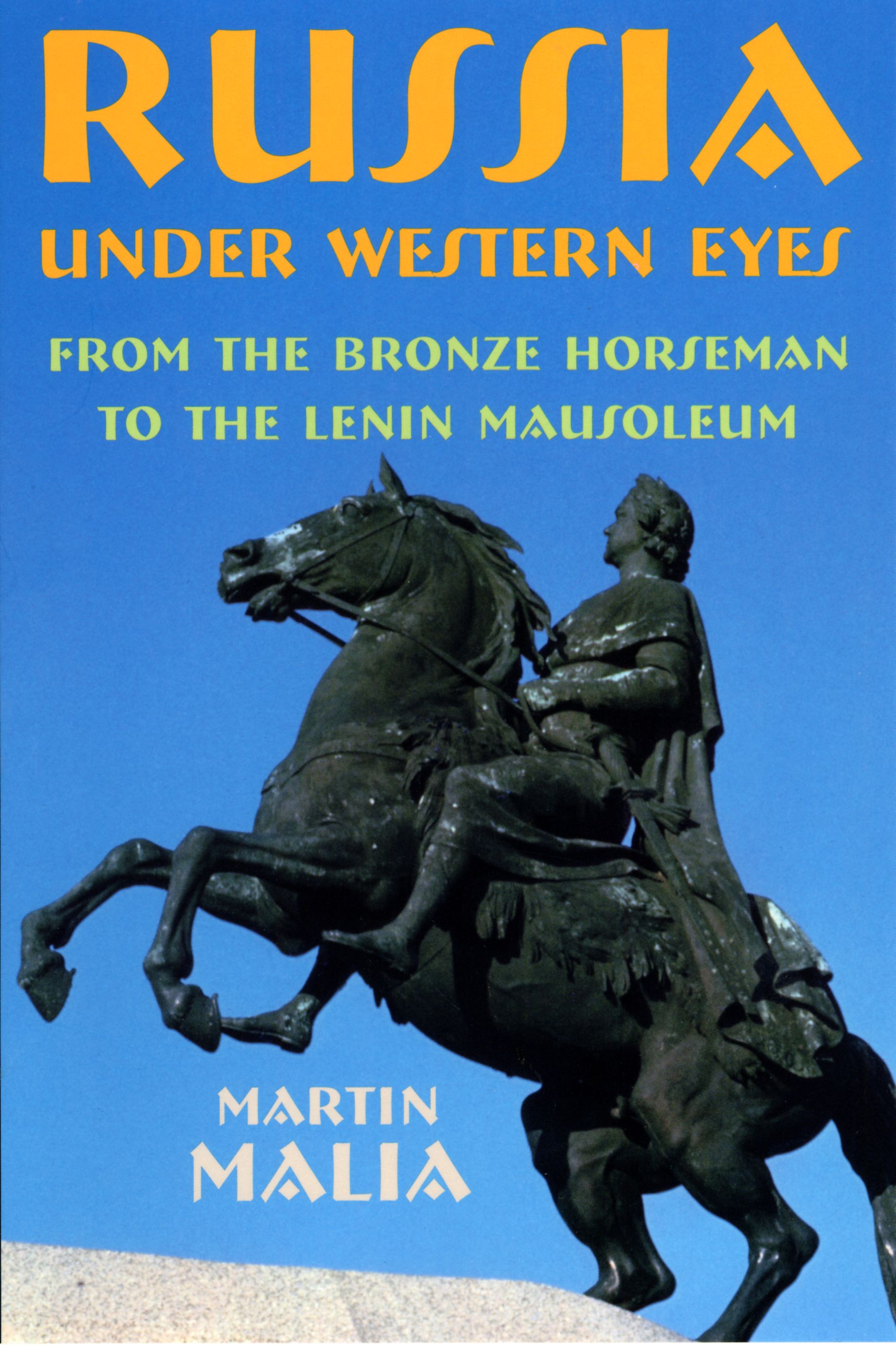
Russia under Western Eyes
As the dust clears from the fall of Communism, will Western eyes see Russia, the unclaimed orphan of Western history or Russia as she truly is, a perplexing but undeniable member of the European family? A dazzling work of intellectual history by a world-renowned scholar, spanning the years from Peter the Great to the fall of the Soviet Union, this book gives us a clear and sweeping view of Russia not as an eternal barbarian menace but as an outermost, if laggard, member in the continuum of European nations.
The Russian troika hurtles through these pages. The Spectre, modernity's belief in salvation by revolutionary ideology, haunts them. Alice's looking glass greets us at this turn and that. Throughout, Martin Malia's inspired use of these devices aptly conveys the surreality of the whole Soviet Russian phenomenon and the West's unbalanced perception of it. He shows us the usually distorted images and stereotypes that have dominated Western ideas about Russia since the eighteenth century. And once these emerge as projections of the West's own internal anxieties, he shifts his focus to the institutional structures and cultural forms Russia shares with her neighbors.
Here modern Europe is depicted as an East-West cultural gradient in which the central and eastern portions respond to the Atlantic West's challenge in delayed and generally skewed fashion. Thus Russia, after two centuries of building then painfully liberalizing its Old Regime, in 1917 tried to leap to a socialism that would be more advanced and democratic than European capitalism. The result was a cruel caricature of European civilization, which mesmerized and polarized the West for most of this century. As the old East-West gradient reappears in genuinely modern guise, this brilliantly imaginative work shows us the reality that has for so long tantalized--and eluded--Western eyes.
eBook