
Catalogue Search | MBRL


Are you sure you want to remove the book from the shelf?

{{itemTitle}}
8
result(s) for
"Soviet Union. Komitet gosudarstvennoĭ bezopasnosti Biography"
Sort by:


Spy Wars
Chosen by William Safire in the New York Times to be the publishing sleeper-seller of the year for 2007.
In this rapid-paced book, a former CIA chief of Soviet bloc counterintelligence breaks open the mysterious case of KGB officer Yuri Nosenko's 1964 defection to the United States. Still a highly controversial chapter in the history of Cold War espionage, the Nosenko affair has inspired debate for more than forty years: was Nosenko a bona fide defector with the real information about Lee Harvey Oswald's stay in Soviet Russia, or was he a KGB loyalist, engaged in a complex game of deception?
As supervisor of CIA operations against the KGB at the time, Tennent H. Bagley directly handled Nosenko's case. This insider knowledge, combined with information gleaned from dozens of interviews with former KGB adversaries, places Bagley in a uniquely authoritative position. He guides the reader step by step through the complicated operations surrounding the Nosenko affair and shatters the comfortable version of events the CIA has presented to the public. Bagley unveils not only the KGB's history of merciless and bloody betrayals but also the existence of undiscovered traitors in the American camp. Shining new light on the CIA-KGB spy wars, he invites deeper thinking about the history of espionage and its implications for the intelligence community today.
eBook
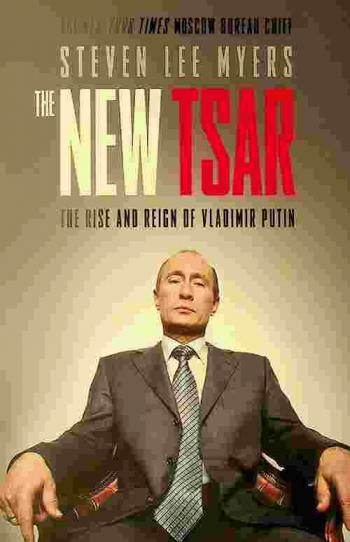
The new tsar : the rise and reign of Vladimir Putin
An epic tale of the path to power of Vladimir Putin, who emerged from obscurity to become one of the world's most conflicted and important leaders. Vladimir Putin rose out of Soviet deprivation to the pinnacle of influence in the new Russian nation. He came to office in 2000 as a reformer, cutting taxes and expanding property rights, bringing a measure of order and eventually prosperity to millions whose only experience of democracy in the early years following the Soviet collapse was instability, poverty and criminality. But soon Putin orchestrated the preservation of a new kind of authoritarianism, consolidating power, reasserting his country's might, brutally crushing revolts and swiftly dispatching dissenters, even as he retained the support of many. New York Times Moscow Bureau Chief, Steven Lee Myers follows Putin's path in a gripping, page-turning narrative about Russian power and prestige, elucidating the cool and calculating leader whose ambitions are as great as Peter's, his means as ruthless as Ivan the Terrible's. It's a path that mirrors the growing pains of a nation stretching from the ends of Europe to the Pacific Ocean, and is key to understanding the new Russian Colossus.

The interloper : Lee Harvey Oswald inside the Soviet Union
Lee Harvey Oswald's assassination of President Kennedy in 1963 remains one of the most horrifying and hotly debated crimes in American history. Just as perplexing as the assassination is the assassin himself; the 24-year-old Oswald's hazy background and motivationsand his subsequent murder at the hands of Jack Rubymake him an intriguing yet frustratingly enigmatic figure. Because Oswald briefly defected to the Soviet Union, some historians allege he was a Soviet agent. But as Peter Savodnik shows in The Interloper, Oswald's time in the U.S.S.R. reveals a stranger, more chilling story. Oswald ventured to Russia at the age of 19, after a failed stint in the U.S. Marine Corps and a childhood spent shuffling from address to address with his unstable, needy mother. Like many of his generation, Oswald struggled for a sense of belonging in postwar American society, which could be materialistic, atomized, and alienating. The Soviet Union, with its promise of collectivism and camaraderie, seemed to offer an alternative. While traveling in Europe, Oswald slipped across the Soviet border, soon settling in Minsk where he worked at a radio and television factory. But Oswald quickly became just as disillusioned with his adopted country as he had been with the United States. He spoke very little Russian, had difficulty adapting to the culture of his new home, and found few trustworthy friends; indeed most, it became clear, were informing on him to the KGB. After nearly three years, Oswald returned to America feeling utterly defeated and more alone than everand as Savodnik shows, he began to look for an outlet for his frustration and rage. Drawing on groundbreaking research, including interviews with Oswald's friends and acquaintances in Russia and the United States, The Interloper brilliantly evokes the shattered psyche not just of Oswald himself, but also
of the era he so tragically defined.
eBook

In the enemy's house : the secret saga of the FBI agent and the code breaker who caught the Russian spies
\"In 1946, genius linguist and codebreaker Meredith Gardner discovered that the KGB was running an extensive network of strategically placed spies inside the United States, whose goal was to infiltrate American intelligence and steal the nation's military and atomic secrets. Over the course of the next decade, he and young FBI supervisor Bob Lamphere worked together on Venona, a top-secret mission to uncover the Soviet agents and protect the Holy Grail of Cold War espionage--the atomic bomb. Opposites in nearly every way, Lamphere and Gardner relentlessly followed a trail of clues that helped them identify and take down these Soviet agents one by one\"--Publisher's description.
Book

Shattered illusions
\"Yevgeni Vladimirovich Brik and James Douglas Finley Morrison were central figures in what was considered one of the most important Cold War operations in the West at the time. Their story, which involves espionage, intelligence tradecraft, intelligence service penetrations, double agent scenarios, and betrayal, is a piece of Cold War intelligence history that has never been fully told. Yevgeni Brik was a KGB deep cover illegal who had been dispatched to Canada in 1951. He settled in Verdun, Quebec. He eventually became the KGB Illegal Resident where he had responsibility for running a number of agents, one of whom was working on the CF-105, Avro Arrow. In 1953, he fell in love with a married Canadian woman to whom he revealed his true identity. She persuaded him to turn himself in, which resulted in his becoming a double agent, working for Canada. He was later betrayed by a Royal Canadian Mounted Police Officer, James Morrison, who sought money from the KGB to pay his debts. Brik was consequently lured back to Moscow in 1955, where he was arrested, and interrogated. Convicted of treason, a traitor's fate awaited him, predictable, grim and final. Incredibly, he reappeared at a British Embassy as an old man in 1992, seeking Canada's help. He was exfiltrated by a joint Canadian/British intelligence team which was headed by Donald Mahar. He was debriefed by Mahar for several months when they returned to Canada\"...
eBook

The new tsar : the rise and reign of Vladimir Putin
\"In this gripping narrative of Putin's rise to power, Steven Lee Myers recounts Putin's origins-from his childhood of abject poverty in Leningrad to his ascent through the ranks of the KGB, and his eventual consolidation of rule in the Kremlin. As the world struggles to confront a bolder Russia, the importance of understanding the formidable and ambitious Vladimir Putin has never been greater. On the one hand, Putin's many domestic reforms-from tax cuts to an expansion of property rights-have helped reshape the potential of millions of Russians whose only experience of democracy had been crime, poverty, and instability after the fall of the Soviet Union. On the other, Putin has ushered in a new authoritarianism-unyielding in its brutal repression of dissent and newly assertive politically and militarily in regions like Crimea and the Middle East. The New Tsar is a staggering achievement, a deeply researched and essential biography of one of the most important and destabilizing world leaders in recent history, a man whose merciless rule has become inextricably bound to Russia's forseeable future.\"--Publisher's website.
BOOK
