
Catalogue Search | MBRL


Are you sure you want to remove the book from the shelf?

{{itemTitle}}
1,696
result(s) for
"Space Science Institute"
Sort by:

The Universe in a Mirror
The Hubble Space Telescope has produced the most stunning images of the cosmos humanity has ever seen. It has transformed our understanding of the universe around us, revealing new information about its age and evolution, the life cycle of stars, and the very existence of black holes, among other startling discoveries. But it took an amazing amount of work and perseverance to get the first space telescope up and running.The Universe in a Mirrortells the story of this telescope and the visionaries responsible for its extraordinary accomplishments.
Robert Zimmerman takes readers behind the scenes of one of the most ambitious scientific instruments ever sent into space. After World War II, astronomer Lyman Spitzer and a handful of scientists waged a fifty-year struggle to build the first space telescope capable of seeing beyond Earth's atmospheric veil. Zimmerman shows how many of the telescope's advocates sacrificed careers and family to get it launched, and how others devoted their lives to Hubble only to have their hopes and reputations shattered when its mirror was found to be flawed. This is the story of an idea that would not die--and of the dauntless human spirit. Illustrated with striking color images,The Universe in a Mirrordescribes the heated battles between scientists and bureaucrats, the perseverance of astronauts to repair and maintain the telescope, and much more. Hubble, and the men and women behind it, opened a rare window onto the universe, dazzling humanity with sights never before seen.
This book tells their remarkable story. A new afterword updates the reader on the May 2009 Hubble service mission and looks to the future of astronomy, including the prospect of a new space telescope to replace Hubble.
eBook
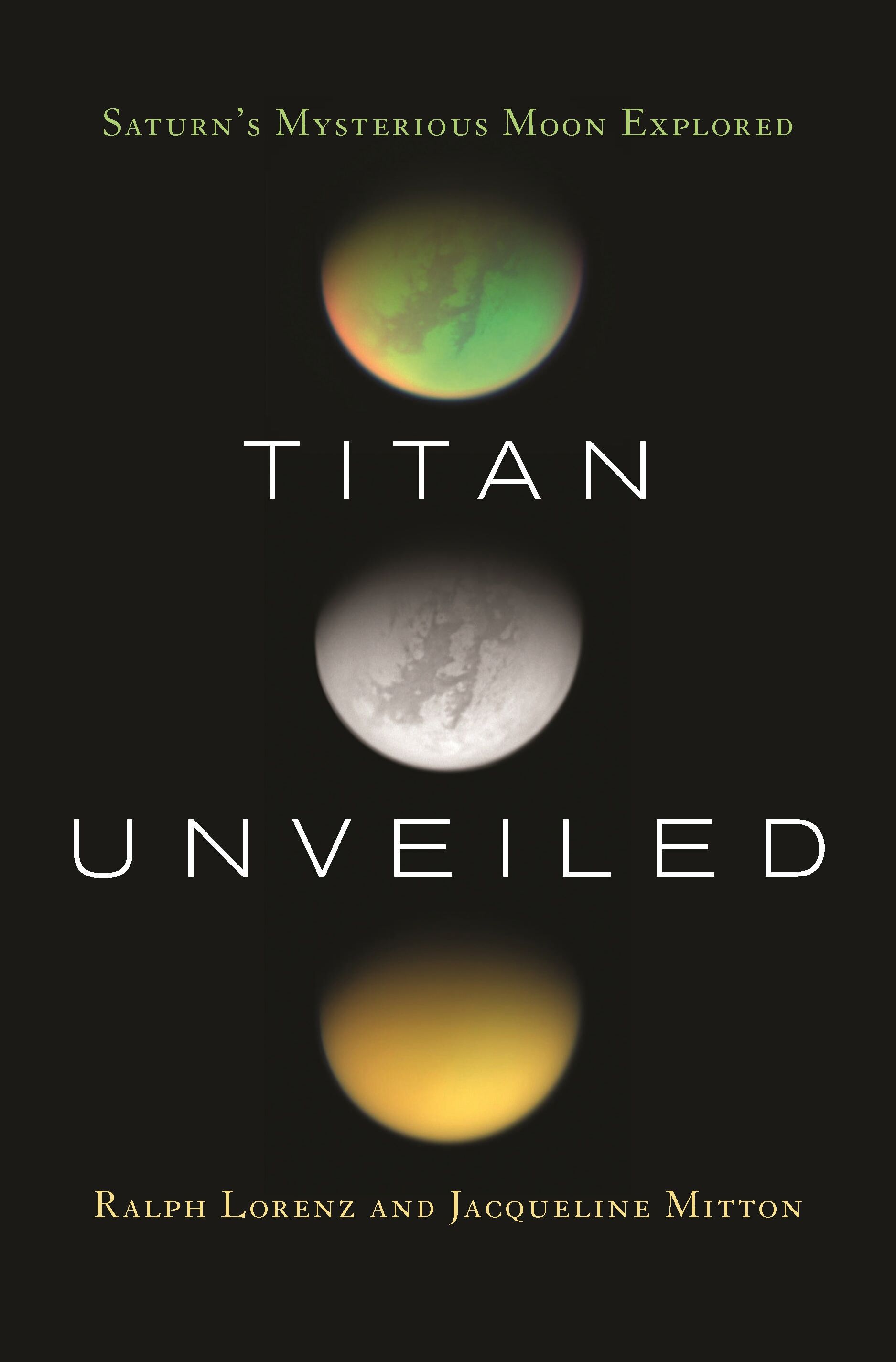
Titan Unveiled
For twenty-five years following the Voyager mission, scientists speculated about Saturn's largest moon, a mysterious orb clouded in orange haze. Finally, in 2005, the Cassini-Huygens probe successfully parachuted down through Titan's atmosphere, all the while transmitting images and data. In the early 1980s, when the two Voyager spacecraft skimmed past Titan, Saturn's largest moon, they transmitted back enticing images of a mysterious world concealed in a seemingly impenetrable orange haze.Titan Unveiledis one of the first general interest books to reveal the startling new discoveries that have been made since the arrival of the Cassini-Huygens mission to Saturn and Titan.
Ralph Lorenz and Jacqueline Mitton take readers behind the scenes of this mission. Launched in 1997, Cassini entered orbit around Saturn in summer 2004. Its formidable payload included the Huygens probe, which successfully parachuted down through Titan's atmosphere in early 2005, all the while transmitting images and data--and scientists were startled by what they saw. One of those researchers was Lorenz, who gives an insider's account of the scientific community's first close encounter with an alien landscape of liquid methane seas and turbulent orange skies. Amid the challenges and frayed nerves, new discoveries are made, including methane monsoons, equatorial sand seas, and Titan's polar hood. Lorenz and Mitton describe Titan as a world strikingly like Earth and tell how Titan may hold clues to the origins of life on our own planet and possibly to its presence on others.
Generously illustrated with many stunning images,Titan Unveiledis essential reading for anyone interested in space exploration, planetary science, or astronomy.
A new afterword brings readers up to date on Cassini's ongoing exploration of Titan, describing the many new discoveries made since 2006.
eBook
Strange New Worlds
Soon astronomers expect to find alien Earths by the dozens in orbit around distant suns. Before the decade is out, telltale signs that they harbor life may be found. If they are, the ramifications for all areas of human thought and endeavor--from religion and philosophy to art and biology--will be breathtaking. In Strange New Worlds, renowned astronomer Ray Jayawardhana brings news from the front lines of the epic quest to find planets--and alien life--beyond our solar system.
eBook

Fly Me to the Moon
When a leaf falls on a windy day, it drifts and tumbles, tossed
every which way on the breeze. This is chaos in action. In Fly
Me to the Moon, Edward Belbruno shows how to harness the same
principle for low-fuel space travel--or, as he puts it, \"surfing
the gravitational field.\"
Belbruno devised one of the most exciting concepts now being
used in space flight, that of swinging through the cosmos on the
subtle fluctuations of the planets' gravitational pulls. His idea
was met with skepticism until 1991, when he used it to get a stray
Japanese satellite back on course to the Moon. The successful
rescue represented the first application of chaos to space travel
and ushered in an emerging new field.
Part memoir, part scientific adventure story, Fly Me to the
Moon gives a gripping insider's account of that mission and of
Belbruno's personal struggles with the science establishment. Along
the way, Belbruno introduces readers to recent breathtaking
advances in American space exploration. He discusses ways to
capture and redirect asteroids; presents new research on the origin
of the Moon; weighs in on discoveries like 2003 UB313 (now named
Eris), a dwarf planet detected in the far outer reaches of our
solar system--and much more.
Grounded in Belbruno's own rigorous theoretical research but
written for a general audience, Fly Me to the Moon is for
anybody who has ever felt moved by the spirit of discovery.
eBook
Accessing Astronomy Surveys
How does one access astronomical surveys? We have moved from clay tablets in the Babylonian era, though handwritten manuscripts, printed books, photographic prints, and CD-ROMS, which, for a while in the 1990s, were distributed to subscribers of professional journals. In recent years, surveys have become so large and the internet has become so accessible that large surveys are no longer disseminated in a complete form. Astronomers use software tools to access the data they are interested in and download it from large servers devoted to the task. Any astronomer, including amateurs, who is willing to learn how to use the necessary software search tools may access these sites and download data from them.
Book Chapter
The CCD Era
In Chapters 5–10 we described the opening up of the electromagnetic spectrum to astronomers, partly as a result of the ability to put telescopes in space. It is now time to enter the fifth era of astronomy, in which visible light has once again become a cornerstone of progress. and ground-based telescopes are once again taking the lead in conducting astronomy surveys. A key to this resurgence has been the development of the charged coupled device (CCD)—a solid-state chip that is capable of capturing images electronically and then feeding them into a computer where they can be stored and analyzed. CCDs, and related devices called C-MOS chips, have completely replaced photographic plates as the technology of choice for recording visible and near-infrared images and spectra.
Book Chapter

ASTRONOMERS HAVE SIGHTS ON BEGINNING
KICKR} THE UNIVERSE TORONTO (AP) - Astronomers using the world's most powerful telescopes are beginning to see galaxies emerge from when the universe was just beginning to organize itself.
Newspaper Article