
Catalogue Search | MBRL


Are you sure you want to remove the book from the shelf?

{{itemTitle}}
4,562
result(s) for
"Space probes."
Sort by:


Jupiter Observing Velocity Experiment (JOVE): Introduction to Wind Rider Solar Electric Propulsion Demonstrator and Science Objectives
The Jupiter Observing Velocity Experiment (JOVE) is a solar-powered technology demonstration of rapid flight to outer solar system targets, performing a flyby of Jupiter 30 days after launch. This is achieved using a magnetic drag device to accelerate with the solar wind plasma. This “Wind Rider” propulsion system can potentially also decelerate against the Jovian magnetosphere dawn eddy, to enable Jupiter orbital insertion in future missions. The 16U cubesat bus contains scientific instruments to record the plasma parameters from the vicinity of the spacecraft, with principal measurements coming from a SPAN-I ion velocity sensor. This paper includes a description of the propulsive mechanisms and supporting subsystems and trajectory simulation results derived from solar wind measurements over the past two solar cycles. The objectives of the JOVE technology demonstrator design include: (1) verify Wind Rider stability and control; (2) characterize loss mechanisms in the solar wind, such as resistive losses in the plasma, as well as the magnetic field transient interaction time; (3) operate onboard instruments to measure the velocity and direction of the solar wind (SPAN-Ai) and speed of the spacecraft relative to the Earth (radio Doppler shift), to enable precision navigation on future science missions; and (4) characterize the Lift-to-Drag ratio of the plasma magnetic field. (The lift force enables lateral course control and maneuvering within the solar wind.) Applying existing scientific data from Voyagers and other deep space probes into new engineering models was important for enabling new insights about Wind Rider propulsion. It enables more science to be performed in a shorter amount of time, across the Jovian system.
Journal Article

Dreams of other worlds : the amazing story of unmanned space exploration
Dreams of Other Worlds describes the unmanned space missions that have opened new windows on distant worlds. Spanning four decades of dramatic advances in astronomy and planetary science, Impey and Henry tell the story of eleven iconic exploratory missions and how they have fundamentally transformed our scientific and cultural perspectives on the universe and our place in it.
Book

Planetary Exploration with Ingenuity and Dragonfly
Planetary Exploration with Ingenuity and Dragonfly aims to lay out to 'space people' what they need to know about rotorcraft, and to 'helicopter people' what they need to know about delivering flying machines through space and operating them on other planets.
eBook

Voyager probes : robots on an interstellar mission
Describes the Voyager 1 and Voyager 2 robotic probes that were launched in 1977, discussing the data they have sent back and plans for their future use.
Book
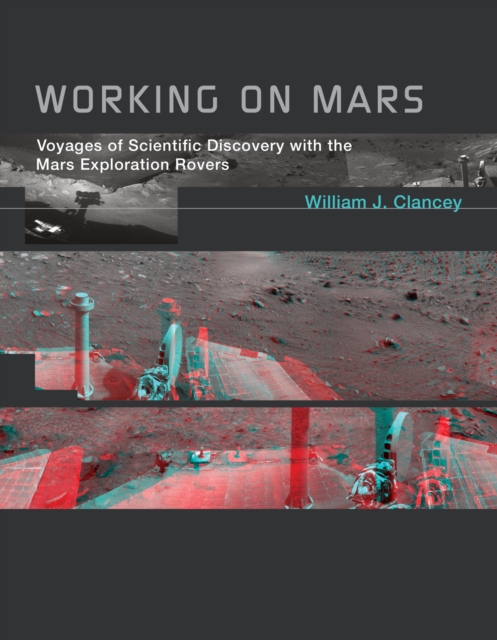
Working on Mars
Geologists in the field climb hills and hang onto craggy outcrops; they put their fingers in sand and scratch, smell, and even taste rocks. Beginning in 2004, however, a team of geologists and other planetary scientists did field science in a dark room in Pasadena, exploring Mars from NASA's Jet Propulsion Laboratory (JPL) by means of the remotely operated Mars Exploration Rovers (MER). Clustered around monitors, living on Mars time, painstakingly plotting each movement of the rovers and their tools, sensors, and cameras, these scientists reported that they felt as if they were on Mars themselves, doing field science. The MER created a virtual experience of being on Mars. In this book, William Clancey examines how the MER has changed the nature of planetary field science. NASA cast the rovers, Spirit and Opportunity, as \"robotic geologists,\" and ascribed machine initiative (\"Spirit collected additional imagery...\") to remotely controlled actions. Clancey argues that the actual explorers were not the rovers but the scientists, who imaginatively projected themselves into the body of the machine to conduct the first overland expedition of another planet. The scientists have since left the darkened room and work from different home bases, but the rover-enabled exploration of Mars continues. Drawing on his extensive observations of scientists in the field and at the JPL, Clancey investigates how the design of the rover mission enables field science on Mars, explaining how the scientists and rover engineers manipulate the vehicle and why the programmable tools and analytic instruments work so well for them. He shows how the scientists felt not as if they were issuing commands to a machine but rather as if they were working on the red planet, riding together in the rover on a voyage of discovery. http://www.youtube.com/watch?v=oZQSWSZnTYs&feature=youtube_gdata
eBook

Mars probes : robots explore the red planet
\"In 1976, Viking 1 became the first spacecraft from Earth to land on Mars. For the first time, scientists were able to see the surface of the red planet. Since then, NASA and other space organizations have sent other probes to Mars and have learned a lot. Readers find out all about the robots created especially for the task of exploring Mars through detailed diagrams, full-color photographs, and interesting main content. Including information about STEM careers and the background of planning a space mission using robots, this book engages readers with exciting STEM content and careers.\"-- Provided by publisher.
Book

Meteor Hazard for Interplanetary Flights in the Ecliptic Plane
To increase the safety of interplanetary missions, it is necessary to have estimates of the meteor hazard along the flight trajectory. Meteoroid particles of known meteor showers that cross the ecliptic plane at a distance of 1 AU from the Sun are observed as “shooting stars” in the Earth’s atmosphere. However, such meteor streams are principally not observable in interplanetary space. The existence of some meteor streams can be predicted using periodic comets as indicators. During their evolution, cometary nuclei expel meteoritic particles, which remain in the parent orbit for millennia. Thus, the orbits of comets can be considered coinciding with the orbits of young meteor streams produced by the decay of cometary nuclei. We have calculated the coordinates of the regions of intersection of known periodic comets with the ecliptic plane, which are considered as regions of increased meteor hazard. Old meteoroid streams originating from totally decayed comets may be tens and hundreds of times more numerous than young streams. All of them are potential sources of direct meteor collisions with space probes. To assess the risk of interplanetary missions, the planned flight trajectory of FOBOS-GRUNT is compared with the regions of expected meteor streams, and the dates of the most dangerous encounters are given.
Journal Article

Journey through our solar system
\"This book takes readers on a tour of our solar system\"--Provided by publisher.
Book

Science Objectives and Rationale for the Radiation Belt Storm Probes Mission
The NASA Radiation Belt Storm Probes (RBSP) mission addresses how populations of high energy charged particles are created, vary, and evolve in space environments, and specifically within Earth’s magnetically trapped radiation belts. RBSP, with a nominal launch date of August 2012, comprises two spacecraft making in situ measurements for at least 2 years in nearly the same highly elliptical, low inclination orbits (1.1×5.8 RE, 10
∘
). The orbits are slightly different so that 1 spacecraft laps the other spacecraft about every 2.5 months, allowing separation of spatial from temporal effects over spatial scales ranging from ∼0.1 to 5 RE. The uniquely comprehensive suite of instruments, identical on the two spacecraft, measures all of the particle (electrons, ions, ion composition), fields (
E
and
B
), and wave distributions (
d
E
and
d
B
) that are needed to resolve the most critical science questions. Here we summarize the high level science objectives for the RBSP mission, provide historical background on studies of Earth and planetary radiation belts, present examples of the most compelling scientific mysteries of the radiation belts, present the mission design of the RBSP mission that targets these mysteries and objectives, present the observation and measurement requirements for the mission, and introduce the instrumentation that will deliver these measurements. This paper references and is followed by a number of companion papers that describe the details of the RBSP mission, spacecraft, and instruments.
Journal Article