
Catalogue Search | MBRL


Are you sure you want to remove the book from the shelf?

{{itemTitle}}
1,560
result(s) for
"Space sciences Biography."
Sort by:

Space
Presents inspiring stories of astronauts such as Mae Jemison, Guy Bluford, and Charles Bolden and go back to the early days of space flight with engineers who helped start the US space program.
Book

We Could Not Fail
The Space Age began just as the struggle for civil rights forced Americans to confront the long and bitter legacy of slavery, discrimination, and violence against African Americans. Presidents John F. Kennedy and Lyndon Johnson utilized the space program as an agent for social change, using federal equal employment opportunity laws to open workplaces at NASA and NASA contractors to African Americans while creating thousands of research and technology jobs in the Deep South to ameliorate poverty. We Could Not Fail tells the inspiring, largely unknown story of how shooting for the stars helped to overcome segregation on earth. Richard Paul and Steven Moss profile ten pioneer African American space workers whose stories illustrate the role NASA and the space program played in promoting civil rights. They recount how these technicians, mathematicians, engineers, and an astronaut candidate surmounted barriers to move, in some cases literally, from the cotton fields to the launching pad. The authors vividly describe what it was like to be the sole African American in a NASA work group and how these brave and determined men also helped to transform Southern society by integrating colleges, patenting new inventions, holding elective office, and reviving and governing defunct towns. Adding new names to the roster of civil rights heroes and a new chapter to the story of space exploration, We Could Not Fail demonstrates how African Americans broke the color barrier by competing successfully at the highest level of American intellectual and technological achievement.
eBook

Tim Peake and Britain's road to space
\"This book puts the reader in the flight suit of Britain's first male astronaut, Tim Peake. In addition to delving into the life of Tim Peake, this book discusses the learning curves required in astronaut and mission training and the complexity of the technologies required to launch an astronaut and keep them alive for months on end. This book underscores the fact that technology and training, unlike space, do not exist in a vacuum; complex technical systems, like the ISS, interact with the variables of human personality, and the cultural background of the astronauts. But ultimately, this is the story of Tim Peake and the Principia mission and the down-to-the-last-bolt descriptions of life aboard the ISS, by way of the hurdles placed by the British government and the rigors of training at Russia's Star city military base\" -- Page [4] of cover.
Book

Shattered Dreams
Shattered Dreamsdelves into the personal stories and recollections of several men and women who were in line to fly a specific or future space mission but lost that opportunity due to personal reasons, mission cancellations, or even tragedies. While some of the subjects are familiar names in spaceflight history, the accounts of others are told here for the first time. Colin Burgess features spaceflight candidates from the United States, Russia, Indonesia, Australia, and Great Britain.Shattered Dreamsbrings to new life such episodes and upheavals in spaceflight history as the saga of the three Apollo missions that were cancelled due to budgetary constraints and never flew; NASA astronaut Patricia Hilliard Robertson, who died of burn injuries after her airplane crashed before she had a chance to fly into space; and a female cosmonaut who might have become the first journalist to fly in space. Another NASA astronaut was preparing to fly an Apollo mission before he was diagnosed with a disqualifying illness. There is also the amazing story of the pilot who could have bailed out of his damaged aircraft but held off while heroically avoiding a populated area and later applied to NASA to fulfill his cherished dream of becoming an astronaut despite having lost both legs in the accident. These are the incredibly human stories of competitive realists fired with an unquenchable passion. Their accounts reveal in their own words-and those of others close to them-how their shared ambition would go awry through personal accidents, illness, theChallengerdisaster, death, or other circumstances.
eBook
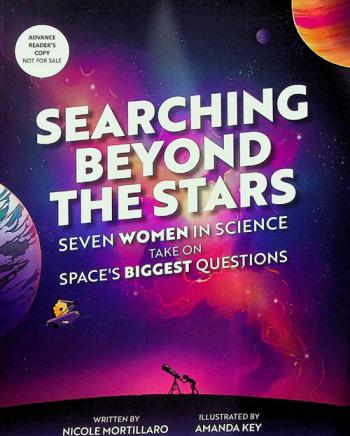
Searching beyond the stars : seven women in science take on space's biggest questions
\"An in-depth look at the lives and accomplishments of seven extraordinary women in the world of astronomy and space study. With a focus on feminist and stem-related content, this non-fiction book is written by a Senior Science Reporter for CBC.\"-- Provided by publisher.

The Cosmonaut Who Couldn’t Stop Smiling
\\u201cLet's go!\\u201d With that, the boyish, grinning Yuri
Gagarin launched into space on April 12, 1961, becoming the first
human being to exit Earth's orbit. The twenty-seven-year-old
lieutenant colonel departed for the stars from within the shadowy
world of the Soviet military-industrial complex. Barbed wires,
no-entry placards, armed guards, false identities, mendacious maps,
and a myriad of secret signs had hidden Gagarin from prying
outsiders-not even his friends or family knew what he had been up
to. Coming less than four years after the Russians launched Sputnik
into orbit, Gagarin's voyage was cause for another round of
capitalist shock and Soviet rejoicing. The Cosmonaut Who Couldn't
Stop Smiling relates this twentieth-century icon's remarkable life
while exploring the fascinating world of Soviet culture. Gagarin's
flight brought him massive international fame-in the early 1960s,
he was possibly the most photographed person in the world, flashing
his trademark smile while rubbing elbows with the varied likes of
Nehru, Castro, Queen Elizabeth II, and Italian sex symbol Gina
Lollobrigida. Outside of the spotlight, Andrew L. Jenks reveals,
his tragic and mysterious death in a jet crash became fodder for
morality tales and conspiracy theories in his home country, and,
long after his demise, his life continues to provide grist for the
Russian popular-culture mill. This is the story of a legend, both
the official one and the one of myth, which reflected the
fantasies, perversions, hopes and dreams of Gagarin's fellow
Russians. With this rich, lively chronicle of Gagarin's life and
times, Jenks recreates the elaborately secretive world of space-age
Russia while providing insights into Soviet history that will
captivate a range of readers.
eBook

Chemistry, Earth, and space sciences
Presents the biographies and discoveries of scientists in the chemistry, Earth, and space fields. Includes time lines.
Book

The Ultimate Engineer
From the late 1950s to 1976 the U.S. manned spaceflight program advanced as it did largely due to the extraordinary efforts of Austrian immigrant George M. Low. Described as the \"ultimate engineer\" during his career at NASA, Low was a visionary architect and leader from the agency's inception in 1958 to his retirement in 1976. As chief of manned spaceflight at NASA, Low was instrumental in the Mercury, Gemini, and Apollo programs. Low's pioneering work paved the way for President Kennedy's decision to make a lunar landing NASA's primary goal in the 1960s. After the tragic 1967Apollo 1 fire that took the lives of three astronauts and almost crippled the program, Low took charge of the redesign of the Apollo spacecraft, and he helped lead the program from disaster and toward the moon. In 1968 Low made the bold decision to go for lunar orbit onApollo 8 before the lunar module was ready for flight and after only one Earth orbit test flight of the command and service modules. Under Low there were five manned missions, includingApollo 11, the first manned lunar landing. Low's clandestine negotiations with the Soviet Union resulted in a historic joint mission in 1975 that was the precursor to the Shuttle-Mir and International Space Station programs. At the end of his NASA career, Low was one of the leading figures in the development of the space shuttle in the early 1970s, and he was instrumental in NASA's transition into a post-Apollo world. Afterward, he embarked on a distinguished career in higher education as a transformational president of Rensselaer Polytechnic Institute, his alma mater. Chronicling Low's escape from Nazi-occupied Austria to his helping land a man on the moon,The Ultimate Enginee r sheds new light on one of the most fascinating and complex personalities of the golden age of U.S. manned space travel.
eBook

Ricci curvature for metric-measure spaces via optimal transport
We define a notion of a measured length space X having nonnegative N-Ricci curvature, for N ∈ [1, ∞), or having ∞-Ricci curvature bounded below by K, for K ∈ ℝ. The definitions are in terms of the displacement convexity of certain functions on the associated Wasserstein metric space P₂(X) of probability measures. We show that these properties are preserved under measured Gromov-Hausdorff limits. We give geometric and analytic consequences. This paper has dual goals. One goal is to extend results about optimal transport from the setting of smooth Riemannian manifolds to the setting of length spaces. A second goal is to use optimal transport to give a notion for a measured length space to have Ricci curvature bounded below. We refer to [11] and [44] for background material on length spaces and optimal transport, respectively. Further bibliographic notes on optimal transport are in Appendix F. In the present introduction we motivate the questions that we address and we state the main results. To start on the geometric side, there are various reasons to try to extend notions of curvature from smooth Riemannian manifolds to more general spaces. A fairly general setting is that of length spaces, meaning metric spaces (X, d) in which the distance between two points equals the infimum of the lengths of curves joining the points. In the rest of this introduction we assume that X is a compact length space. Alexandrov gave a good notion of a length space having \"curvature bounded below by K\", with K a real number, in terms of the geodesic triangles in X. In the case of a Riemannian manifold M with the induced length structure, one recovers the Riemannian notion of having sectional curvature bounded below by K. Length spaces with Alexandrov curvature bounded below by K behave nicely with respect to the Gromov-Hausdorff topology on compact metric spaces (modulo isometries); they form a closed subset.
Journal Article

Setting Aside All Authority
Setting Aside All Authority is an important account and analysis of seventeenth-century scientific arguments against the Copernican system. Christopher M. Graney challenges the long-standing ideas that opponents of the heliocentric ideas of Copernicus and Galileo were primarily motivated by religion or devotion to an outdated intellectual tradition, and that they were in continual retreat in the face of telescopic discoveries.
Graney calls on newly translated works by anti-Copernican writers of the time to demonstrate that science, not religion, played an important, and arguably predominant, role in the opposition to the Copernican system. Anti-Copernicans, building on the work of the Danish astronomer Tycho Brahe, were in fact able to build an increasingly strong scientific case against the heliocentric system at least through the middle of the seventeenth century, several decades after the advent of the telescope. The scientific case reached its apogee, Graney argues, in the 1651 New Almagest of the Italian Jesuit astronomer Giovanni Battista Riccioli, who used detailed telescopic observations of stars to construct a powerful scientific argument against Copernicus. Setting Aside All Authority includes the first English translation of Monsignor Francesco Ingoli's essay to Galileo (disputing the Copernican system on the eve of the Inquisition's condemnation of it in 1616) and excerpts from Riccioli's reports regarding his experiments with falling bodies.
eBook