
Catalogue Search | MBRL


Are you sure you want to remove the book from the shelf?

{{itemTitle}}
315
result(s) for
"Spain -- Colonies -- America"
Sort by:

Transatlantic studies : Latin America, Iberia, and Africa
Emerges from, and performs, an ongoing debate concerning the role of transatlantic approaches in the fields of Iberian, Latin American, African, and Luso-Brazilian studies. The innovative research and discussions contained in this volume's 35 essays by leading scholars in the field reframe the intertwined cultural histories of the diverse transnational spaces encompassed by the former Spanish and Portuguese empires. An emerging field, Transatlantic Studies seeks to provoke a discussion and a reconfiguration of the traditional academic notions of area studies, while critically engaging the concepts of national cultures and postcolonial relations among Spain, Portugal and their former colonies. Crucially, Transatlantic Studies transgresses national boundaries without dehistoricizing or decontextualizing the texts it seeks to incorporate within this new framework.
Book
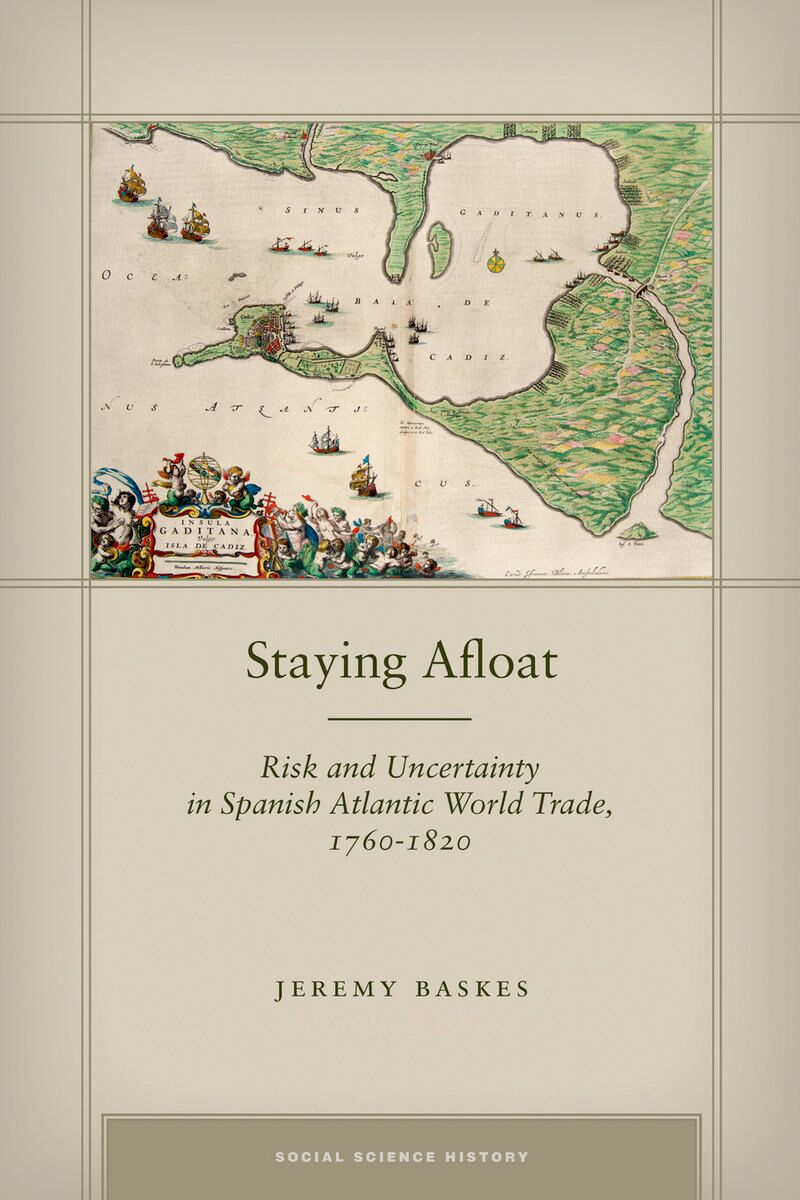
Staying Afloat
Early modern, long-distance trade was fraught with risk and uncertainty, driving merchants to seek means (that is, institutions) to reduce them. In the traditional historiography on Spanish colonial trade, the role of risk is largely ignored. Instead, the guild merchants are depicted as anti-competitive monopolists who manipulated markets and exploited colonial consumers. Jeremy Baskes argues that much of the commercial behavior interpreted by modern historians as predatory was instead designed to reduce the uncertainty and risk of Atlantic world trade. This book discusses topics from the development and use of maritime insurance in eighteenth- century Spain to the commercial strategies of Spanish merchants; the traditionally misunderstood effects of the 1778 promulgation of \"comercio libre,\" and the financial chaos and bankruptcies that ensued; the economic rationale for the Spanish flotillas; and the impact of war and privateering on commerce and business decisions. By elevating risk to the center of focus, this multifaceted study makes a number of revisionist contributions to the late colonial economic history of the Spanish empire.
eBook


Experiencing nature : the Spanish American empire and the early scientific revolution
“A very significant contribution. . . . This book tells a story that is usually left out of the master narrative of the history of exploration. . . . Moreover, it tells a story based on real expeditions and experiences, and it quotes liberally and effectively from engaging reports and sixteenth-century treatises, so it should appeal to general readers as well.” -Carla Rahn Phillips, Union Pacific Professor in Comparative Early Modern History, University of Minnesota As Spain colonized the Americas during the sixteenth century, Spanish soldiers, bureaucrats, merchants, adventurers, physicians, ship pilots, and friars explored the natural world, gathered data, drew maps, and sent home specimens of America's vast resources of animals, plants, and minerals. This amassing of empirical knowledge about Spain's American possessions had two far-reaching effects. It overturned the medieval understanding of nature derived from Classical texts and helped initiate the modern scientific revolution. And it allowed Spain to commodify and control the natural resources upon which it built its American empire. In this book, Antonio Barrera-Osorio investigates how Spain's need for accurate information about its American colonies gave rise to empirical scientific practices and their institutionalization, which, he asserts, was Spain's chief contribution to the early scientific revolution. He also conclusively links empiricism to empire-building as he focuses on five areas of Spanish activity in America: the search for commodities in, and the ecological transformation of, the New World; the institutionalization of navigational and information-gathering practices at the Spanish Casa de la Contratación (House of Trade); the development of instruments and technologies for exploiting the natural resources of the Americas; the use of reports and questionnaires for gathering information; and the writing of natural histories about the Americas.
eBook


Apogee of empire : Spain and New Spain in the age of Charles III, 1759-1789
Once Europe's supreme maritime power, Spain by the mid-eighteenth century was facing fierce competition from England and France. England, in particular, had successfully mustered the financial resources necessary to confront its Atlantic rivals by mobilizing both aristocracy and merchant bourgeoisie in support of its imperial ambitions. Spain, meanwhile, remained overly dependent on the profits of its New World silver mines to finance both metropolitan and colonial imperatives, and England's naval superiority constantly threatened the vital flow of specie. When Charles III ascended the Spanish throne in 1759, then, after a quarter-century as ruler of the Kingdom of the Two Sicilies, Spain and its colonial empire were seriously imperiled. Two hundred years of Hapsburg rule, followed by a half-century of ineffectual Bourbon \"reforms,\" had done little to modernize Spain's increasingly antiquated political, social, economic, and intellectual institutions. Charles III, recognizing the pressing need to renovate these institutions, set his Italian staff—notably the Marqués de Esquilache, who became Secretary of the Consejo de Hacienda (the Exchequer)—to this formidable task. In Apogee of Empire, Stanley J. Stein and Barbara H. Stein trace the attempt, initially under Esquilache's direction, to reform the Spanish establishment and, later, to modify and modernize the relationship between the metropole and its colonies. Within Spain, Charles and his architects of reform had to be mindful of determining what adjustments could be made that would help Spain confront its enemies without also radically altering the Hapsburg inheritance. As described in impressive detail by the authors, the bitter, seven-year conflict that ensued between reformers and traditionalists ended in a coup in 1766 that forced Charles to send Esquilache back to Italy. After this setback at home, Charles still hoped to effect constructive change in Spain's imperial system, primarily through the incremental implementation of a policy of comercio libre (free-trade). These reforms, made half-heartedly at best, failed as well, and by 1789 Spain would find itself ill prepared for the coming decades of upheaval in Europe and America. An in-depth study of incremental response by an old imperial order to challenges at home and abroad, Apogee of Empire is also a sweeping account of the personalities, places, and policies that helped to shape the modern Atlantic world.
eBook


Crisis in an Atlantic Empire
The capstone of a research endeavor begun by Barbara Stein and Stanley Stein nearly sixty years ago, this volume concludes their masterful tetralogy on Spanish economic and Atlantic history. With a compelling narrative that weaves together story and thesis and brings to life immense archival research and empirical data, Crisis in an Atlantic Empire is a finely grained historical tour of the period covering 1808 to 1810, which is often called \"the age of revolutions.\" The study examines an accumulation of countervailing elements in a spasm of imperial crisis, as Spain and its major colony New Spain struggled to preserve traditional structures of exchange—Spain's transatlantic trade system—with Caribbean ports at Veracruz and Havana in wartime after 1804. Rooted in the struggle between businessmen seeking to expand their economic reach and the ruling class seeking to maintain its hegemonic control, the crisis sheds light on the contest between free trade and monopoly trade and the politics of preservation among an enduring and influential interest group: merchants. Reflecting the authors' masterful use of archival sources and their magisterial knowledge of the era's complex metropolitan and colonial institutions, this volume is the capstone of a research endeavor spanning nearly sixty years.
eBook


Spain, Europe and the Wider World 1500-1800
When J. H. Elliott publishedSpain and Its World, 1500-1700some twenty years ago, one of many enthusiasts declared, \"For anyone interested in the history of empire, of Europe and of Spain, here is a book to keep within reach, to read, to study and to enjoy\" (Times Literary Supplement). Since then Elliott has continued to explore the history of Spain and the Hispanic world with originality and insight, producing some of the most influential work in the field. In this new volume he gathers writings that reflect his recent research and thinking on politics, art, culture, and ideas in Europe and the colonial worlds between 1500 and 1800.
The volume includes fourteen essays, lectures, and articles of remarkable breadth and freshness, written with Elliott's characteristic brio. It includes an unpublished lecture in honor of the late Hugh Trevor-Roper. Organized around three themes-early modern Europe, European overseas expansion, and the works and historical context of El Greco, Velázquez, Rubens, and Van Dyck-the book offers a rich survey of the themes at the heart of Elliott's interests throughout a career distinguished by excellence and innovation.
eBook