
Catalogue Search | MBRL


Are you sure you want to remove the book from the shelf?

{{itemTitle}}
19
result(s) for
"Spain Civilization Islamic influences."
Sort by:

Lost civilization : the contested Islamic past in Spain and Portugal
\"Al-Andalus, the Iberian Islamic civilization centred on Cordoba in the tenth and eleventh centuries, has been a 'lost' civilization in several respects. Its history suppressed or denied for much of the nineteenth and twentieth centuries, it was regarded as a kind of 'historical parenthesis' with no lasting influence. Over the past twenty-five years, however, the history and archaeology of the Islamic period in the Iberian peninsula has undergone a complete transformation. Lost Civilization presents an introduction to this debate as it has played out in archaeology, taking a comparative civilizations approach that puts the formation of al-Andalus in context with corresponding developments elsewhere in Europe, North Africa and the Middle East.\"--BOOK JACKET.
Book

Disorientations
This book explores from a new perspective the fraught processes of Spaniards' efforts to formulate a national identity, from the Enlightenment to the present day. Focusing on the nation's Islamic-African legacy, Susan Martin-Márquez disputes received wisdom that Spain has consistently rejected its historical relationship to Muslims and Africans. Instead, she argues, Spaniards have sometimes denied and sometimes embraced this legacy, and that vacillation has served to destabilize presumably fixed borders between Europe and the Muslim world and between Europe and Africa.
Martin-Márquez analyzes a wealth of texts produced by Spaniards as well as by Africans and Afro-Spaniards from the early nineteenth century forward. She illuminates the complexities and disorientations of Spanish identity and shows how its evolution has important implications for current debates not only in Spanish culture but also in other countries involved in negotiating a modern identity.
eBook

Exotic Nation
In the Western imagination, Spain often evokes the colorful culture of al-Andalus, the Iberian region once ruled by Muslims. Tourist brochures inviting visitors to sunny and romantic Andalusia, home of the ingenious gardens and intricate arabesques of Granada's Alhambra Palace, are not the first texts to trade on Spain's relationship to its Moorish past. Despite the fall of Granada to the Catholic Monarchs in 1492 and the subsequent repression of Islam in Spain, Moorish civilization continued to influence both the reality and the perception of the Christian nation that emerged in place of al-Andalus. InExotic Nation, Barbara Fuchs explores the paradoxes in the cultural construction of Spain in relation to its Moorish heritage through an analysis of Spanish literature, costume, language, architecture, and chivalric practices. Between 1492 and the expulsion of the Moriscos (Muslims forcibly converted to Christianity) in 1609, Spain attempted to come to terms with its own Moorishness by simultaneously repressing Muslim subjects and appropriating their rich cultural heritage. Fuchs examines the explicit romanticization of the Moors in Spanish literature-often referred to as \"literary maurophilia\"-and the complex, often silent presence of Moorish forms in Spanish material culture. The extensive hybridization of Iberian culture suggests that the sympathetic depiction of Moors in the literature of the period does not trade in exoticism but instead reminded Spaniards of the place of Moors and their descendants within Spain. Meanwhile, observers from outside Spain recognized its cultural debt to al-Andalus, often deliberately casting Spain as the exotic racial other of Europe.
eBook

A Descriptive and Comparative Grammar of Andalusi Arabic
Built on the scarce, but not insignificant surviving materials of Andalusi Arabic, this work provides a synchronic descriptive survey as complete as possible of its basic grammar and lexicon, plus some diachronic comparative remarks, allowing the reader to obtain a near accurate picture of this subject-matter.
eBook

Mudâejar art : Islamic aesthetics in Christian art
\"Mudâejar art : Islamic aesthetics in Christian art reveals the fascinating exuberance of a unique cultural and artistic symbiosis that characterizes Christian Spain after the Reconquista. The Mudâejars were Muslims allowed to stay in the reconquered territories. Their artists and artisans strongly influenced the culture and art of the new Christian kindoms. In Aragon, Castille, Extremadura and Andalucâia sumptuously decorated brick churches, monasteries and palaces illustrate the creative endurance of Islamic forms in Christian art between the 11th and 16th centures in Spain. Thirteen itineraries invite you to discover 124 musuems, monuments and sites in Madrid, Guadalajara, Saragossa, Tordesillas, Toledo, Guadalupe and Seville (among others)-- Provided by publisher.
Book

The lost paradise : Andalusi music in urban North Africa
For more than a century, urban North Africans have sought to protect and revive Andalusi music, a prestigious Arabic-language performance tradition said to originate in the \"lost paradise\" of medieval Islamic Spain. Yet despite the Andalusi repertoire's enshrinement as the national classical music of postcolonial North Africa, its devotees continue to describe it as being in danger of disappearance. In The Lost Paradise, Jonathan Glasser explores the close connection between the paradox of patrimony and the questions of embodiment, genealogy, secrecy, and social class that have long been central to Andalusi musical practice.
Through a historical and ethnographic account of the Andalusi music of Algiers, Tlemcen, and their Algerian and Moroccan borderlands since the end of the nineteenth century, Glasser shows how anxiety about Andalusi music's disappearance has emerged from within the practice itself and come to be central to its ethos. The result is a sophisticated examination of musical survival and transformation that is also a meditation on temporality, labor, colonialism and nationalism, and the relationship of the living to the dead.
eBook
Revisiting al-Andalus
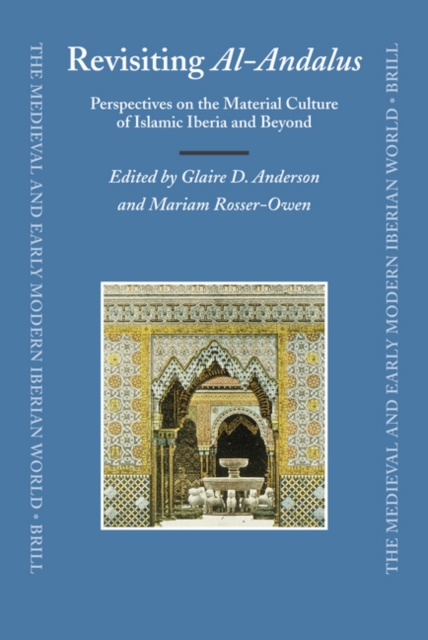
Revisiting al-Andalus brings together a range of new approaches to the material culture of Islamic Iberia, highlighting especially new directions in Anglo-American scholarship in this field since the influential exhibition in 1992, Al-Andalus: the Art of Islamic Spain.
eBook